By Elliot Spagat and Nomaan Merchant

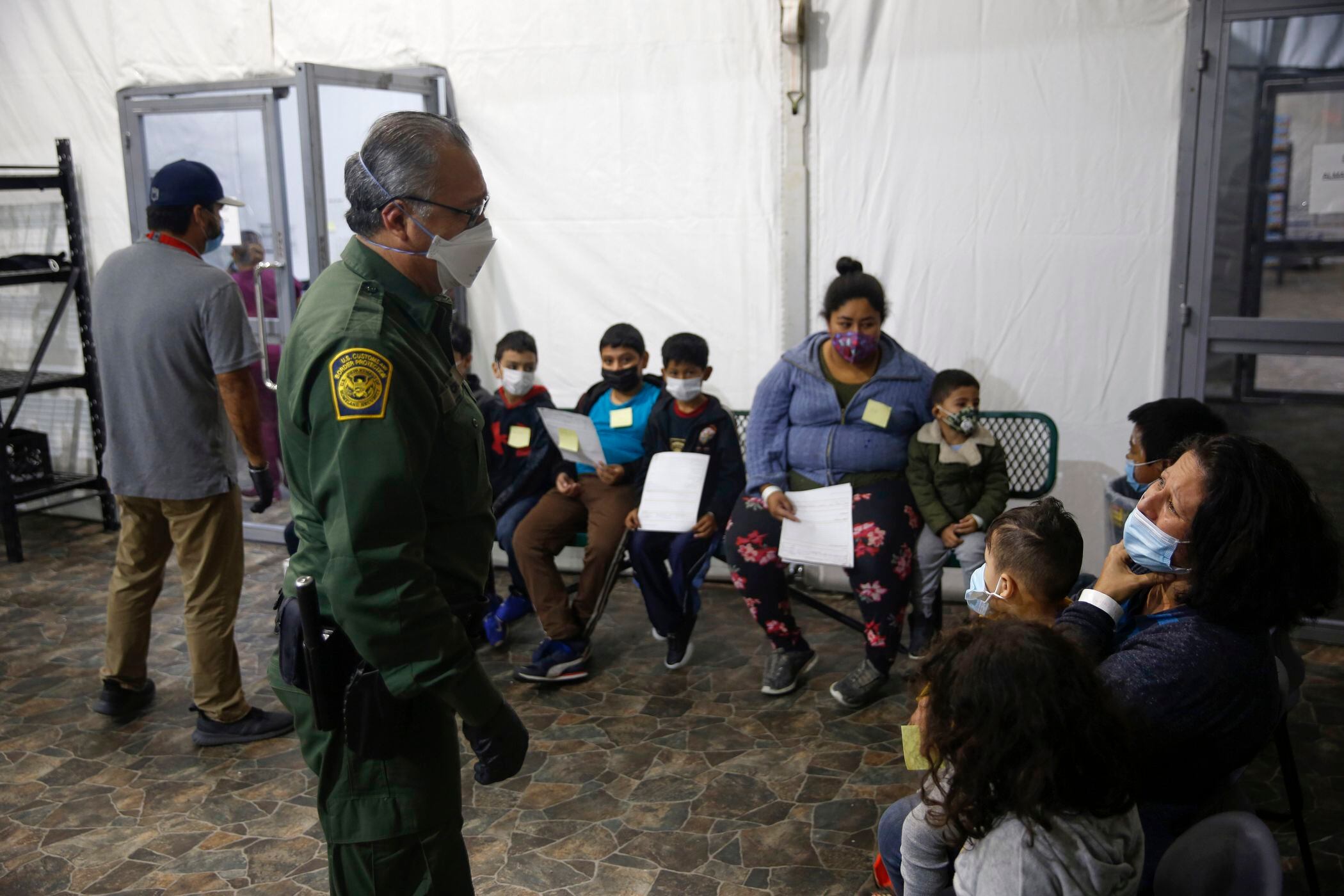
The Biden administration for the first time Tuesday allowed journalists inside its main border detention facility for migrant children, revealing a severely overcrowded tent structure where more than 4,000 people, including children and families, were crammed into a space intended for 250 and the youngest were kept in a large playpen with mats on the floor for sleeping.

With thousands of children and families arriving at the U.S.-Mexico border in recent weeks and packing facilities, President Joe Biden has been under pressure to bring more transparency to the process. U.S. Customs and Border Protection allowed two journalists from The Associated Press and a crew from CBS to tour the facility in Donna, Texas, in the Rio Grande Valley, the nation's busiest corridor for illegal crossings.

More than 4,100 people were being housed on the property Tuesday. Most were unaccompanied children processed in tents before being taken to facilities run by the Department of Health and Human Services and then placed with a family member, relative or sponsor.

The children were being housed by the hundreds in eight "pods" formed by plastic dividers, each about 3,200 square feet (297 square meters) in size. Many of the pods had more than 500 children in them.

Oscar Escamilla, acting executive officer of the U.S. Border Patrol in the Rio Grande Valley, said 250 to 300 kids enter daily and far fewer leave.

The youngest children — among them, a 3-year-old girl being cared for by her 11-year-old brother and a newborn with a 17-year-old mother — are kept out of the pods and sleep in a playpen area.

On Tuesday, journalists watched children being processed. They went into a small room for lice inspection and a health check. Their hair was hosed down and towels were tossed in a black bin marked “Lice.” The kids — many of whom have made long journeys to get to the border, including stretches on foot — were also checked for scabies, fever, and other ailments. No COVID-19 test was administered unless a child showed symptoms.

Nurse practitioners also gave psychological tests, asking children if they had suicidal thoughts. All shoelaces were removed to avoid harm to anyone.

The children were then led down a green turf hall to a large intake room. Those 14 and older are fingerprinted and have their photo taken; younger children did not.

They went to a second intake room where they got notices to appear for immigration court. Border Patrol agents asked them if they had a contact in the U.S. and allowed the child to call that person.

Children were given bracelets with a barcode that shows a history of when they showered and medical conditions.

Outside the facility, the roar of construction equipment could be heard along with air conditioning units.

The Biden administration has continued expelling adults who try to cross the border under a coronavirus-related public health declaration enacted by former President Donald Trump. Biden also has tried to expel most families traveling together, but changes in Mexican law have forced agents to release many parents and children into the U.S.

Biden has declined to resume the Trump-era practice of expelling unaccompanied immigrant children. Several hundred kids and teenagers are crossing the border daily, most fleeing violence, poverty or the effects of natural disasters in Central America. In some cases, parents refused entry into the U.S. have sent their children across the border alone, hoping they will be placed with relatives eventually.

The Border Patrol is apprehending far more children daily than Health and Human Services is placing with U.S. sponsors, leading to a severe backlog in the system. The Border Patrol generally is not supposed to detain children for more than three days, but Health and Human Services lacks space.

More than 2,000 kids have been at the Donna facility for more than 72 hours, including 39 for more than 15 days.

HHS is housing children at convention centers in Dallas and San Diego and is opening large-scale sites in San Antonio, El Paso and elsewhere.

Biden has been sharply criticized by Republicans seeking to defend Trump's immigration record, which includes the separation of thousands of immigrant families under a “zero tolerance" policy.

Share:
More In Politics
US tariffs are having an uneven effect on holiday prices and purchases
Many U.S. consumers say they’ve noticed higher than usual prices for holiday gifts in recent months, according to a a December poll from The Associated Press-NORC Center for Public Affairs Research. A contributing factor is the unusually high import taxes the Trump administration put on foreign goods. While the worst-case consumer impact that many economists foresaw from the administration’s trade policies hasn’t materialized, some popular gift items have been affected more than others. Most toys and electronics sold in the U.S. come from China. So do most holiday decorations. Jewelry prices have risen due to the cost of gold.
Serbia organized crime prosecutors charge minister, others in connection with Kushner-linked project
Serbia’s prosecutor for organized crime has charged a government minister and three others with abuse of position and falsifying of documents related to a luxury real estate project linked to U.S. President Donald Trump’s son-in-law Jared Kushner. The charges came on Monday. The investigation centers on a controversy over a a bombed-out military complex in central Belgrade that was a protected cultural heritage zone but that is facing redevelopment as a luxury compound by a company linked to Kushner. The $500 million proposal to build a high-rise hotel, offices and shops at the site has met fierce opposition from experts at home and abroad. Selakovic and others allegedly illegally lifted the protection status for the site by falsifying documentation.
Trump signs executive order to block state AI regulations
President Donald Trump has signed an executive order to block states from regulating artificial intelligence. He argues that heavy regulations could stifle the industry, especially given competition from China. Trump says the U.S. needs a unified approach to AI regulation to avoid complications from state-by-state rules. The order directs the administration to draw up a list of problematic regulations for the Attorney General to challenge. States with laws could lose access to broadband funding, according to the text of the order. Some states have already passed AI laws focusing on transparency and limiting data collection.
New York Times, after Trump post, says it won’t be deterred from writing about his health
The New York Times and President Donald Trump are fighting again. The news outlet said Wednesday it won't be deterred by Trump's “false and inflammatory language” from writing about the 79-year-old president's health. The Times has done a handful of stories on that topic recently, including an opinion column that said Trump is “starting to give President Joe Biden vibes.” In a Truth Social post, Trump said it might be treasonous for outlets like the Times to do “FAKE” reports about his health and "we should do something about it.” The Republican president already has a pending lawsuit against the newspaper for its past reports on his finances.
Trump approves sale of more advanced Nvidia computer chips used in AI to China
President Donald Trump says he will allow Nvidia to sell its H200 computer chip used in the development of artificial intelligence to “approved customers” in China. Trump said Monday on his social media site that he had informed China’s leader Xi Jinping and “President Xi responded positively!” There had been concerns about allowing advanced computer chips into China as it could help them to compete against the U.S. in building out AI capabilities. But there has also been a desire to develop the AI ecosystem with American companies such as chipmaker Nvidia.
Swing district Republicans brace for political fallout if health care subsidies expire
House Republicans in key battleground districts are working to contain the political fallout expected when thousands of their constituents face higher bills for health insurance coverage obtained through the Affordable Care Act. For a critical sliver of the GOP majority, the impending expiration of the enhanced premium tax credits after Dec. 31 could be a major political liability as they potentially face midterm headwinds in a 2026 election critical to President Donald Trump’s agenda. For Democrats, the party’s strategy for capturing the House majority revolves around pinning higher bills for groceries, health insurance and utilities on Republicans.
Load More