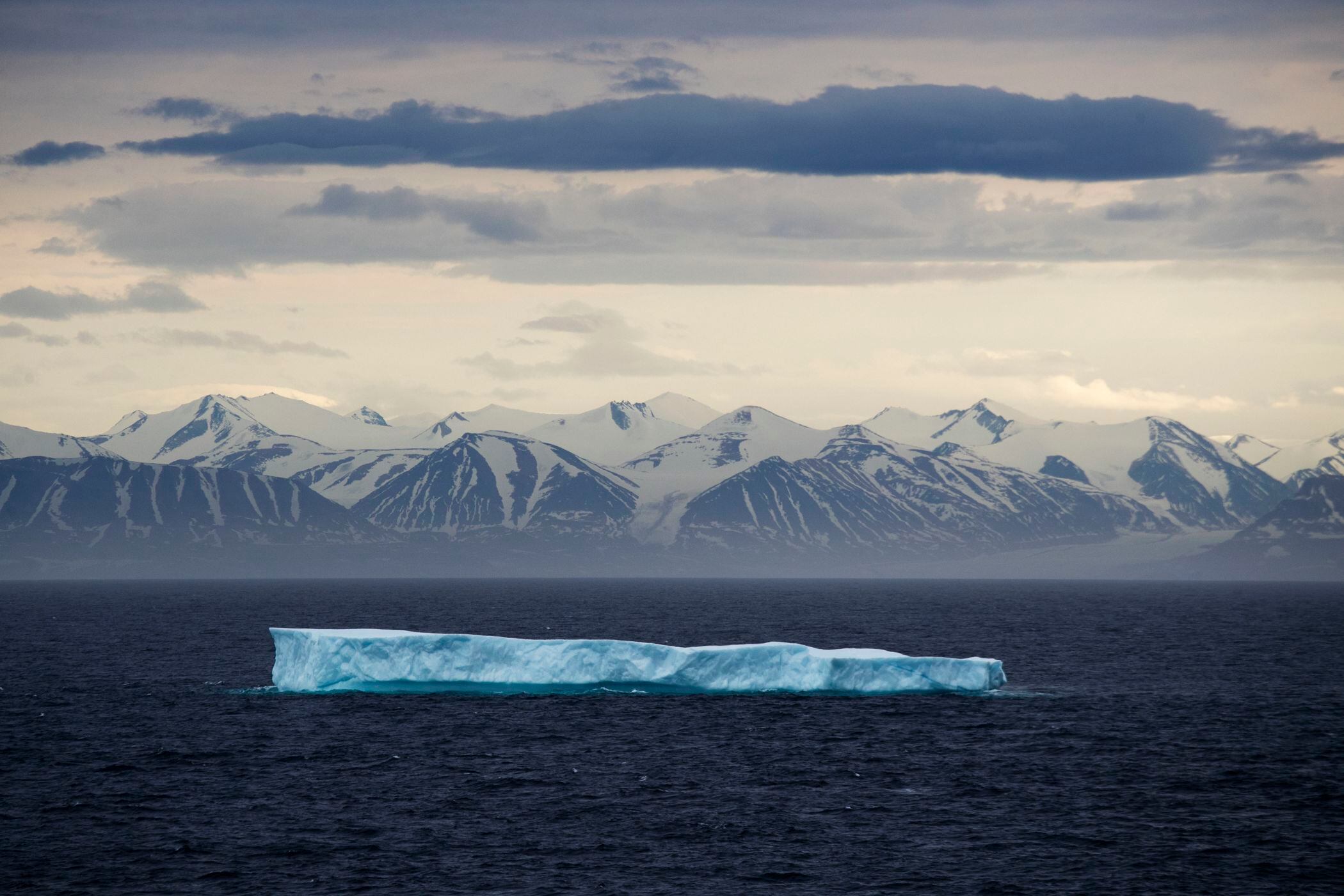
In this July 24, 2017 file photo, an iceberg floats past Bylot Island in the Canadian Arctic Archipelago. The National Oceanic and Atmospheric Administration’s annual Arctic Report Card, released on Tuesday, Dec. 8, 2020, shows how warming temperatures in the Arctic are transforming the region's geography and ecosystems. (AP Photo/David Goldman, File)
By Christina Larson
This year's vast wildfires in far northeastern Russia were linked to broader changes in a warming Arctic, according to a report Tuesday by the National Oceanic and Atmospheric Administration.
Wildfires are a natural part of many boreal ecosystems. But the extent of flames during the 2020 fire season was unprecedented in the 2001-2020 satellite record, and is consistent with the predicted effects of climate change, said Alison York, a University of Alaska Fairbanks fire scientist and a contributor to the annual Arctic Report Card.
The recent wildfires were exacerbated by elevated air temperatures and decreased snow cover on the ground in the Arctic region, the report found.
The past year — from October 2019 to September 2020 — was the second warmest on record in the Arctic, the report said. And the extent of snow on the ground in June across the Eurasian Arctic was the lowest recorded in 54 years.
Under those conditions, trees and plants “are just more flammable,” said York.
“The Arctic isn’t just this collection of components, it’s really an integrated system,” said Dartmouth sea ice scientist Don Perovich, who contributed to the report. "When something happens to one part of the system, it has cascading effects," he said.
Satellites recorded the second lowest extent of sea ice in September since record-keeping began 42 years ago, the report found.
Melting ice is both a result of increased temperatures and an accelerator of further changes, Perovich said. “As sea ice thins, more light can penetrate into the ocean, with unclear impacts for ecosystems,” he said.
As snow and ice cover decreases, the land and ocean surfaces also absorb more heat.
“Changes in the Arctic climate are important because the Arctic acts as a refrigerator for the rest of the world — it helps cool the planet,” said Lawrence Mudryk, a report contributor and a climate scientist at Environment and Climate Change Canada, a governmental research group.
“How much of the Arctic continues to be covered by snow and sea ice reflects part of how efficiently that refrigerator is working,” he said.
Last year's report included essays and research contributed by the Arctic's Indigenous communities for the first time. But in 2020, close collaboration between visiting scientists and Indigenous communities was not possible because of travel restrictions related to COVID-19.
Report contributor Matthew Druckenmiller, a climate scientist at the University of Colorado Boulder, said efforts to involve Indigenous communities would resume after the pandemic subsides.
The consequences of a warming Arctic are already felt far beyond the region.
“The Arctic continues to be a warning siren of how our Earth system is changing and it is important for policymakers and the public to understand that the impacts don’t stay in the Arctic with the polar bears,” said University of Georgia meteorology professor Marshall Shepherd, who was not involved in the report.
“We feel them, too, through changes in our weather patterns, sea level rise, and fisheries."
___
The Associated Press Health and Science Department receives support from the Howard Hughes Medical Institute’s Department of Science Education. The AP is solely responsible for all content.
William Li and Danielle Chang, co-founders of The Hao Life, join Cheddar Innovates to discuss how they're shaking up the $71 billion supplement industry by putting a modern spin on traditional natural Chinese remedies.
The Coca-Cola Company is teaming up with science education personality Bill Nye as part of its World Without Waste Initiative to describe the bottle-to-bottle plastic recycling process through a vividly animated, stop-motion short film. Christine Yeager, director of sustainability at The Coca-Cola Company, North America, joined Cheddar News to talk about their initiative and the partnership. "We really wanted to partner with someone who can help us make recycling relatable, but also has a very um respected voice in the climate change space," she said.
Catching you up on what you need to know on Apr 14, 2022, with the U.S. sending $800M to Ukraine, updates on the subway shooting in Brooklyn, Gov. Abbott putting a pause on his southern border truck inspections, migrants being bused from Texas to Washington, DC, the travel mask mandate extending until May 3, and more.
Energy costs continue to rise, our electrical grid is outdated, and the focus on renewable energy is more important than ever. One company says it has an answer: pods that store solar energy for long-term, 24-hour usage that can also function as mini power grids and charge electric vehicles. Azelio's TES.PODs store solar energy during the day, and hold it for use around the clock, providing a solution for charging electric vehicles, powering rural areas, and much more. Jonas Wallmander, CEO of Azelio, joins Closing Bell to discuss the company's solar energy storage technology, how it can be used to power communities and build out electric vehicle charging infrastructure, and more.
Catching you up with what you need to know on Apr 12, 2022, with Russia concentrating forces in eastern Ukraine, rising inflation, severe weather from Minnesota to the Gulf Coast, Philadelphia brings back its indoor mask mandate, PG&E pays $55 million for wildfire settlement, and more
Catching you up on what you need to know on April 11, 2022, with updates on the Russia-Ukraine War, France’s presidential election, the record deforestation of the Amazon Rainforest, retail giant Amazon's objection to the Staten Island union vote, the worsening baby formula shortage, a lawsuit against Rutgers Law School, and a stomach illness possibly linked to Lucky Charms cereal.
SpaceX launched its first all commercial-crew mission to the International Space Station on Friday. Cheddar News speaks with Jim Cantrell, CEO and President of Phantom Space Corporation why this launch is a big leap for space tourism.
Nautilus Labs closed $34 million in funding from investors including the Microsoft Climate Innovation Fund. The company plans to use its funding to improve shipping industry efficiency with its software. Nautilus CEO Matt Heider joined Cheddar News to talk about how it tackles the carbon emissions in the global supply chain. "We've seen on 10-day voyages saving $60,000 worth of fuel just by managing speed with greater confidence around the future. The environmental impact of that is also huge," he said. "Saving that amount of fuel is a kind of taking over 1000 cars off the road this year."