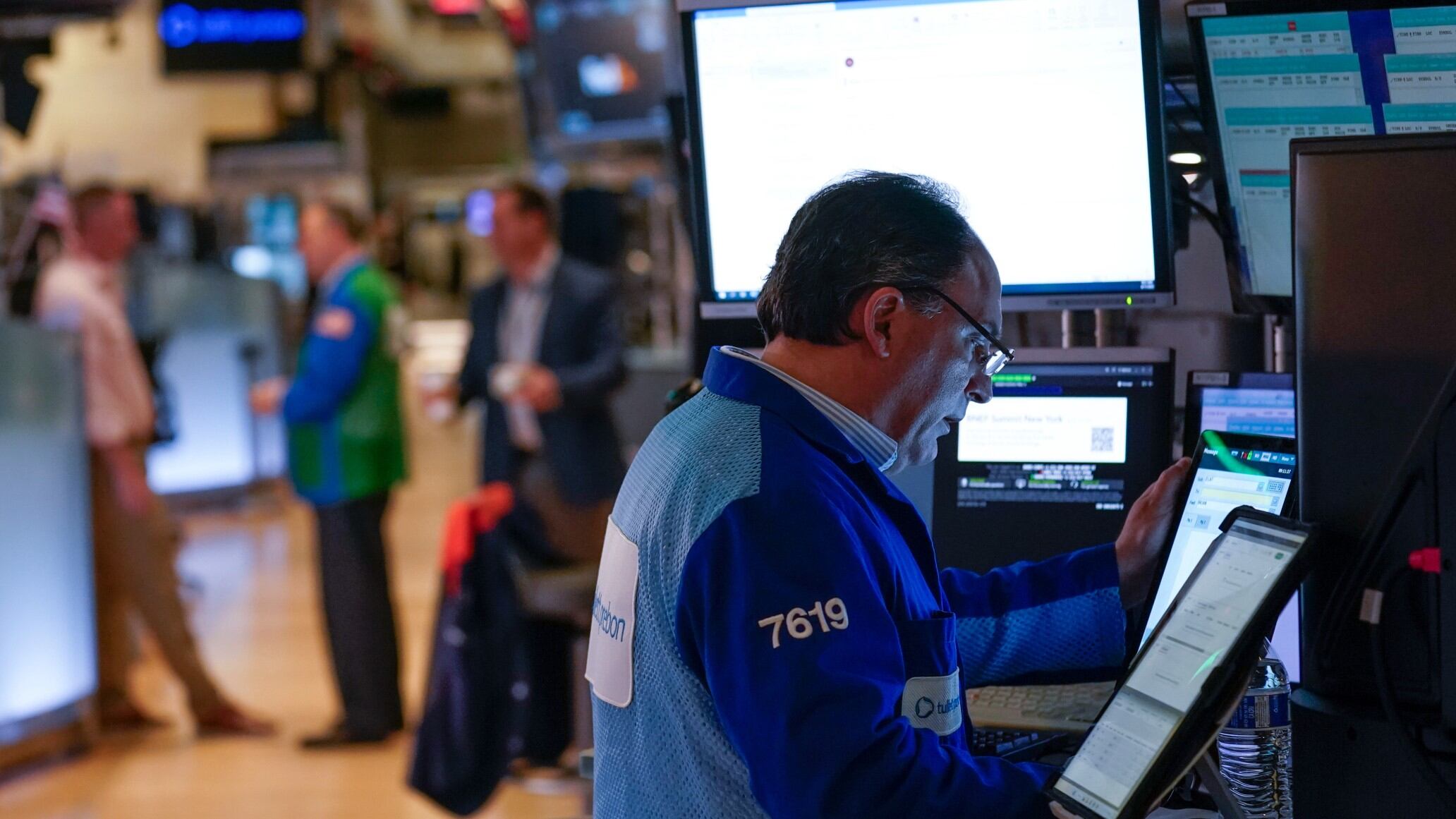
Another drop for stocks on Friday has Wall Street on track to close out its first losing week in the last six.
The S&P 500 was 0.6% lower in morning trading, pulling back further from last week when it reached its highest level in more than a year. The Dow Jones Industrial Average was down 175 points, or 0.5%, at 33,770, as of 10:20 a.m. Eastern time, while the Nasdaq composite was 0.9% lower.
Stocks fell even more in markets abroad, while crude oil prices sank on worries that a global economy under threat of a recession will burn less fuel.
Europe’s economy appears to be weaker than expected, according to a preliminary report measuring manufacturing and services businesses. That’s adding to this week’s hesitance in markets, caused by a crank higher in interest rates by central banks around the world as they try to get high inflation under control. High rates drive down inflation by slowing the economy, which raises the risk of a recession.
High interest rates in the United States have already dragged manufacturing and other industries into contraction, while also helping to cause several failures in the banking system that have rattled confidence. Federal Reserve Chair Jerome Powell said this week that even though his central bank didn’t raise rates last week, it could still push through a couple more hikes by the end of this year.
Critics have also said the U.S. stock market was due for a breather after it climbed too far, too fast following a rally of more than 20% since mid-October.
Much of the exuberance was because the U.S. economy had managed to avoid a recession, even though the Fed hiked rates at a breakneck pace since early 2022. The job market in particular has remained remarkably solid.
Wall Street’s hope has been that slowing inflation could get the Fed to take it easier on rates, while a small cadre of stocks soared to incredible heights amid a frenzy around artificial-intelligence technology.
Wall Street traders for the most part are still expecting fewer rate hikes this year than what the Fed has suggested. They may once again be underestimating the Fed's resolve, economist Ethan Harris wrote in a BofA Global Research report.
“Early in the hiking cycle, the focus was on avoiding a recession," he said. "However, with persistently high inflation, the focus has shifted from erring on the side of doing too little to doing too much.”
A preliminary report on Friday indicated the overall U.S. economy is continuing to grow, even though manufacturing is shrinking and its output fell to a five-month low.
“The question remains as to how resilient service sector growth can be in the face of the manufacturing decline and the lagged effect of prior rate hikes,” said Chris Williamson, chief business economist at S&P Global Market Intelligence. “Any further rate hikes will of course have a further dampening effect on this sector which is especially susceptible to changes in borrowing costs.”
A slower economy would likely mean pressure on demand for energy, and the price for a barrel of benchmark U.S. oil fell 1.7% to $68.36. Brent crude, the international standard, lost 1.6%, to $73.15 per barrel.
That helped drag energy stocks to some of the sharper losses on Wall Street. Halliburton lost 2.2%.
Tech companies were also hit hard. Higher interest rates hurt all kinds of investments, from stocks to bonds to crypto, but high-growth stocks tend to be among the most impacted. A 1.2% drop for Microsoft and 3.8% fall for Tesla were among the heaviest weights on the S&P 500.
On the winning side of Wall Street was CarMax. It jumped 9.1% after reporting much stronger profit for the latest quarter than analyst expected.
In European stock markets, Germany’s DAX lost 1%, and France’s CAC 40 fell 0.6%. The FTSE 100 in London slipped 0.5%.
On Thursday, the Bank of England hiked its main interest rate by a bigger margin than expected to a 15-year high. It was the central bank’s 13th straight increase. Central banks in Norway, Switzerland and Turkey also raised borrowing rates.
In Asia, Hong Kong’s Hang Seng lost 1.7%.
Japan’s Nikkei 225 dropped 1.7% after its inflation rate came in higher than expected. That added to expectations that its central bank might adjust its policies for ultralow interest rates. The Bank of Japan has kept its benchmark interest rate at minus 0.1% for a decade as policymakers encourage more investment and spending.
In the bond market, yields dropped as investors looked for safer places to park cash amid worries about the economy. The yield on the 10-year Treasury fell to 3.73% from 3.79% late Thursday. It helps set rates for mortgages and other important loans.