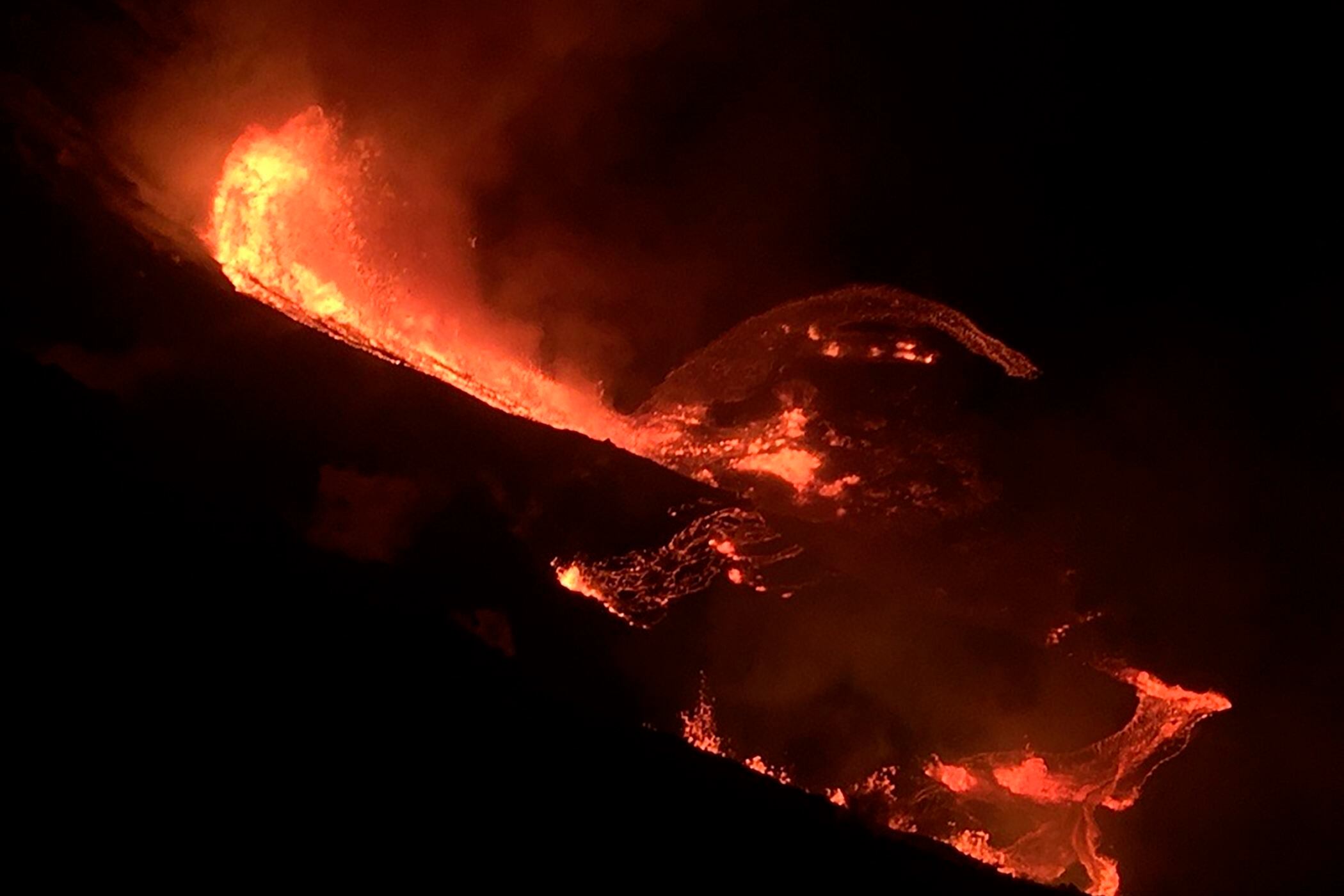
The Kilauea volcano on Hawaii’s Big Island erupted and shot a steam cloud into the atmosphere that lasted about an hour, an official with the National Weather Service said early Monday.
The eruption began late Sunday within the within Halema’uma’u crater, the U.S. Geological Survey said. The volcano is located within Hawaii Volcanoes National Park.
Tom Birchard, a senior forecaster with the National Weather Service in Hawaii, said a new lava flow interacted with a pool of water inside the crater and that led to a short-lived but fairly vigorous eruption.
All the water evaporated out of the lake and a steam cloud shot up about 30,000 feet (9 kilometers) into the atmosphere, Birchard said.
An advisory was issued by the National Weather Service in Honolulu, warning of fallen ash from the volcano. Excessive exposure to ash is an eye and respiratory irritant, it said. The agency later said the eruption was easing and a “low-level steam cloud” was lingering in the area.
By 1 a.m., USGS officials told Hawaii News Now that there were reported lava fountains shooting about 165 feet (50 meters) into the sky.
David Phillips, a Hawaiian Volcano Observatory spokesman, said the agency was monitoring the situation.
"We will send out further notifications on Kilauea and other Hawaiian volcanoes as we observe changes,” he said.
A magnitude 4.4 earthquake hit about an hour after the volcano began erupting.
The USGS said it received more than 500 reports of people who felt the earthquake but significant damage to buildings or structures was not expected.
Kilauea erupted in 2018, destroying more than 700 homes and spewing enough lava to fill 320,000 Olympic-sized swimming pools. An area more than half the size of Manhattan was buried in up to 80 feet (24 meters) of now-hardened lava. The lava flowed over the course of four months.
___
Associated Press journalist Julie Walker in New York City contributed to this report.