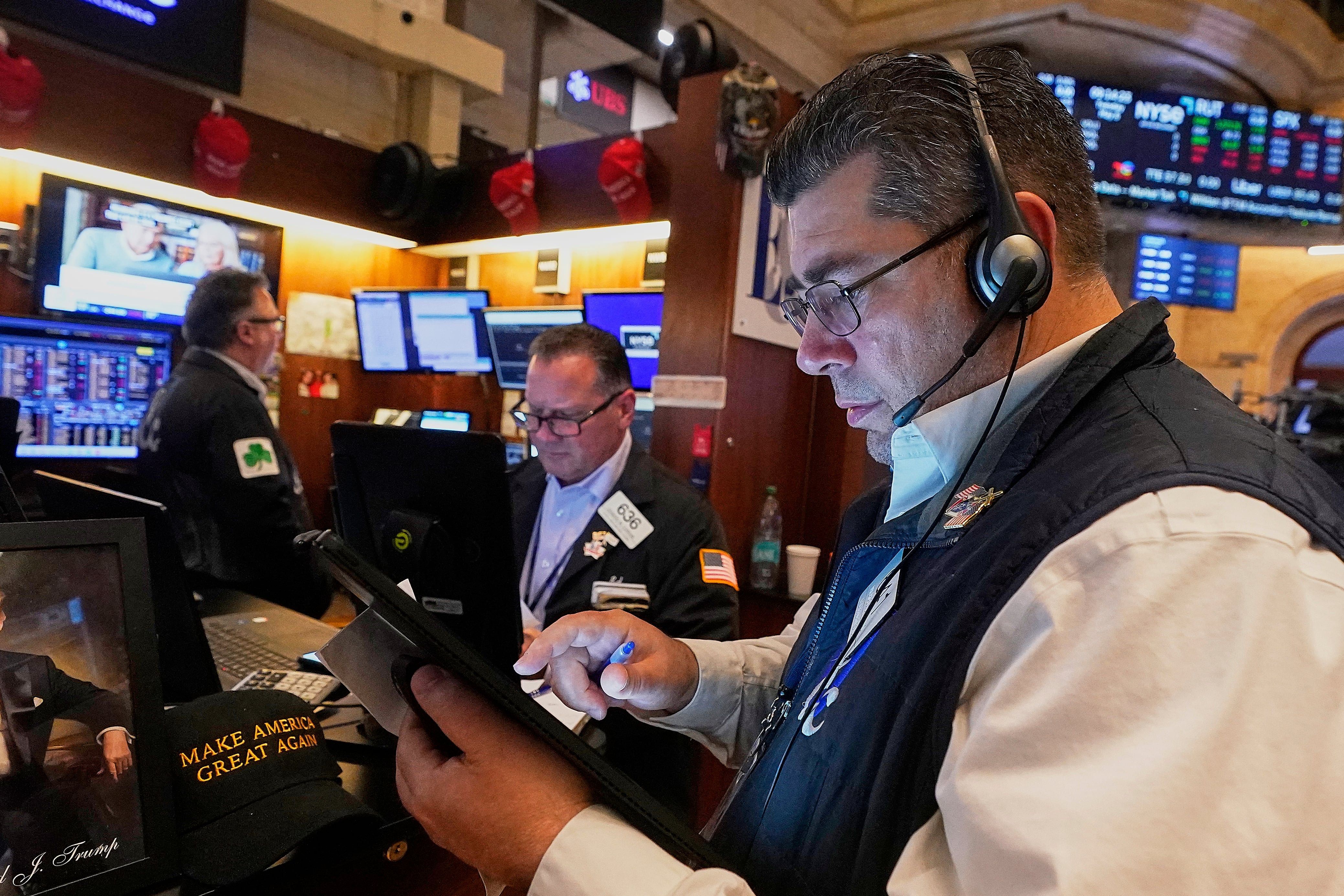
U.S. stocks are sinking Tuesday as AI mania on Wall Street loses more steam and as more companies scrub their forecasts for upcoming profits because of uncertainty created by President Donald Trump’s tariffs.
The S&P 500 was down 0.6% in afternoon trading and on track for a second drop after breaking a nine-day winning streak, its longest such run in more than 20 years. The Dow Jones Industrial Average was down 321 points, or 0.8%, as of 2:27 p.m. Eastern time, and the Nasdaq composite was 0.6% lower.
Palantir Technologies was one of the heaviest weights on the market after falling 11.9%. The company, which offers an AI platform for customers, dropped even though it reported a profit for the latest quarter that met analysts’ expectations and raised its forecast for revenue over the full year.
AI-related companies have been finding it more difficult recently to convince investors to support their stocks after they’ve already shot so high. Palantir’s stock’s price remains near $110, when it was sitting at only $20 less than a year ago.
The return to Earth for AI stocks is happening as Trump’s tariffs change the economic landscape for other companies.
Clorox CEO Linda Rendle said her company saw changes in shopping behavior during the first three months of the year, for example, that led to lower revenue. The company reported both weaker revenue and profit for the latest quarter than analysts expected. Clorox expects the slowdowns to continue in the current quarter, and its stock fell 2.6%.
Toymaker Mattel, meanwhile, was swinging between losses and gains after it said it’s “pausing” its financial forecasts for 2025, in part because the “evolving U.S. tariff landscape” is making it difficult to predict how much U.S. shoppers will spend over the holiday season and the rest of this year.
Mattel was up 2.9%. It also reported better results for the latest quarter than analysts feared.
Ford Motor said it’s expecting to take a $1.5 billion hit this year because of tariffs. Ford said it’s also cancelling financial forecasts for the full year because of “tariff-related uncertainty.”
They’re the latest companies to join a lengthening list that have yanked their forecasts for the year given uncertainty about what Trump’s on-again, off-again rollout of tariffs will do to the economy. The hope is that Trump will relent on some of his tariffs after reaching trade deals with other countries. Without them, many investors expect the economy to fall into a recession.
Regardless, all the will-he-won’t-he uncertainty around tariffs has already made U.S. households more pessimistic about the economy and could affect their long-term plans for purchases. That uncertainty has helped fuel a surge in imports ahead of potentially more severe tariffs ahead.
The U.S. trade deficit soared to a record $140.5 billion in March as consumers and businesses alike tried to get ahead of tariffs that went into effect in April and others that have been postponed until July. That follows another update from last week showing that the U.S. economy shrank at a 0.3% annual pace during the first quarter of the year because of a surge in imports.
Some companies say they’re already seeing impacts to their business from the uncertainty created by tariffs.
Food processing giant Archer Daniels Midland said that operating profit for agricultural services slumped 31% during its most recent quarter because of trade policy uncertainty. The stock was up 2.4%.
DoorDash fell 7.4% after reporting weaker revenue than analysts expected for the latest quarter, though it may have also offered a more encouraging snapshot of how U.S. households are doing. The company said order growth in its U.S. marketplace remained healthy and consistent with average growth over the last year.
Treasury yields were edging lower in the bond market. The yield on the 10-year Treasury slipped to 4.32% from 4.36% late Monday.
The Federal Reserve is beginning a two-day meeting, and it will announce its next move on interest rates Wednesday. Virtually no one expects it to do anything to its main rate, even though Trump has been advocating for cuts.
“While the possibility still exists for potential rate cuts later this year, the economic picture is complicated, and it’s too early to know if or when those cuts might happen,” said Michele Raneri, vice president and head of U.S. research and consulting at TransUnion.
Lower interest rates could help goose the economy, but they could also give inflation more fuel. And worries are already simmering that Trump’s tariffs could push inflation higher.
Markets were mixed across Europe and Asia. Indexes rose 1.1% in Shanghai and 0.7% in Hong Kong.
___
AP Business Writers Matt Ott and Elaine Kurtenbach contributed.