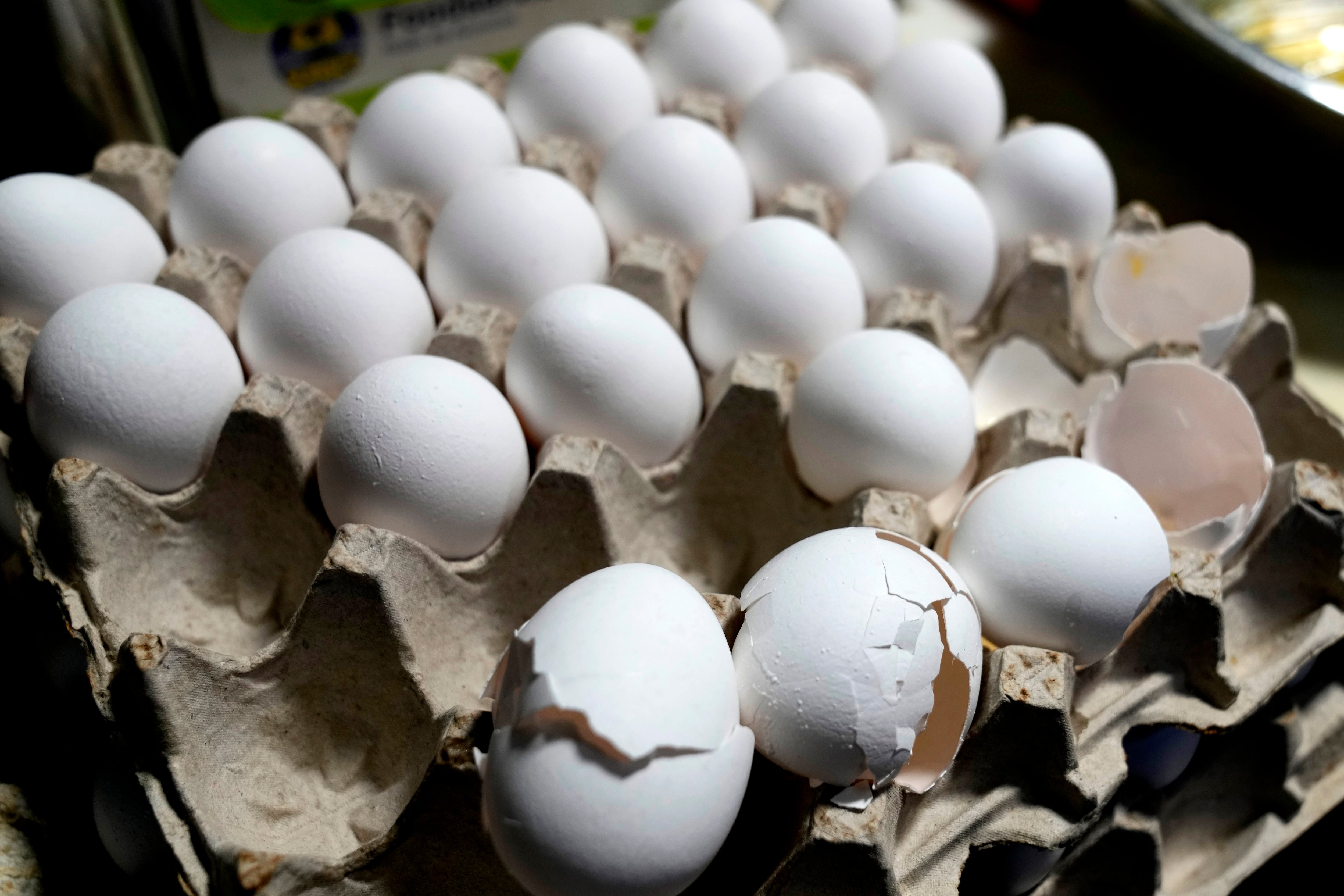
U.S. egg prices increased again last month to reach a new record-high of $6.23 per dozen despite President Donald Trump’s predictions, a drop in wholesale prices and no egg farms having bird flu outbreaks.
The increase reported Thursday in the Consumer Price Index means consumers and businesses that rely on eggs might not get much immediate relief. Demand for eggs is typically elevated until after Easter, which falls on April 20.
Industry experts were expecting the index to reflect a drop in retail egg prices because wholesale egg prices fell significantly in March. University of Arkansas agricultural economist Jada Thompson said the wholesale prices did not start dropping until mid-March, so there may not have been enough time for the average price for the month to decline. And grocery stores may not have immediately passed on the lower prices.
The bird flu effect
Bird flu outbreaks were cited as the major cause of price spikes in January and February after more than 30 million egg-laying chickens were killed to prevent the spread of the disease. Only 2.1 million birds were slaughtered in March and none of them were on egg farms.
Egg prices hit $5.90 in February one month after setting a record at $4.95 per dozen, according to the U.S. Bureau of Labor Statistics.
The farms that had fall outbreaks have been working to resume egg production after sanitizing their barns and raising new flocks, but chickens must be about six months old before they start laying eggs. Thompson said those farms did not come back online as quickly as anticipated.
In the latest U.S. Department of Agriculture numbers, there were only about 285 million hens laying eggs nationwide as of March 1, Before the outbreak, the flock typically numbered more than 315 million.
Since the current bird flu outbreak began, more than 168 million birds have been slaughtered, most of them egg-laying chickens. Any time a bird gets sick, the entire flock is killed to help keep bird flu from spreading. That can have an effect on the egg supply because massive egg farms may have millions of birds.
Egg price politics
Trump tried to take credit for the lower wholesale egg prices the USDA reported in recent weeks.
“The egg prices they were going through the sky. And you did a fantastic job,” Trump said to Agriculture Secretary Brooke Rollins before he announced the details of his tariffs at the White House last week. ”Now we have lots of eggs and they are much cheaper now.”
But experts say the president’s plan to fight bird flu by focusing on strengthening egg farmers’ defenses against the virus is likely to be more of a long-term help.
The Agriculture Department tried to find egg imports to add to the supply and nearly 4 million dozens of eggs were brought into the country in February. But egg traders saw an opportunity with the high prices and 7.6 million dozens were exported. Numbers for March were not yet available.
“I think there are lots of people who are looking to see the egg prices coming down because they wanted to call it a win. And I think it’s a loss for everybody. I think we all want to see egg prices come down,” Thompson said.
Rollins on Thursday suggested the rise in egg prices is temporary. She pointed to the overall consumer price index showing a slight dip in prices for goods and services across the U.S. economy in March and suggested egg prices will soon follow.
“We’re also moving into the Super Bowl of eggs, which is Easter,” Rollins said. “So from the beginning, I’ve said this is sort of the high price for retail for eggs, but we feel very confident that will continue to come back down.”
Earlier this week, Trump said the annual White House egg roll would use real eggs again this year despite the high prices. Egg farmers typically donate more than 30,000 eggs for the event.
Egg prices around the country
U.S. egg prices did began falling in mid-March, according to Datasembly, a market research company that tracks prices at thousands of stores. Datasembly said eggs averaged $5.98 per dozen the week beginning March 16 and dropped to $5.51 the week beginning March 30.
But prices vary widely around the country, depending on the location of recent bird flu outbreaks and some state laws requiring eggs to be cage-free. At a Walmart in Richmond, California, a dozen eggs were $6.34 on Thursday. In Omaha, Nebraska, Walmart was selling eggs for $4.97 per dozen. California requires eggs sold to be cage-free; Nebraska doesn't.
The latest numbers could increase scrutiny of Cal-Maine Foods, which provides 20% of the nation’s eggs, and other large egg producers.
Earlier this week, Cal-Maine acknowledged it is being investigated by the antitrust division of the U.S. Department of Justice, which is looking into egg price increases. Cal-Maine said it is cooperating with the investigation.
In its most recent quarter, which ended March 1, Cal-Maine said its net income more than tripled to $508.5 million compared to the same period a year ago.
Faking it
The price of real eggs has some consumers turning to fake ones for Easter crafts this year.
Craft retailer Michaels said sales of its plastic egg craft kits — which were listed for $2.49 on the company's website Thursday — are up 20% over last year. Michaels said sales usually peak closer to Easter, but it started seeing a noticeable uptick in early March this year.
“With a little over a week still to go until Easter, our craft egg kits are nearly sold out,” the company said.
___
Associated Press writer Aamer Madhani contributed to this report.