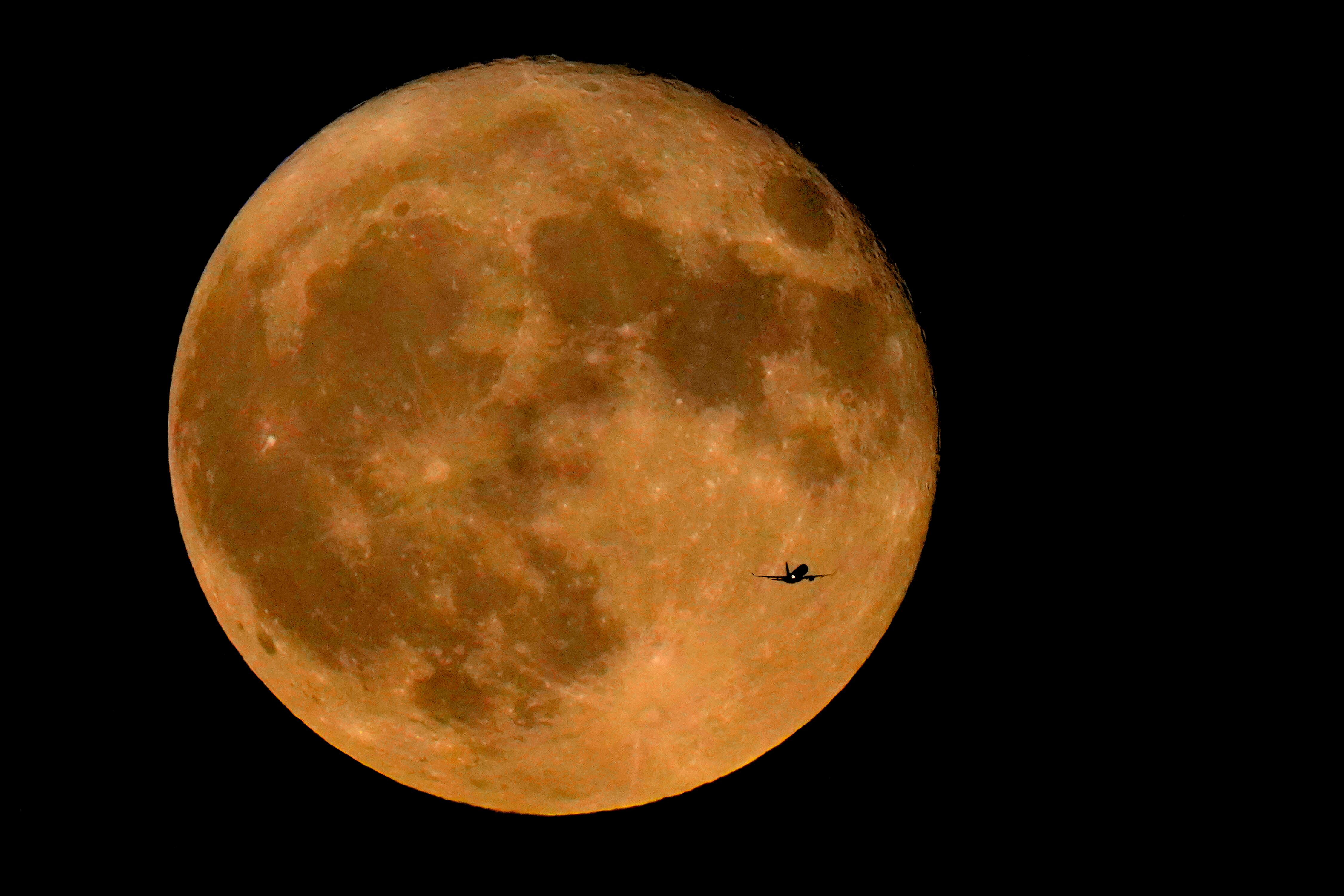
A commercial airliner flies Northwest across Lake Michigan in front of the "Full Buck" supermoon, the first of four supermoons in 2023, July 3, 2023, in Chicago. The cosmos is offering up a double feature in August: a pair of supermoons. Catch the first show Tuesday night, Aug. 2, as the full moon rises in the southeast. (AP Photo/Charles Rex Arbogast, File)
The cosmos is offering up a double feature in August: a pair of supermoons culminating in a rare blue moon.
Catch the first show Tuesday evening as the full moon rises in the southeast, appearing slightly brighter and bigger than normal. That’s because it will be closer than usual, just 222,159 miles (357,530 kilometers) away, thus the supermoon label.
The moon will be even closer the night of Aug. 30 — a scant 222,043 miles (357,344 kilometers) distant. Because it’s the second full moon in the same month, it will be what's called a blue moon.
“Warm summer nights are the ideal time to watch the full moon rise in the eastern sky within minutes of sunset. And it happens twice in August,” said retired NASA astrophysicist Fred Espenak, dubbed Mr. Eclipse for his eclipse-chasing expertise.
The last time two full supermoons graced the sky in the same month was in 2018. It won’t happen again until 2037, according to Italian astronomer Gianluca Masi, founder of the Virtual Telescope Project.
Masi will provide a live webcast of Tuesday evening’s supermoon, as it rises over the Coliseum in Rome.
“My plans are to capture the beauty of this ... hopefully bringing the emotion of the show to our viewers,” Masi said in an email.
“The supermoon offers us a great opportunity to look up and discover the sky,” he added.
This year’s first supermoon was in July. The fourth and last will be in September. The two in August will be closer than either of those.
Provided clear skies, binoculars or backyard telescopes can enhance the experience, Espenak said, revealing such features as lunar maria — the dark plains formed by ancient volcanic lava flows — and rays emanating from lunar craters.
According to the Old Farmer’s Almanac, the August full moon is traditionally known as the sturgeon moon. That’s because of the abundance of that fish in the Great Lakes in August, hundreds of years ago.
Experts say that at some point next year, the pandemic will officially drop its pandemic status, becoming endemic. While this is a milestone to acknowledge, it does not mean we're free of infections, illnesses, and deaths. Dr. Rajeev Fernando, infectious disease specialist, Beth Israel Hospital and fellow, joins Cheddar News' Closing Bell to discuss.
Chicago-based Internist Dr. Vivek Cherian joined Wake Up With Cheddar to break down the unprecedented surge in U.S. COVID-19 as many prepare to celebrate the new year.
Dr. Soumi Eachempati, co-founder and CEO of Cleared4 and former professor of surgery and public health at Weill Cornell Medical College, joined Cheddar to breakdown what people should know about the recently FDA-approved emergency use of Merck and Pfizer's COVID-19 treatment pills. He noted that not only do people need to be aware of other medications they are taking that could cause adverse effects if coupled with COVID-19 pill treatments, he also talked about the intense in-take regiment. "The Merck pills are actually about 40 pills over five days. The Pfizer ones are three pills over five days, so people have to be prepared for that because it is a lot of pills you'll have to take to get full value from these drugs," Eachempati told Cheddar.
Twitter is exploding with a new meme after the CDC revised its Covid-19 guidelines, shortening the recommended isolation period to five days instead of 10 for when you test positive and are asymptomatic. The change came amid a skyrocketing surge of new cases is the U.S. due to the Omicron variant, drawing criticism from experts and Twitter --with users claiming the government agency is giving funny advise on a variety of issues. But what does the meme say about the public’s trust in the agency? Cheddar News speaks with political strategist Hastie Afkhami.
The list of questions should be getting shorter as we enter the pandemic's third year, but that isn't the case. There's another question to add to that list: is the U.S. doing enough to track the virus and its variants? Lawrence Gostin, faculty director of the O'Neill Institute for national and global health law at Georgetown University, joins Cheddar News.
As we prepare to ring in the new year, COVID cases are hitting an all-time high. Dr. Anthony Fauci has said the safest way to celebrate would be a small gathering with vaccinated family members only... far from the large, flashy parties from a few years ago. Dr. Christina Johns, senior medical advisor at PM Pediatrics, joins Cheddar News to discuss how to celebrate safely.