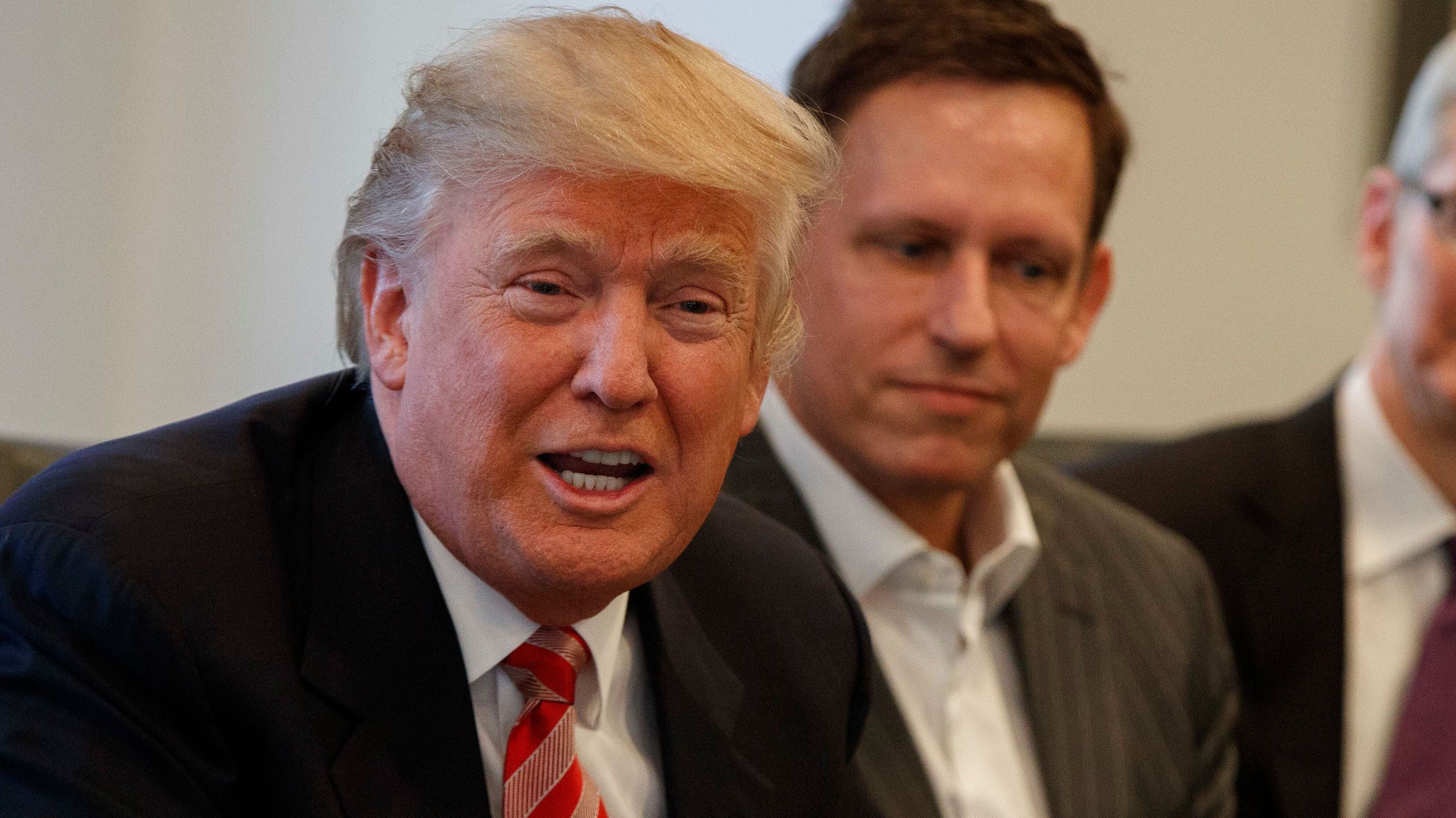
President Donald Trump said the government will investigate Google following an accusation by tech billionaire Peter Thiel that the company is working with China and committing treason.
"A great and brilliant guy who knows this subject better than anyone! The Trump Administration will take a look!" Trump said on Twitter Tuesday morning after a segment on Fox News aired on the issue.
In a speech on Sunday, Thiel reportedly suggested that Google's ($GOOGL) AI operations had been infiltrated by foreign intelligence agencies — especially China's — and said that senior management has made a "seemingly treasonous decision" to work with China.
These questions "need to be asked by the FBI, by the CIA," Thiel said at the National Conservatism Conference in Washington D.C., according to Axios, adding that a probe should be conducted "in a not excessively gentle manner."
Google strongly pushed back against the charge, saying in a statement to Cheddar that "we do not work with the Chinese military. We are working with the U.S. government, including the Department of Defense, in many areas including cybersecurity, recruiting and healthcare."
Thiel, who is on the board of Facebook ($FB) and has been a longtime supporter of Trump, is the co-founder of PayPal ($PYPL) and Palantir Technologies, a data mining firm that works with several U.S. government agencies.
"Treason is a very, very serious word here," Jason Moser, senior analyst at the investor firm The Motley Fool, told Cheddar. "You need to be very careful when you use that language and at least have something to back it up."
Larry Kudlow, the director of the White House's National Economic Council, also pushed back against the accusation, telling Fox Business on Monday that he is "not sure where [Thiel] is going, what [Thiel] is pointing to."
Wealthfront’s CFO Alan Iberman talks the $2.05B IPO and the major moment for robo banking as the company bets on AI, automation, and “self-driving money."
A rare magnum of Dom Pérignon Vintage 1961 champagne that was specially produced for the 1981 wedding of Prince Charles and Lady Diana has failed to sell during an auction. Danish auction house Bruun Rasmussen handled the bidding Thursday. The auction's house website lists the bottle as not sold. It was expected to fetch up to around $93,000. It is one of 12 bottles made to celebrate the royal wedding. Little was revealed about the seller. The auction house says the bids did not receive the desired minimum price.
The New York Times and President Donald Trump are fighting again. The news outlet said Wednesday it won't be deterred by Trump's “false and inflammatory language” from writing about the 79-year-old president's health. The Times has done a handful of stories on that topic recently, including an opinion column that said Trump is “starting to give President Joe Biden vibes.” In a Truth Social post, Trump said it might be treasonous for outlets like the Times to do “FAKE” reports about his health and "we should do something about it.” The Republican president already has a pending lawsuit against the newspaper for its past reports on his finances.
OpenAI has appointed Slack CEO Denise Dresser as its first chief of revenue. Dresser will oversee global revenue strategy and help businesses integrate AI into daily operations. OpenAI CEO Sam Altman recently emphasized improving ChatGPT, which now has over 800 million weekly users. Despite its success, OpenAI faces competition from companies like Google and concerns about profitability. The company earns money from premium ChatGPT subscriptions but hasn't ventured into advertising. Altman had recently announced delays in developing new products like AI agents and a personal assistant.
President Donald Trump says he will allow Nvidia to sell its H200 computer chip used in the development of artificial intelligence to “approved customers” in China. Trump said Monday on his social media site that he had informed China’s leader Xi Jinping and “President Xi responded positively!” There had been concerns about allowing advanced computer chips into China as it could help them to compete against the U.S. in building out AI capabilities. But there has also been a desire to develop the AI ecosystem with American companies such as chipmaker Nvidia.