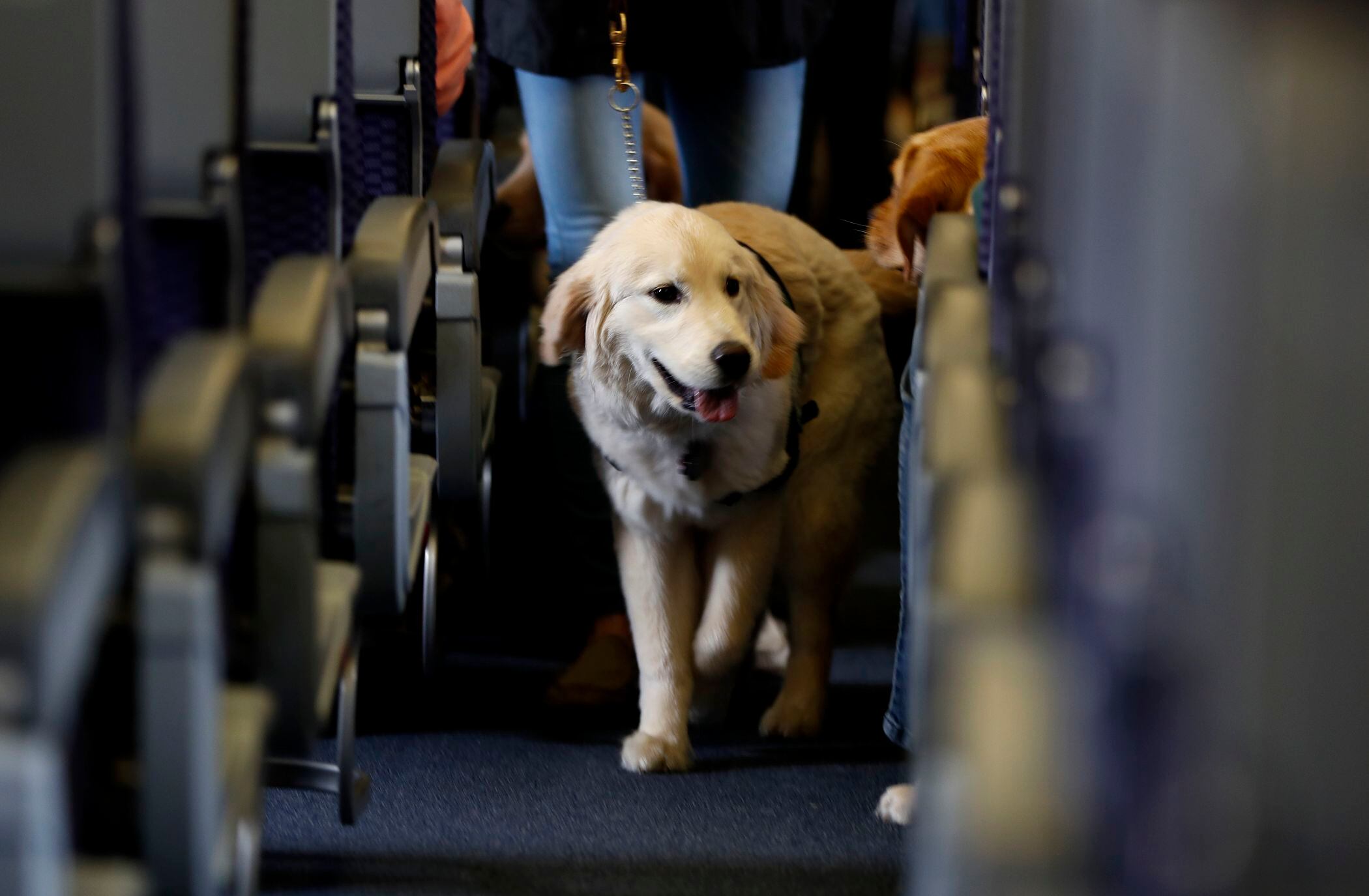
A service dog strolls through the isle inside a United Airlines plane at Newark Liberty International Airport while taking part of a training exercise, Saturday, April 1, 2017, in Newark, N.J. (AP Photo/Julio Cortez)
The government has decided that when it comes to air travel, only dogs can be service animals, and companions used for emotional support don't count.
The Transportation Department issued a final rule Wednesday that aims to settle years of tension between airlines and passengers who bring their pets on board for free by saying they need them for emotional support.
Under the final rule, which takes effect in 30 days, a service animal is a dog trained to help a person with a disability.
For years, the department required airlines to allow animals with passengers who had a doctor's note saying they needed the animal for emotional support. Airlines believed passengers abused the rule to bring a menagerie of animals on board including cats, turtles, pigs, and in one case, a peacock.
The new rule will likely force those passengers to check their animals into the cargo hold — for a fee — or leave them at home.
The rule requires airlines to treat dogs trained to help people with psychiatric issues the same as other service animals. Advocates for veterans and others had pushed for that.
Airlines will be able to require owners to vouch for the dog's health, behavior, and training. Airlines can require people with a service dog to turn in paperwork up to 48 hours before a flight, but they can't bar those travelers from checking in online like other passengers.
Airlines can require service dogs to be leashed at all times, and they can bar dogs that show aggressive behavior. There have been incidents of emotional-support animals biting passengers.
While tech employees worry about artificial intelligence taking over their jobs, Microsoft says Iran, North Korea, and more U.S. adversaries are beginning to use AI in cyber spying.
The self-proclaimed "only Post who worked at Kellogg" was a military veteran who fought in World War II before inventing everyone’s favorite fruit-filled breakfast ravioli.
Kevin Gordon, Senior Investment Research Manager at Charles Schwab, shares his thoughts on how investors can take advantage of the current bull market while keeping in mind the impacts of Fed policy and inflation.
Lab-created diamonds come with sparkling claims: that they are ethically made by machines running on renewable energy. But many don't live up to these claims or don't respond to questions about their electricity sources, and lab diamonds require a lot of electricity.
Geoff Freeman, president and CEO of the U.S. Travel association, explains why other nations are outcompeting the U.S., and the innovations that would put American back on top.
Tony Drake, founder of Drake & Associates, breaks down the latest CPI report, why ‘inflation is still trending down,’ and why the Fed doesn’t want to cut rates too soon.