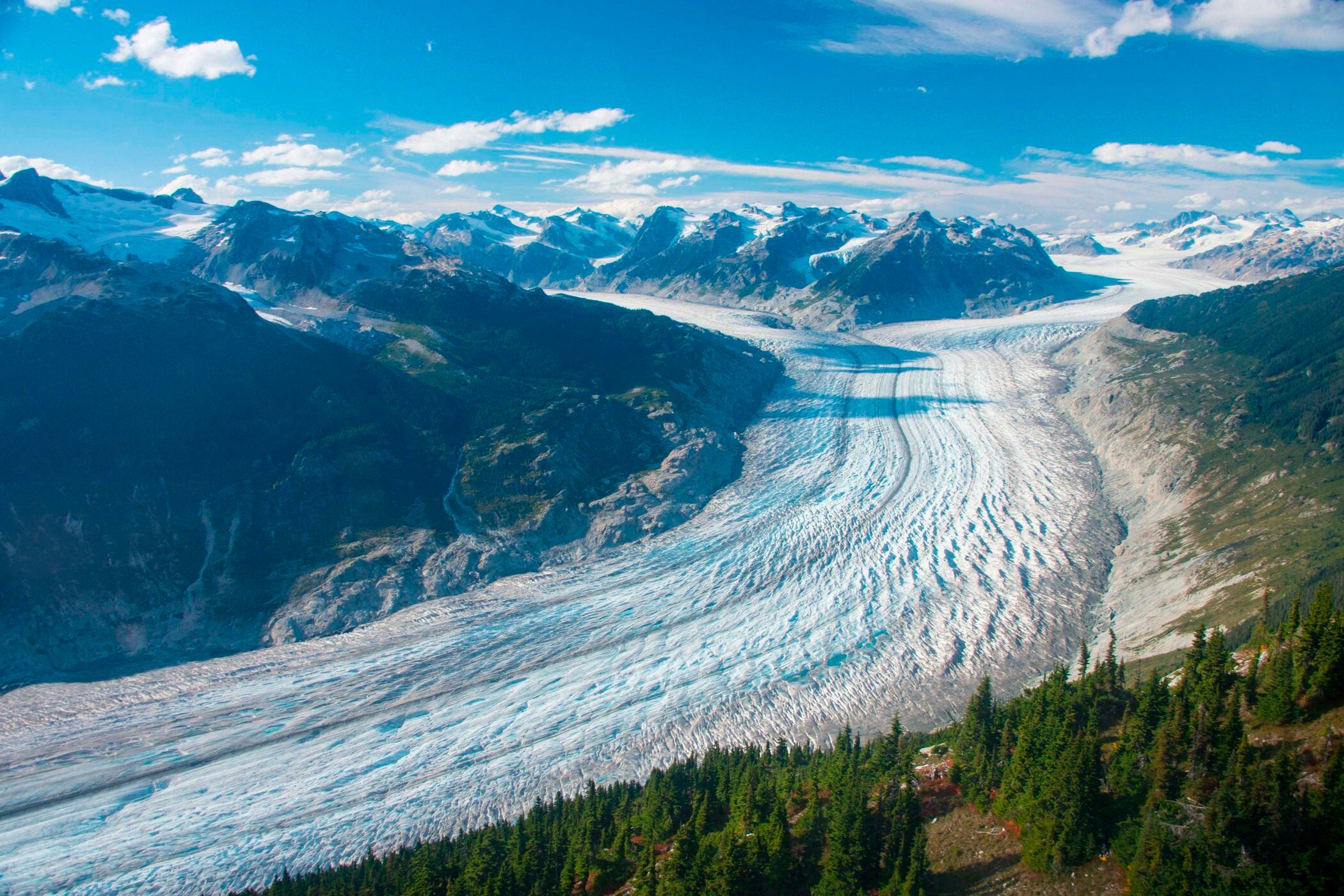
This September 2017 photo provided by researcher Brian Menounos shows the Klinaklini glacier in British Columbia, Canada. The glacier and the adjacent icefield has lost nearly 16 billion tons (14.5 billion metric tons) of snow and ice since 2000, with 10.7 billion tons of that (9.8 billion metric tons) of that since 2010, Menounos says. And the rate of loss accelerated over the last five years of the study. (Brian Menounos via AP)
By Seth Borenstein
Glaciers are melting faster, losing 31% more snow and ice per year than they did 15 years earlier, according to three-dimensional satellite measurements of all the world’s mountain glaciers.
Scientists blame human-caused climate change.
Using 20 years of recently declassified satellite data, scientists calculated that the world’s 220,000 mountain glaciers are losing more than 328 billion tons (298 billion metric tons) of ice and snow per year since 2015, according to a study in Wednesday’s journal Nature. That’s enough melt flowing into the world’s rising oceans to put Switzerland under almost 24 feet (7.2 meters) of water each year.
The annual melt rate from 2015 to 2019 is 78 billion more tons (71 billion metric tons) a year than it was from 2000 to 2004. Global thinning rates, different than volume of water lost, doubled in the last 20 years and “that’s enormous,” said Romain Hugonnet, a glaciologist at ETH Zurich and the University of Toulouse in France who led the study.
Half the world’s glacial loss is coming from the United States and Canada.
Alaska’s melt rates are “among the highest on the planet," with the Columbia glacier retreating about 115 feet (35 meters) a year, Hugonnet said.
Almost all the world’s glaciers are melting, even ones in Tibet that used to be stable, the study found. Except for a few in Iceland and Scandinavia that are fed by increased precipitation, the melt rates are accelerating around the world.
The near-uniform melting “mirrors the global increase in temperature” and is from the burning of coal, oil and gas, Hugonnet said. Some smaller glaciers are disappearing entirely. Two years ago, scientists, activists and government officials in Iceland held a funeral for a small glacier.
“Ten years ago, we were saying that the glaciers are the indicator of climate change, but now actually they’ve become a memorial of the climate crisis,” said World Glacier Monitoring Service Director Michael Zemp, who wasn’t part of the study.
The study is the first to use this 3D satellite imagery to examine all of Earth’s glaciers not connected to ice sheets in Greenland and Antarctic. Past studies either only used a fraction of the glaciers or estimated the loss of Earth’s glaciers using gravity measurements from orbit. Those gravity readings have large margins of error and aren't as useful, Zemp said.
Ohio State University’s Lonnie Thompson said the new study painted an “alarming picture."
Shrinking glaciers are a problem for millions of people who rely on seasonal glacial melt for daily water and rapid melting can cause deadly outbursts from glacial lakes in places like India, Hugonnet said.
But the largest threat is sea level rise. The world’s oceans are already rising because warm water expands and because of melting ice sheets in Greenland and Antarctica, but glaciers are responsible for 21% of sea level rise, more than the ice sheets, the study said. The ice sheets are larger longer term threats for sea level rise.
“It’s becoming increasingly clear that sea level rise is going to be a bigger and bigger problem as we move through the 21st century,” said National Snow and Ice Data Center Director Mark Serreze.
The Associated Press Health and Science Department receives support from the Howard Hughes Medical Institute’s Department of Science Education. The AP is solely responsible for all content.
Stan Farnsworth, chief marketing officer at PulseForge, joined Cheddar to talk about his company's debut at CES 2022 and how it plans to innovate the sustainable tech manufacturing space. PulseForge is bringing a new approach to industrial thermal processing, which contributes to 30 percent of global greenhouse gas emissions, according to Farnsworth. "By using 85 percent less energy in the processing of materials through a variety of manufacturing processes, we can make a direct impact in reducing carbon output and reducing carbon footprint associated with manufacturing," he said.
The U.S. will be implementing a vaccine mandate for all people entering through its land borders, removing exemptions for "essential" travelers such as truckers, students, and business people. While the Canadian Trucking Alliance argues that the new, stricter rule might exacerbate ongoing auto supply chain issues, some health experts see the potential for helping curb the ongoing pandemic. Anthony Santella, a professor of health administration at the University of New Haven, joined Cheddar to give his take on the updated border crossing restriction. "We can't just focus on one type of travel. We need to ensure that it's clear and consistent across all types of travel," Santella said.
Mona Zhang, states cannabis policy reporter at POLITICO Pro joins Cheddar News to discuss major factors that caused Canada's retail marijuana sales to drop last year.
To encourage and inspire young women to pursue careers in STEAM, or science, technology, engineering, arts, and math, Space VIP has officially launched its New York Space Prize Challenge. Young women enrolled in the public school system within New York's five boroughs and are between the ages of 15 to 18 are welcomed to participate. Executive Director of Space Prize, Kim Macharia, joined Cheddar to discuss more.
According to a recent report from NASA and NOAA, the last eight years have been the eight hottest years on record. Director of NASA's Goddard Institute For Space Studies Gavin Schmidt, joined Cheddar to discuss more.
Aditi Mayer, a climate justice activist joins Cheddar News to discuss her partnership with DoSomething.org and how a new PSA is working to shine a light on environmental racism.
The drama surrounding tennis star Novak Djokovic continues after he was deported from Australia over the weekend due to the nation's COVID-19 vaccine requirements. Djokovic was forced to leave the country on the eve of what was to be his first match in defense of his Australian Open title after three judges ruled in favor of his removal and revealed their reasoning for doing so. Adding to his woes, a law recently passed in France is putting his chances of defending his French Open title in jeopardy. The director of Marist's Center for Sports Communication, Jane McManus, joined Cheddar to discuss the ongoing fallout.
On this episode of Cheddar Innovates: Vrai CEO discusses the process of creating lab grown diamonds, Entrupy CEO breaks down how the app uses artificial intelligence to analyze authenticity for luxury goods and sneakers; A look at Curiosity Stream's 'Red Elvis.'
The Department of Agriculture has officially unveiled its plan to fight catastrophic wildfires that have devastated parts of the West in the last few years. The department, along with the Forest Service will work to significantly increase fuels and forest health treatments to address the escalating crisis of wildfire danger. Executive Editor of Cipher, a publication by Breakthrough Energy, Amy Harder, joined Cheddar to discuss more.
Brainsway, the medical device company that developed deep TMS, has been conducting clinical trials of the treatment in various psychiatric, neurological, and addiction disorders. Their most recent research suggests that deep TMS is an effective treatment for OCD. Christopher Von Jako, president and chief executive officer of Brainsway, joins Cheddar News to discuss.