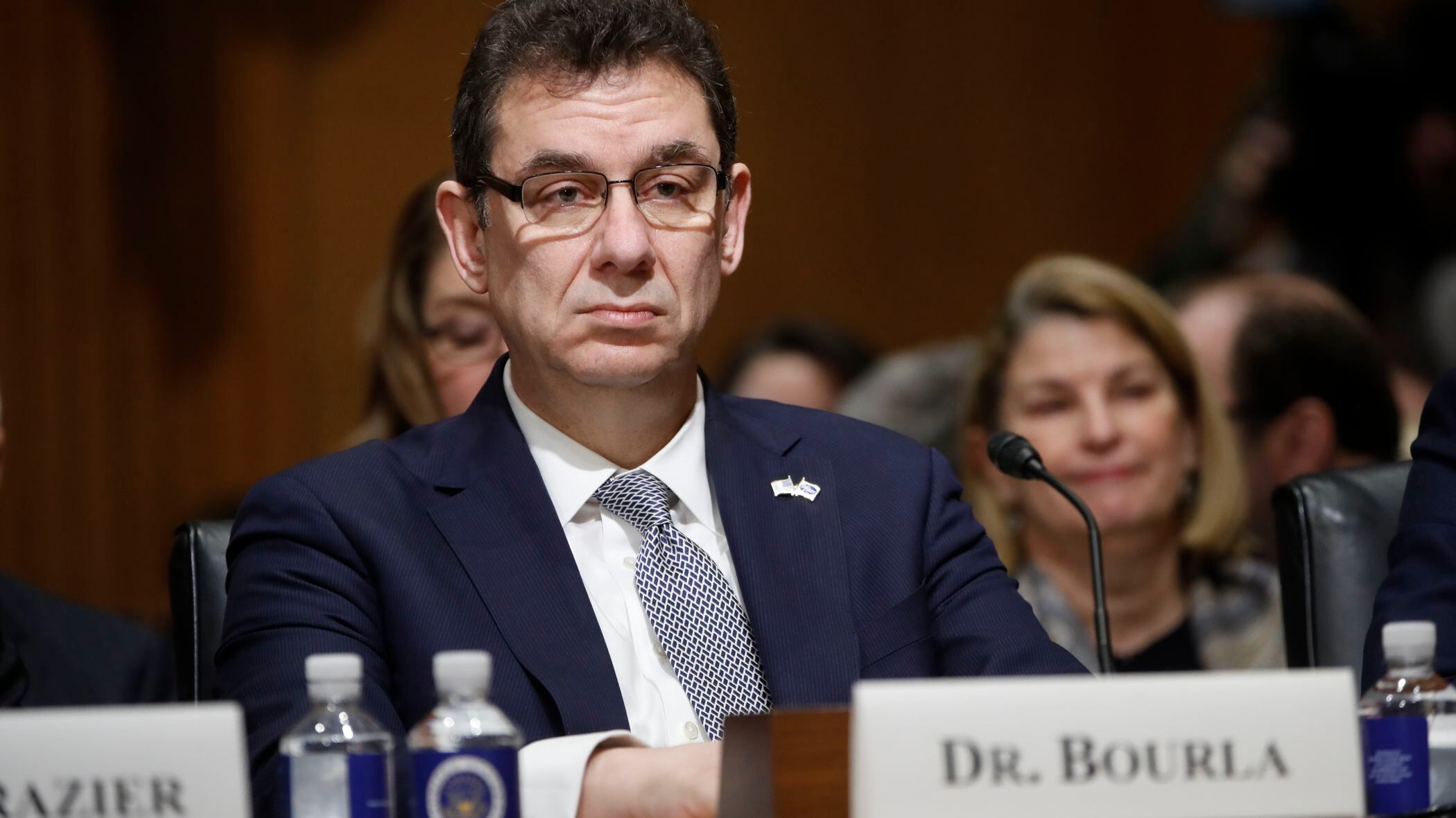
In this Feb. 26, 2019 file photo, Albert Bourla, chief executive officer of Pfizer, prepares to testify before the Senate Finance Committee hearing on drug prices, on Capitol Hill in Washington. Pfizer Inc.'s CEO says it can't seek emergency authorization of its COVID-19 vaccine before the third week of November — and that's if everything goes well. The announcement on Friday, Oct. 16, 2020, by Bourla reflects estimates from leading scientists that its unlikely data would start to emerge until November or December showing any of the leading vaccine candidates work. (AP Photo/Pablo Martinez Monsivais, File)
Pfizer Inc. cannot request emergency authorization of its COVID-19 vaccine before the third week of November -- and that’s if everything goes well, the company’s CEO announced Friday.
Despite President Donald Trump’s repeated promises of a vaccine before Election Day, scientists have been cautioning that it’s unlikely data showing a leading shot actually works would come until November or December.
Another leading U.S. contender, Moderna Inc., previously announced the earliest it could seek authorization of its own vaccine would be Nov. 25.
Pfizer CEO Albert Bourla has long said it's possible testing might reveal by the end of October if his company’s vaccine actually protects against the coronavirus. But in Friday’s announcement, he made clear that effectiveness is only part of the equation.
The vaccine also must be proven safe. And to qualify for an “emergency use authorization,” any COVID-19 vaccine must track at least half the participants in large-scale studies for two months after their second dose, the time period in which side effects are likely to appear.
Bourla estimated Pfizer's 44,000-person study will reach that milestone in the third week of November.
“We are operating at the speed of science,” he wrote in a letter posted to the company’s website.
The vaccine made by Pfizer and its German partner BioNTech is among several leading candidates in final testing.
Even if a vaccine emerges by year’s end, only limited doses will be available right away. The U.S. government is deciding who would be first in line, almost certainly health care workers, and estimates there may be enough for widespread vaccinations in the spring.
___
The Associated Press Health and Science Department receives support from the Howard Hughes Medical Institute’s Department of Science Education. The AP is solely responsible for all content.
Orangetheory Fitness is redefining the future of workouts with smarter tech, strength-based programming, and community-driven studios built for what’s next.
Spain's government has fined Airbnb 64 million euros or $75 million for advertising unlicensed tourist rentals. The consumer rights ministry announced the fine on Monday. The ministry stated that many listings lacked proper license numbers or included incorrect information. The move is part of Spain's ongoing efforts to regulate short-term rental companies amid a housing affordability crisis especially in popular urban areas. The ministry ordered Airbnb in May to remove around 65,000 listings for similar violations. The government's consumer rights minister emphasized the impact on families struggling with housing. Airbnb said it plans to challenge the fine in court.
Roomba maker iRobot has filed for Chapter 11 bankruptcy protection, but says that it doesn’t expect any disruptions to devices as the more than 30-year-old company is taken private under a restructuring process. iRobot said that it is being acquired by Picea through a court-supervised process. Picea is the company's primary contract manufacturer. The Bedford, Massachusetts-based anticipates completing the prepackaged chapter 11 process by February.
Serbia’s prosecutor for organized crime has charged a government minister and three others with abuse of position and falsifying of documents related to a luxury real estate project linked to U.S. President Donald Trump’s son-in-law Jared Kushner. The charges came on Monday. The investigation centers on a controversy over a a bombed-out military complex in central Belgrade that was a protected cultural heritage zone but that is facing redevelopment as a luxury compound by a company linked to Kushner. The $500 million proposal to build a high-rise hotel, offices and shops at the site has met fierce opposition from experts at home and abroad. Selakovic and others allegedly illegally lifted the protection status for the site by falsifying documentation.
Wealthfront’s CFO Alan Iberman talks the $2.05B IPO and the major moment for robo banking as the company bets on AI, automation, and “self-driving money."