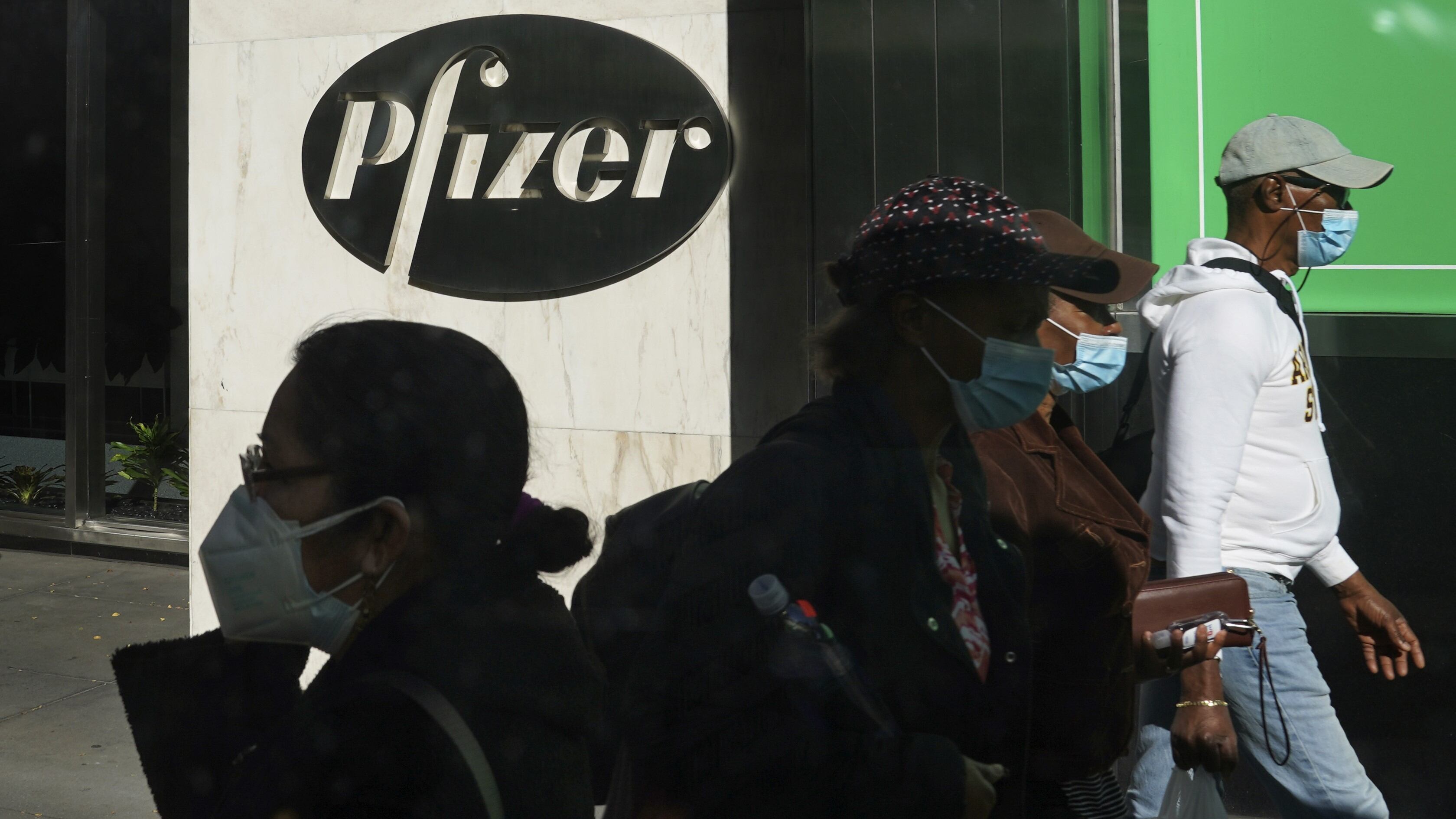
In this Nov. 9, 2020, file photo, pedestrians walk past Pfizer world headquarters in New York. Pfizer announced Wednesday, Nov. 18, 2020, more results in its ongoing coronavirus vaccine study that suggest the shots are 95% effective a month after the first dose. (AP Photo/Bebeto Matthews, File)
By Linda A. Johnson and Frank Jordans
Pfizer said Wednesday that new test results show its coronavirus vaccine is 95% effective, is safe and also protects older people most at risk of dying — last data needed to seek emergency use of limited shot supplies even as the catastrophic outbreak worsens across the globe.
The announcement from Pfizer and its German partner BioNTech, just a week after they revealed the first promising preliminary results, comes as the team is preparing within days to formally ask U.S. regulators to allow emergency use of the vaccine.
They also have begun “rolling submissions” for the vaccine with regulators in Europe, the U.K. and Canada and soon will add this new data.
Pfizer and BioNTech had initially estimated the vaccine was more than 90% effective after 94 infections had been counted in a study that included 44,000 people. With the new announcement, the company now has accumulated 170 infections in the study -- and said only eight of them occurred in volunteers who got the actual vaccine rather than a dummy shot. One of those eight developed severe disease, the company said.
“This is an extraordinarily strong protection,” Dr. Ugur Sahin, BioNTech's CEO and co-founder, told The Associated Press.
The companies have not yet released detailed data on its study, and results have not been analyzed by independent experts. Also still to be determined are important questions such as how long protection lasts and whether people might need boosters.
But all eyes are on the progress of potential vaccines as the grim infection rate jumps in the U.S. and abroad as winter weather forces people indoors, in the close quarters that fuels viral spread.
Pfizer and BioNTech said the vaccine was more than 94% effective in adults over age 65, though it is not clear exactly how that was determined with only eight infections in the vaccinated group to analyze and no breakdown provided of those people’s ages.
Sahin said there were enough older adults enrolled in the study and among the placebo recipients who became infected that he is confident “this vaccine appears to work in the higher-risk population.”
Earlier this week Moderna, Inc. announced that its experimental vaccine appears to be 94.5% effective after an interim analysis of its late-stage study.
Similar results from two vaccines both made with a brand-new technology — using a snippet of the genetic code of the coronavirus to train the body to recognize if the real virus comes along — likely will add to experts' reassurance about the novel approach.
While initial supplies will be scarce and rationed, as the supply grows Sahin said the companies have a responsibility to help ensure access for lower-income countries as well.
Pfizer and BioNTech also say now have the required data on the vaccine’s safety needed to seek emergency authorization from the Food and Drug Administration.
The companies didn’t disclose safety details but said no serious vaccine side effects have been reported, with the most common problem being fatigue after the second vaccine dose, affecting about 4% of participants.
The study has enrolled nearly 44,000 people in the U.S. and five other countries. The trial will continue to collect safety and effectiveness data on volunteers for two more years.
Pfizer and BioNTech said they expect to produce up to 50 million vaccine doses globally in 2020 and up to 1.3 billion doses in 2021.
U.S. officials have said they hope to have about 20 million vaccine doses each from Moderna and Pfizer available for distribution in late December. The first shots are expected to be offered to vulnerable groups like medical and nursing home workers, and people with serious health conditions.
AP medical writer Lauran Neergaard contributed to this report.
The Associated Press Health and Science Department receives support from the Howard Hughes Medical Institute’s Department of Science Education. The AP is solely responsible for all content.
Carlo and Baker cover the latest developments with the Omicron variant, and break down what we know and what we still don't. Plus, a relatively tame Black Friday, and more.
Dr. Amesh Adalja, an infectious disease specialist and senior scholar at Johns Hopkins Center for Health Security, joined Cheddar to discuss the nations joining in on a travel ban against several African nations after South Africa reported the emergence of the omicron variant of COVID-19 currently worrying health experts. Adalja also added his own voice to the World Health Organization's objection to the travel ban at this time. "When you do a travel ban, you basically waste a lot of resources implementing the travel ban, you give people a false sense of security when the virus is likely already outside of the area of the travel ban, and then you punish countries like South Africa." He noted that South Africa should be praised for its transparency and not punished with restrictions, an act he thinks will lead to a chilling effect among other nations sharing data freely.
Blue Origin is gearing up for its next launch, set to blast off on December 9th. Michael Strahan is one of the six crew members who will snag a seat on the the New Shepard rocket. Jim Cantrell, CEO and co-founder at Phantom Space, joins Cheddar News to discuss.
Donald Pettey, Program Manager for Strategic Initiatives for MassDOT, and Mohammed Siddiqui, Vice President of Public Relations at Ko-Solar, join Cheddar Climate, where they discuss their plan to test highway barriers that absorb sound and solar energy, with construction expected to begin in the first half of 2022.
Over 100 world leaders signed on to a pledge at the United Nations COP26 climate meeting with the aim of ending and reversing deforestation by 2030. Leaders agreed to conserve forests and ecosystems, support developing countries on deforestation prevention, and more. Rod Taylor, Global Forests Director at the World Resources Institute, joins Cheddar Climate to discuss the pledge, whether it will have a significant impact, whether 2030 is a suitable deadline, and how we can verify if forests are actually being protected.
President Joe Biden's "Build Back Better" bill could mean cheaper electric bicycles and scooters as the nation attempts to shift away from gas-powered cars. Noa Banayan, the director of federal affairs at PeopleForBikes, joined Cheddar's "Closing Bell" to provide some background on the E-Bike Act included in Biden's reconciliation bill that would provide tax credits for qualified purchases. "We want to make sure, from the bike industry's perspective, that this is a technology and a product that is available to the majority of Americans who want to lower their carbon footprint and get around town faster and do everything that they would normally do in a short car trip but by bike, because it's healthier, it's fast, it's efficient, you're not in traffic," she said.
It's being called the next big trend in crypto. A decentralized autonomous organization, or DAO, is an internet community of different types of groups and businesses. The purpose is to allow people to commit funds to a specific cause in a safe way. Now, one social platform is creating a do-it-yourself kit for those who want to step into the space. Upstream Collective just launched the beta mode of its platform with the goal of putting all facets of running a DAO in one place. Alex Taub, co-founder and CEO of Upstream, joins Cheddar News to discuss.
A NASA spacecraft that will deliberately crash into an asteroid is preparing to launch this week. The goal of the DART mission, or the Double Asteroid Redirection Test, is to hit the smaller of the two asteroids, Dimorphos, with the spacecraft at about 15,000 miles per hour and see how the impact changes the asteroid’s trajectory. Joey Roulette, space reporter at The New York Times, joins Cheddar News to talk more about it.
NFL Hall of Famer and "Good Morning America" host Michael Strahan will be able to add space travel to his list of accomplishments as he prepares to launch into orbit with the next Blue Origin mission.