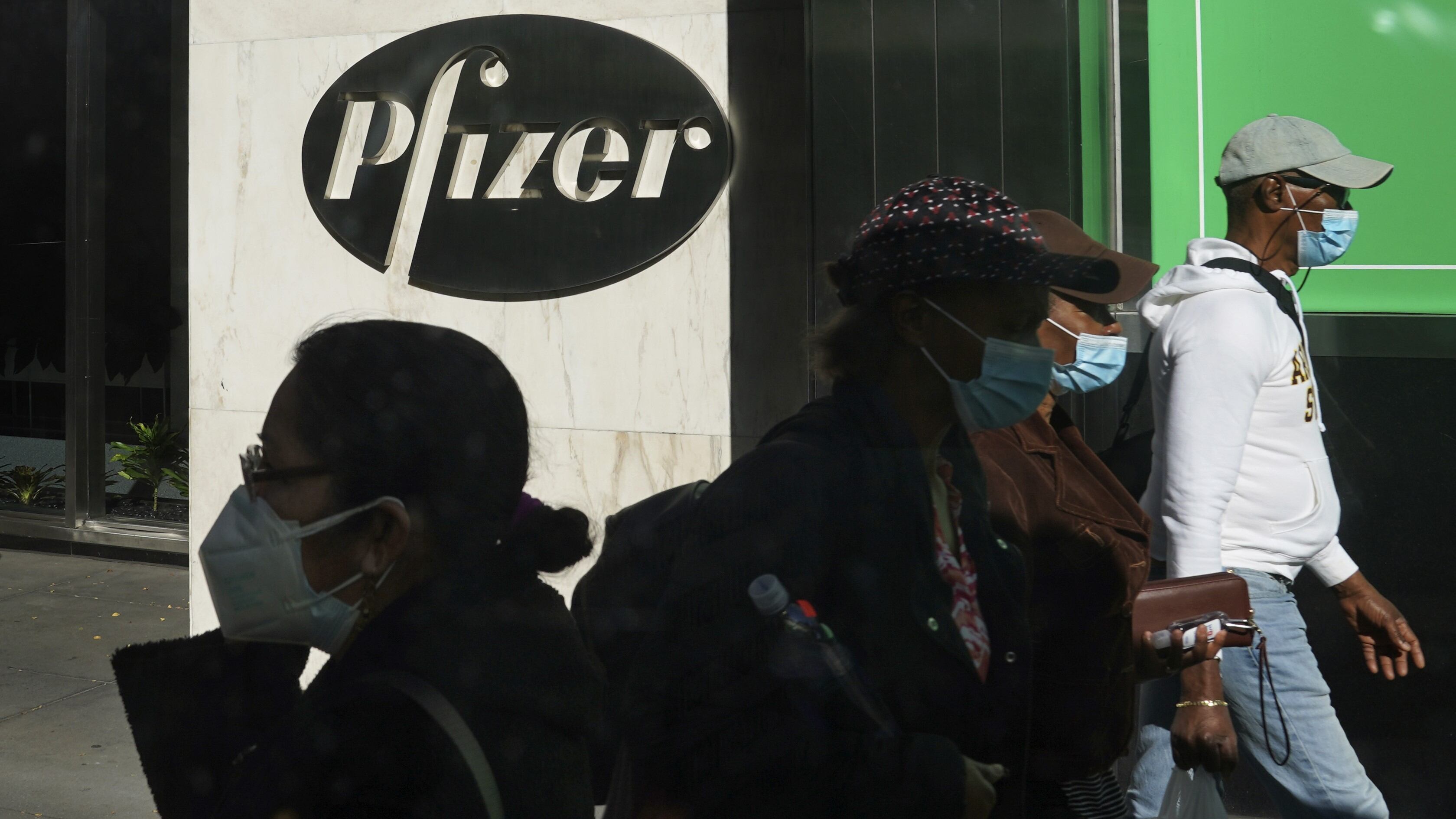
In this Nov. 9, 2020, file photo, pedestrians walk past Pfizer world headquarters in New York. Pfizer announced Wednesday, Nov. 18, 2020, more results in its ongoing coronavirus vaccine study that suggest the shots are 95% effective a month after the first dose. (AP Photo/Bebeto Matthews, File)
By Linda A. Johnson and Frank Jordans
Pfizer said Wednesday that new test results show its coronavirus vaccine is 95% effective, is safe and also protects older people most at risk of dying — last data needed to seek emergency use of limited shot supplies even as the catastrophic outbreak worsens across the globe.
The announcement from Pfizer and its German partner BioNTech, just a week after they revealed the first promising preliminary results, comes as the team is preparing within days to formally ask U.S. regulators to allow emergency use of the vaccine.
They also have begun “rolling submissions” for the vaccine with regulators in Europe, the U.K. and Canada and soon will add this new data.
Pfizer and BioNTech had initially estimated the vaccine was more than 90% effective after 94 infections had been counted in a study that included 44,000 people. With the new announcement, the company now has accumulated 170 infections in the study -- and said only eight of them occurred in volunteers who got the actual vaccine rather than a dummy shot. One of those eight developed severe disease, the company said.
“This is an extraordinarily strong protection,” Dr. Ugur Sahin, BioNTech's CEO and co-founder, told The Associated Press.
The companies have not yet released detailed data on its study, and results have not been analyzed by independent experts. Also still to be determined are important questions such as how long protection lasts and whether people might need boosters.
But all eyes are on the progress of potential vaccines as the grim infection rate jumps in the U.S. and abroad as winter weather forces people indoors, in the close quarters that fuels viral spread.
Pfizer and BioNTech said the vaccine was more than 94% effective in adults over age 65, though it is not clear exactly how that was determined with only eight infections in the vaccinated group to analyze and no breakdown provided of those people’s ages.
Sahin said there were enough older adults enrolled in the study and among the placebo recipients who became infected that he is confident “this vaccine appears to work in the higher-risk population.”
Earlier this week Moderna, Inc. announced that its experimental vaccine appears to be 94.5% effective after an interim analysis of its late-stage study.
Similar results from two vaccines both made with a brand-new technology — using a snippet of the genetic code of the coronavirus to train the body to recognize if the real virus comes along — likely will add to experts' reassurance about the novel approach.
While initial supplies will be scarce and rationed, as the supply grows Sahin said the companies have a responsibility to help ensure access for lower-income countries as well.
Pfizer and BioNTech also say now have the required data on the vaccine’s safety needed to seek emergency authorization from the Food and Drug Administration.
The companies didn’t disclose safety details but said no serious vaccine side effects have been reported, with the most common problem being fatigue after the second vaccine dose, affecting about 4% of participants.
The study has enrolled nearly 44,000 people in the U.S. and five other countries. The trial will continue to collect safety and effectiveness data on volunteers for two more years.
Pfizer and BioNTech said they expect to produce up to 50 million vaccine doses globally in 2020 and up to 1.3 billion doses in 2021.
U.S. officials have said they hope to have about 20 million vaccine doses each from Moderna and Pfizer available for distribution in late December. The first shots are expected to be offered to vulnerable groups like medical and nursing home workers, and people with serious health conditions.
AP medical writer Lauran Neergaard contributed to this report.
The Associated Press Health and Science Department receives support from the Howard Hughes Medical Institute’s Department of Science Education. The AP is solely responsible for all content.
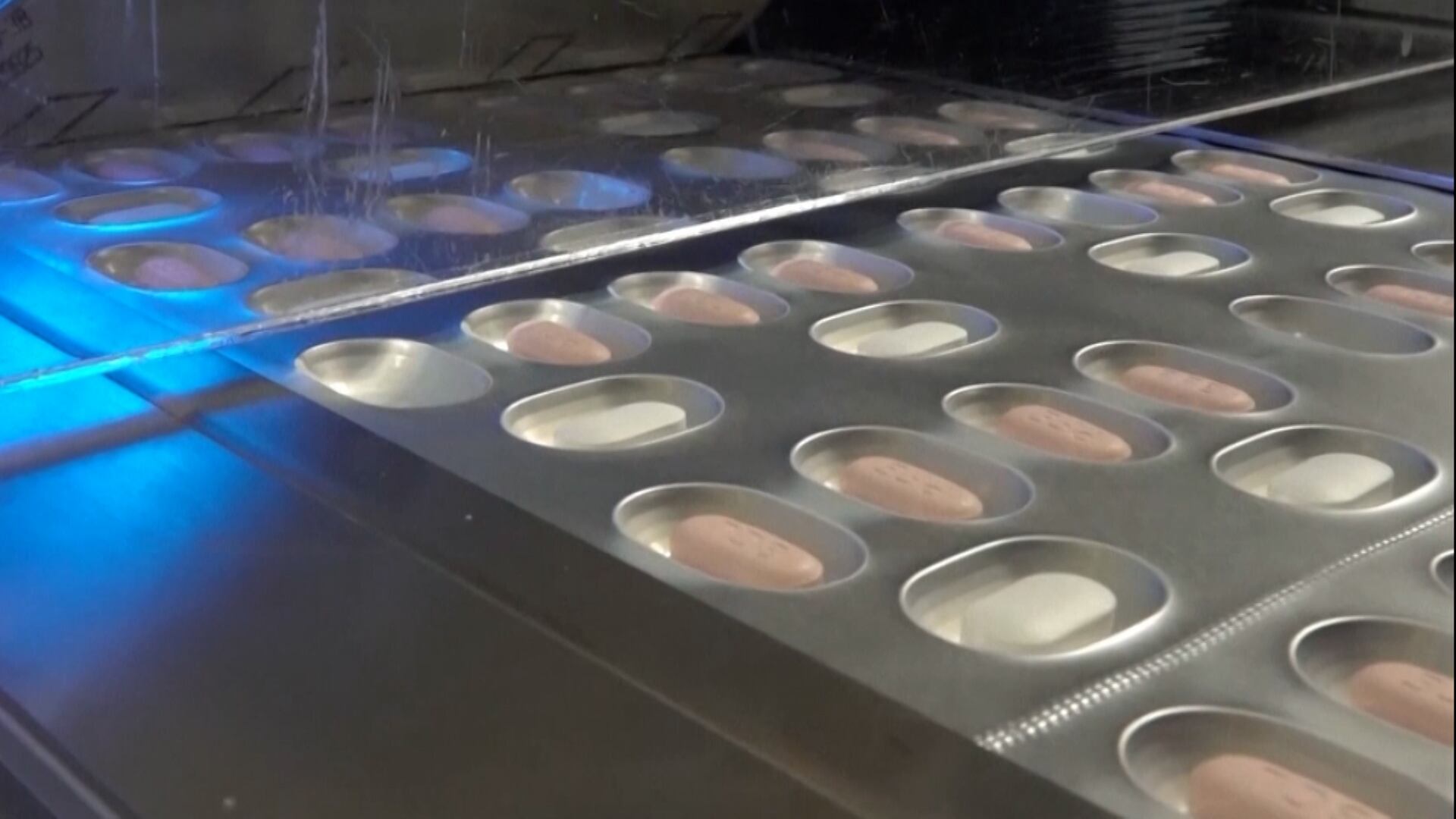
The FDA has granted emergency use authorization to Pfizer's pill to treat covid-19. The treatment, called Paxlovid, is the first antiviral covid-19 pill that people can take at home.
Pfizer says the pill can reduce the risk of severe illness by 90 percent and is intended for people at high risk for severe disease, including those over 65, people with obesity, diabetes, or a weakened immune system. Professor Peter Pitts, Founder, Center for Medicine in the Public Interest & Former FDA Associate joined Wake Up with Cheddar to discuss.
Ahead of a four day week for the markets due to the upcoming Christmas holiday, investors hoping for a quiet end to the year, or even a Santa Claus rally, may not be in luck. Investors are still digesting the latest from the Fed regarding a quicker than expected taper, as well as ever increasing blow back as the Omicron variant spreads. Octavio Marenzi, CEO of Opimas LLC, explains why the markets have been so volatile ever since the emergence of the latest variant and what to expect going forward into 2022.
Carlo and Baker cover the heartening news on the Covid front ahead of the holiday, plus President Biden punting student loan repayments again, a new space telescope and Love, Hate, Ate: Christmas Eve Eve Edition!
Pfizer, one of the makers of a currently available COVID-19 vaccine, has taken another critical step forward in combatting the pandemic by getting regulatory approval for Paxlovid, a pill treatment rather than IV or injection as others have been. Dr. Purvi Parikh, an immunologist with the Allergy and Asthma Network, spoke to Cheddar about the ramifications of the authorization. "This is huge, especially because we know early treatment does keep people out of the hospital, especially with this antiviral," Parikh said. "The fact that people can start a regimen at home so they don't have to leave and further expose others is a big breakthrough." She also explained how the drug is a combination of two antiviral medications that are not without its risks but should be safe over the short term.
This year's worldwide semiconductor shortage limited the supply of everything from new cars to smartphones; and now, many in the chip industry expect the shortage to continue deep into 2022, and maybe even 2023. Semiconductor senior research analyst for Robert W. Baird & Co., Tristan Gerra, joins Cheddar News' Closing Bell to discuss.
Direct health care company Nomi Health recently raised $110 million in a Series A round. Nomi Health lets public and private organizations directly purchase healthcare at reduced costs, and pay providers in real-time. It also delivers healthcare directly to under-served communities via its fleet of mobile care units, which the company says is the largest in the country. Nomi Health says its mission is to improve the health care experience for all Americans. Nomi Health CEO Mark Newman joined Cheddar News' Closing Bell to discuss.
The airline industry says it is contending with staff shortages that threaten to hamper operations amid the COVID resurgence, andDelta Airlines CEO Ed Bastian called on the CDC to revise its guidance for vaccinated workers who test positive from a 10-day quarantine to just five. Chuck Liberman, chief investment officer and managing partner at Advisors Capital Management LLC, joined Cheddar to talk about the current guidance on isolation and why he believes the omicron variant calls for more relaxed guidance given its reportedly mild symptoms.
The boys discuss President Biden's plans to send out free rapid tests as the testing supply chain starts to buckle ahead of the holidays. Also, why aren't Americans having more babies, and The Matrix returns.
NASA is launching its new generation of space telescopes just before Christmas. The James Webb Space Telescope, set to launch on December 24th, will succeed the Hubble space telescope as the world's most powerful complex space observatory. The project has been 30 years in the making and is one of the most highly anticipated space science missions of the 21st century. Klaus Pontoppidan, astronomer and JWST Project Scientist at the Space Telescope Science Institute joined Cheddar's Opening Bell to discuss.
With Omicron becoming the dominant COVID-19 variant in the U.S., President Joe Biden announced that he will make 500 million rapid tests available to Americans in January 2022. Cheddar News speaks with Dr. Shereef Elnahal, President and CEO of University Hospital why testing is key to combatting the spread of the virus.