At long last, the Democrats are set to gather for a week-long virtual convention that promises to be a shadow of its former self, as former VP Joe Biden formally accepts the party nomination. As is always the case, the nights and hours preceding the nominee's speech will feature a who's who of party bigwigs: Barack Obama. Hillary Clinton. Nancy Pelosi. 

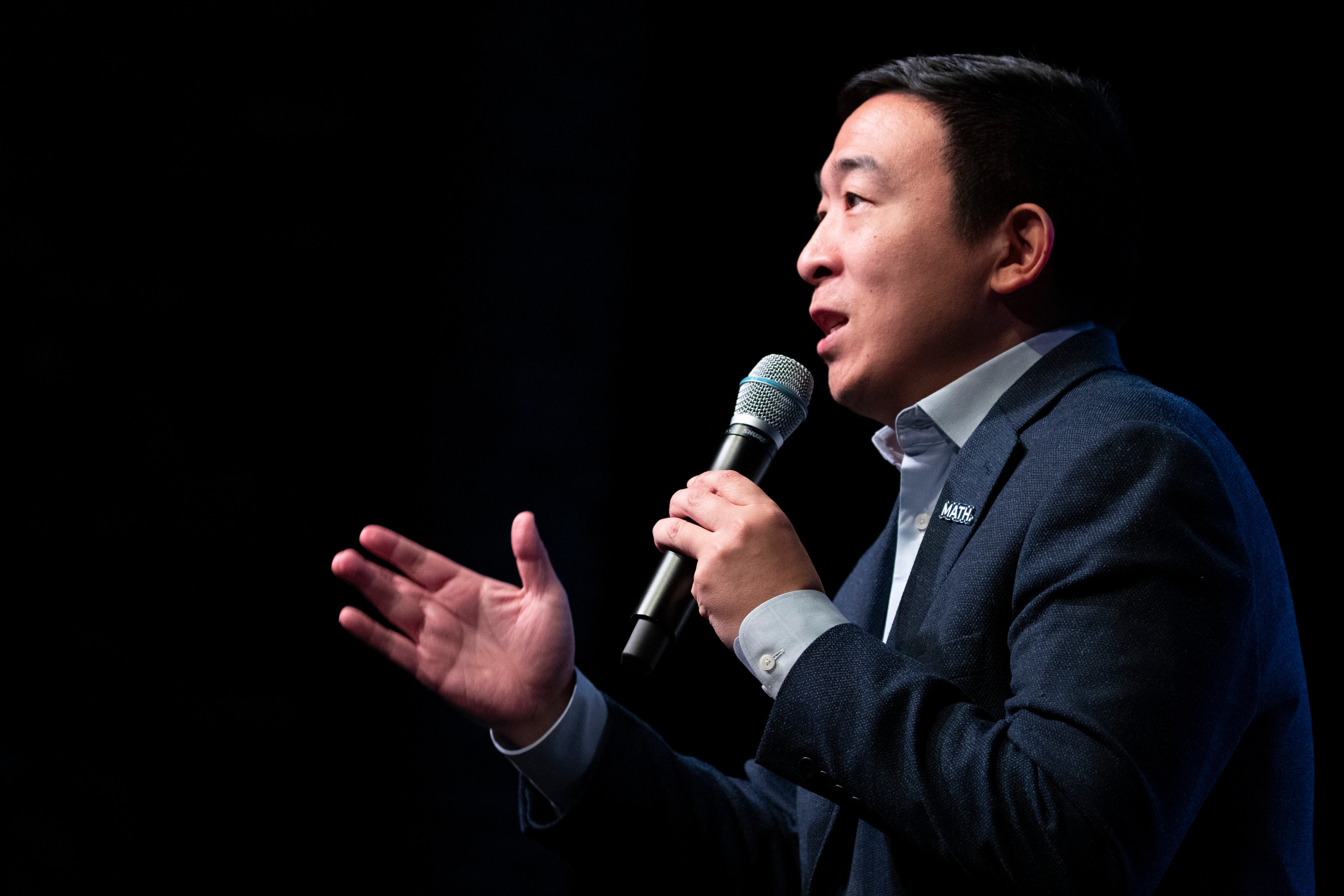
Of course, it won't be held in the 17,000-capacity Fiserv Forum in Milwaukee, Wisconsin; instead, the proceedings will look more like what the New York Times calls "a star-studded Zoom call." But even a quick glance at the four-night speakers reveals one glaring absence that DNC officials must correct if their "event" is to hold grassroots legitimacy: Andrew Yang.

Yang shot to prominence on the 2020 campaign trail with his eloquent descriptions of workforce displacement, the challenges of an increasingly digital age, and being the only candidate who crowd-surfed and danced the Cupid Shuffle. But his once-niche signature policy of Universal Basic Income quickly gained in mainstream acceptance, and as the country descended into a once-in-a-generation pandemic, the idea of direct payments became a political necessity for even the biggest party-insiders in Washington… of both parties.

In short, few have changed the national conversation quite like Andrew Yang. And the DNC is doing its voters a huge disservice by not including him in the ranks of expected speakers at the convention.

Don't get me wrong — the party is right to spotlight particular voices in an effort to unify disparate voting concerns; progressives like Vermont Senator Bernie Sanders and Rep. Alexandria Ocasio-Cortez will surely be must-watch speakers early in the week. And newly-announced VP pick Kamala Harris and Senator Cory Booker, who moved the needle on justice in policing and have publicly prosecuted the case against Donald Trump as well as anyone else, are deserving of convention placement, too. 

But ignoring Yang's contributions to the Democratic cause — not to mention his rockstar-esque appeal to disaffected and young voters across this country — shows that the DNC remains out-of-touch with the forward-thinking approach that endeared Yang to the public in the first place. No candidate has done a better job elucidating the workforce challenges that contributed to the rise of Trump to begin with (especially in the heartland) and his thinking on topics such as artificial intelligence and job automation should become staples of the official Democratic Party platform. 

And there's a very real representation and inclusivity component to this as well; Rep. Ted Lieu, one of the most visible Democrats on Capitol Hill, called out the DNC directly today, writing on Twitter: "Dear @DNC : Asian Americans are the fastest increasing group in America, including in multiple swing states. The gross underrepresentation of Asian American speakers in the four days of the DNC Convention is tone deaf and a slap in the face." If the Democratic Party is serious about defining itself as in-step with an increasingly diverse electorate, ignoring Andrew Yang is a gross misjudgment. 

But being shunned by the DNC and powers-that-be is nothing new for Yang. He and I spoke in the spin room following the September 2019 debate in Houston, Texas, the third consecutive outing where Yang got the least amount of on-stage speaking time. He shrugged off any concerns.

"I've started to just gauge how optimally impactful the time I get is," Yang told me. "And as long as I'm making an impact with the time I get, then I'm doing great."

"We raised over a million dollars in the hours immediately afterwards [the last debate]," he added.

And that's the magic of Yang's influence: he doesn't need a lot of time to convey extremely persuasive points. The DNC would be smart to reconsider its convention lineup, and even give Yang the shortest speaking slot available; because to Yang, it doesn't matter how little time he's given. As he told me in Houston last Fall, "Americans can tell when someone is calling out the real problems and solutions, and I can do that in whatever time I'm given."

The opinions expressed by the author do not necessarily reflect the ideas and opinions of Cheddar and Altice USA.

Share:
More In Politics
US tariffs are having an uneven effect on holiday prices and purchases
Many U.S. consumers say they’ve noticed higher than usual prices for holiday gifts in recent months, according to a a December poll from The Associated Press-NORC Center for Public Affairs Research. A contributing factor is the unusually high import taxes the Trump administration put on foreign goods. While the worst-case consumer impact that many economists foresaw from the administration’s trade policies hasn’t materialized, some popular gift items have been affected more than others. Most toys and electronics sold in the U.S. come from China. So do most holiday decorations. Jewelry prices have risen due to the cost of gold.
Serbia organized crime prosecutors charge minister, others in connection with Kushner-linked project
Serbia’s prosecutor for organized crime has charged a government minister and three others with abuse of position and falsifying of documents related to a luxury real estate project linked to U.S. President Donald Trump’s son-in-law Jared Kushner. The charges came on Monday. The investigation centers on a controversy over a a bombed-out military complex in central Belgrade that was a protected cultural heritage zone but that is facing redevelopment as a luxury compound by a company linked to Kushner. The $500 million proposal to build a high-rise hotel, offices and shops at the site has met fierce opposition from experts at home and abroad. Selakovic and others allegedly illegally lifted the protection status for the site by falsifying documentation.
Trump signs executive order to block state AI regulations
President Donald Trump has signed an executive order to block states from regulating artificial intelligence. He argues that heavy regulations could stifle the industry, especially given competition from China. Trump says the U.S. needs a unified approach to AI regulation to avoid complications from state-by-state rules. The order directs the administration to draw up a list of problematic regulations for the Attorney General to challenge. States with laws could lose access to broadband funding, according to the text of the order. Some states have already passed AI laws focusing on transparency and limiting data collection.
New York Times, after Trump post, says it won’t be deterred from writing about his health
The New York Times and President Donald Trump are fighting again. The news outlet said Wednesday it won't be deterred by Trump's “false and inflammatory language” from writing about the 79-year-old president's health. The Times has done a handful of stories on that topic recently, including an opinion column that said Trump is “starting to give President Joe Biden vibes.” In a Truth Social post, Trump said it might be treasonous for outlets like the Times to do “FAKE” reports about his health and "we should do something about it.” The Republican president already has a pending lawsuit against the newspaper for its past reports on his finances.
Trump approves sale of more advanced Nvidia computer chips used in AI to China
President Donald Trump says he will allow Nvidia to sell its H200 computer chip used in the development of artificial intelligence to “approved customers” in China. Trump said Monday on his social media site that he had informed China’s leader Xi Jinping and “President Xi responded positively!” There had been concerns about allowing advanced computer chips into China as it could help them to compete against the U.S. in building out AI capabilities. But there has also been a desire to develop the AI ecosystem with American companies such as chipmaker Nvidia.
Swing district Republicans brace for political fallout if health care subsidies expire
House Republicans in key battleground districts are working to contain the political fallout expected when thousands of their constituents face higher bills for health insurance coverage obtained through the Affordable Care Act. For a critical sliver of the GOP majority, the impending expiration of the enhanced premium tax credits after Dec. 31 could be a major political liability as they potentially face midterm headwinds in a 2026 election critical to President Donald Trump’s agenda. For Democrats, the party’s strategy for capturing the House majority revolves around pinning higher bills for groceries, health insurance and utilities on Republicans.
Load More