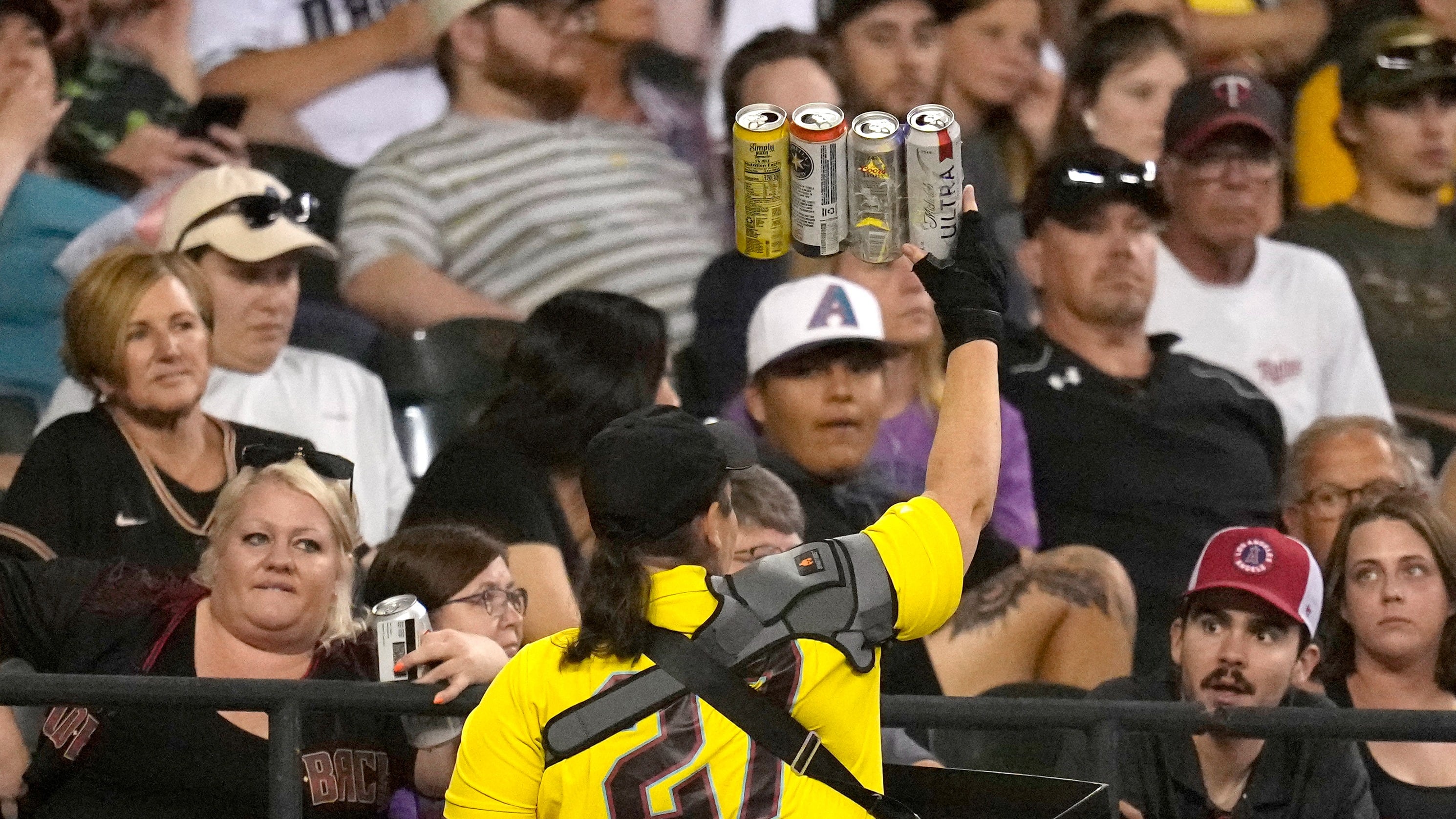
A beer vendor walks through the stands during the seventh inning of a baseball game between the Arizona Diamondbacks and the Milwaukee Brewers Tuesday, April 11, 2023, in Phoenix. (AP Photo/Ross D. Franklin)
By David Brandt
Thanks to the pitch clock, the action is moving much faster at Major League Baseball games.
It also means a little less time for fans to enjoy a frosty adult beverage.
To combat that time crunch, at least four teams — the Arizona Diamondbacks, Texas Rangers, Minnesota Twins and Milwaukee Brewers — have extended alcohol sales through the eighth inning this season. Others, like the Miami Marlins and New York Mets, still have seventh-inning cutoffs, but haven't ruled out changes.
“Totally makes sense to me,” said Tom Lienhardt, who was sipping on a beer Tuesday night before the Brewers-Diamondbacks game at Chase Field. “Since the games are shorter, you’ve got to adjust.”
Teams historically have stopped selling alcohol after the seventh.
At least one team, the Baltimore Orioles, already sold alcohol through the eighth inning, or until 3 1/2 hours after first pitch, whichever came first.
MLB games have been considerably shorter this season, largely thanks to a series of rule changes, particularly the new pitch clock. Through the first 1 1/2 weeks of the season, the average game time was down 31 minutes, on track to be the sport’s lowest since 1984.
The minor leagues played with the pitch clock last season. At least one minor league general manager — Kevin Mahoney of the Class A Brooklyn Cyclones — said there was no dropoff in concession sales even with shorter games.
Still, some big league teams have felt the need to make adjustments.
The Rangers allowed some alcohol sales in the eighth inning last season, but have made that option more widely available in 2023. The team said the move to offer in-seat service to everyone — fans can order on their phones — was done partly in reaction to the pitch clock and the potential of shorter game times so fans would not have to miss extended action waiting in lines at concession stands.
Brewers President of business operations Rick Schlesinger confirmed to MLB.com that their team's move to extend alcohol sales through the eighth was an experiment.
“If it turns out that this is causing an issue or we feel that it might cause an issue, then we’ll revert to what we have done previously,” Schlesinger said.
MLB says it does not regulate when teams sell alcohol. Most franchises have used the seventh inning as a cutoff, at least partly to avoid overserving customers who could then get in their cars and drive home.
But in reality, most teams already had areas around the ballpark where fans could get alcohol after the seventh, even if the concession stands stopped serving. Many parks are connected to restaurants or have VIP areas where the booze still flows.
“If it cuts off sales in the seventh inning, the eighth inning or the ninth inning, that really doesn’t affect our stance because regardless, we just don’t want people to drink alcohol and then drive home from the game,” said Erin Payton, Regional Executive Director for Mothers Against Drunk Driving.
___
AP Baseball Writers Ronald Blum, Noah Trister and Stephen Hawkins, and AP Sports Writers Dave Campbell, Alanis Thames and Ryan Kryska contributed to this report.
Alex Monaco, host of the “The Bettor Half Hour” on MSG Networks and the “Sports Gambling with Moneyline Monaco” podcast, joins Cheddar Bets to give his last-minute tips before tonight's slate of games starts.
Sponsored by BetMGM
Richard Jefferson, host of the Road Trippin' podcast, NBA Today analyst, and NBA Champion, joins Cheddar Bets to break down All-Star Weekend festivities and to give his "Pick 6" for tonight.
Sponsored by BetMGM
BetMGM Host Olivia Harlan Dekker joins Cheddar Bets to break down tonight's big Bucks-76ers matchup -- likely Philly's last game without James Harden.
Sponsored by BetMGM
While many are excited to watch the final two NFL teams square-off and see which one ultimately takes home the trophy, some, on the other hand, are there for another mian attraction -- the commercials. Companies during this year's game are looking towards the future From electric vehicles, to robots, and crypto-currency, several first-time advertisers are expected to join long-time advertisers like Pepsi, Budweiser and Doritos during the NFL's biggest game. Tom Morton, Global Chief Strategy Officer at R/GA, joined Cheddar News' Big Game Special to discuss.
This week's Spring Training has been delayed as a result of the ongoing MLB Lockout. This past Saturday lead negotiators and lawyers from Major League Baseball and the players union met to discuss the economic hurdles needed to be cleared for a new labor deal, but from all accounts, it seems the sides are still far apart. Baseball Columnist and Publisher of "The Joe Sheehan" Baseball Newsletter, Joe Sheehan, joined Cheddar to discuss more.
The Super Bowl might be over, but people are still buzzing about the players, commercials, halftime show, and more. Google tracks the top searches before and after the game every year, revealing the show-stopping moments of the biggest sporting event of the year. Sadie Thoma, Director of US Creative Partnerships at Google, joined Cheddar's Opening Bell to discuss the top trends this year.
Private equity firms are taking a big interest in investing in NBA teams, the sports league showing the highest ROI over the last two decades according to Sportico, Forbes, and PitchBook. Wylie Fernyhough, lead analys for private equity at PitchBook joined Cheddar News to discuss the way firms are looking to get a piece of the action on the court. “There’s a certain amount of rarity, with these," Fernyhough said. "They’re not exactly printing new NBA franchises."
Kyle Jaeger, senior editor for Marijuana Moment, joined Cheddar News' Closing Bell, where he explains why a stigma still exists for the cannabis industry in advertising and social media after NBC rejected Weedmaps' ad for the big game even though more states across the country are legalizing cannabis.
We know that the Los Angeles Rams emerged as Super Bowl champions, but the crypto industry also came out a winner on Sunday with several notable companies getting airtime in primetime. However, Richard Smith, author of the Risk Rituals Newsletter, joins Cheddar News' Closing Bell, where he says the campaigns were a 'disappointment' and adds that crypto companies would be wiser spending their resources on creating value.