Microsoft founder Bill Gates reflects upon a 50-year-old computer code
By Michael Liedtke
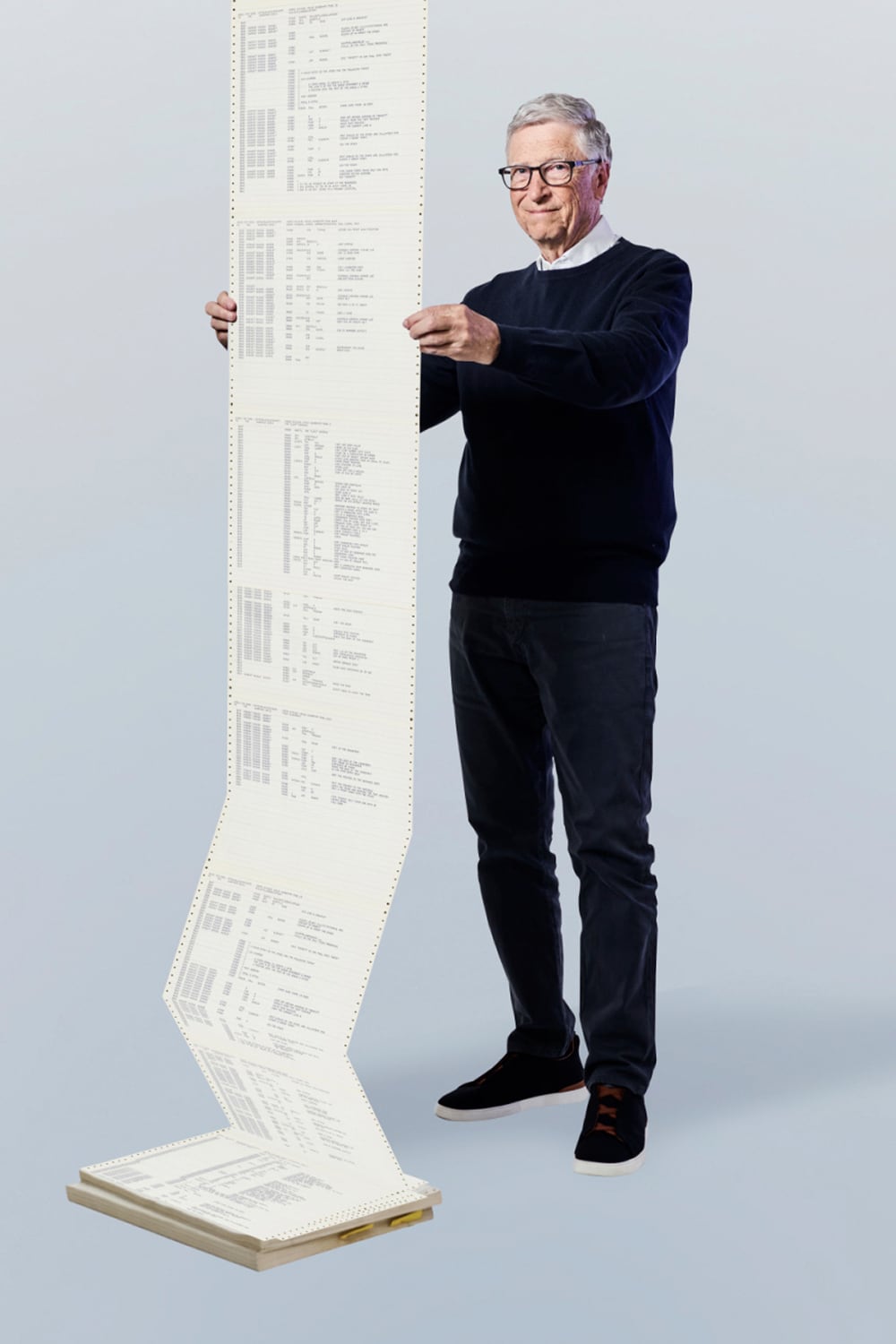
CORRECTS THAT PHOTO WAS TAKEN IN RECENT TIMES - This recent photo provided by Gates Ventures shows Microsoft founder Bill Gates holding a printout of the computer coding that launched the software maker in April 1975. (Ian Allen/Gates Ventures via AP)
Even as he grows older, Microsoft founder Bill Gates still fondly remembers the catalytic computer code he wrote 50 years ago that opened up a new frontier in technology.
Although the code that Gates printed out on a teletype machine may look crude compared to what's powering today's artificial intelligence platforms, it played a critical role in creating Microsoft in April 1975 — a golden anniversary that the Redmond, Washington, company will celebrate on Friday.
Gates, 69, set the stage for that jubilee with a blog post reminiscing on how he and his old high school friend — the late Paul Allen — scrambled to create the world's first “software factory” after reading an article in the January 1975 issue of Popular Electronics magazine about the Altair 8800, a minicomputer that would be powered by a tiny chip made by the then-obscure technology company, Intel.
The article inspired Gates, who was just a freshman at Harvard University, and Allen to call Altair's maker, Micro Instrumentation and Telemetry Systems, and promise the company's CEO Ed Roberts they had developed software that would enable consumers to control the hardware. There was just one hitch: Gates and Allen hadn't yet come up with the code they promised Roberts.
Gates and Allen tackled the challenge by latching onto the BASIC computer language that had been developed in 1964 at Dartmouth College, but they still had to figure out a way to make the technology compatible with the forthcoming Altair computer, even though they didn't even have a prototype of the machine.
After spending two months working on the program with little sleep, Gates finished the code that became the basis for the Altair's first operating system. “That code remains the coolest I’ve ever written,” Gates wrote in his blog post, which includes an option to download the original program.
The code would go on to provide the foundation for a business that would make personal computers a household staple, with a suite of software that include the Word, Excel and PowerPoint programs, as well as the Windows operating system that still powers most PCs today.
“That was the revolution,” Gates said of the code in a video accompanying his post. “That was the thing that ushered in personal computing.”
Gates' recollection of the code is part of a nostalgic kick that he has been on this year as he prepares to turn 70 in October.
The trip down memory lane included the February release of a memoir exploring his early years as an often-misunderstood child with few friends, and a hailing of the 25th anniversary of the philanthropic foundation he created after stepping down as Microsoft's CEO in 2000. The tech giant initially stumbled after Gates' departure but has been thriving under CEO Satya Nadella, and has amassed a market value of about $2.8 trillion.
In his memoir, Gates also reflected on his tempestuous relationship with fellow PC pioneer, the late Apple co-founder Steve Jobs, whose company will be celebrating its golden anniversary next year.
“Fifty years is a long time,” said Gates, whose personal fortune is estimated at $108 billion. “It’s crazy that the dream came true.”
Phoebe Gates and Sophia Kianni introduce Phia, a fashion tech startup that helps users find price comparisons and discover alternative options for apparel
Universal Music Group and AI platform Udio have settled a copyright lawsuit and will collaborate on a new music creation and streaming platform. The companies announced on Wednesday that they reached a compensatory legal settlement and new licensing agreements. These agreements aim to provide more revenue opportunities for Universal's artists and songwriters. The rise of AI song generation tools like Udio has disrupted the music streaming industry, leading to accusations from record labels. This deal marks the first since Universal and others sued Udio and Suno last year. Financial terms of the settlement weren't disclosed.
Microsoft says users of its Azure cloud portal may be not be able to access Office 365, Minecraft or other services due to issues with its global content delivery network services. The tech company posted a note to its Azure status page that its teams are currently deploying a fix to address the outage.
Nvidia on Wednesday became the first public company to reach a market capitalization of $5 trillion. The ravenous appetite for the Silicon Valley company’s chips is the main reason that the company’s stock price has increased so rapidly since early 2023.
A new poll finds that as the United States rapidly builds massive data centers for the development of artificial intelligence, many Americans are concerned about the environmental impact.
Brain.fm merges music and neuroscience to enhance focus, creativity, and mental health—Dr. Kevin Woods reveals how sound is transforming cognitive performance.
An internet outage on Monday morning highlights the reliance on Amazon's cloud services. This incident reveals vulnerabilities in the concentrated system. Cloud computing allows companies to rent Amazon's infrastructure instead of building their own. Amazon leads the market, followed by Google and Microsoft. The outage originated in Northern Virginia, the biggest and oldest cloud hub in the U.S. This region handles significantly more data than other hubs. Despite the idea of spreading workloads, many rely on this single hub. The demand for computing power, especially for AI, is driving a construction boom for data centers.
Ashley Fieglein Johnson, CFO & President at Planet, joins us to share the story behind the Owl launch—and how strategy, tech, and vision are fueling liftoff.
OpenAI has announced that ChatGPT will soon engage in "erotica for verified adults." CEO Sam Altman says the company aims to allow more user freedom for adults while setting limits for teens. OpenAI isn't the first to explore sexualized AI, but previous attempts have faced legal and societal challenges. Altman believes OpenAI isn't the "moral police" and wants to differentiate content similar to how Hollywood differentiates R-rated movies. This move could help OpenAI, which is losing money, turn a profit. However, experts express concerns about the impact on real-world relationships and the potential for misuse.