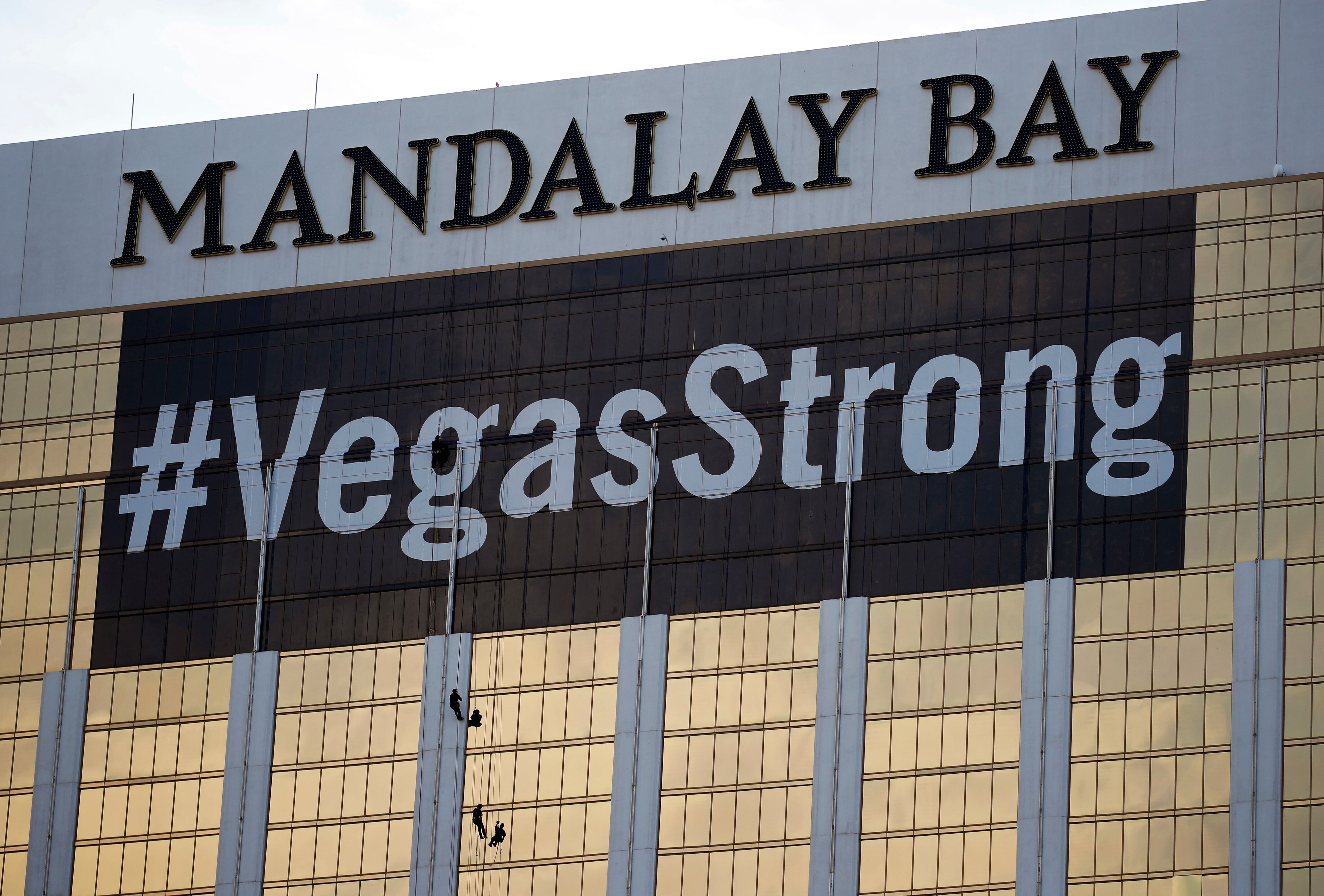
MGM Resorts International will pay up to $800 million to settle pending litigation with survivors of the 2017 mass shooting in Las Vegas, the company announced Thursday. The settlement comes two years to the week after a gunman in the Mandalay Bay hotel, which MGM owns, killed 58 people and injured hundreds in the worst mass shooting in modern U.S. history.
"While nothing will be able to bring back the lives lost or undo the horrors so many suffered on that day, this settlement will provide fair compensation for thousands of victims and their families,” said Robert Eglet, the lead counsel for the plaintiffs.
The total payout is expected to be between $735 million and $800 million, depending on how many claims are filed, and should be completed by the end of 2020.
Scores of survivors and bereaved families sued MGM for neglecting security in the Mandalay, where a 64-year-old gunman opened fire from his 32nd floor hotel room onto a crowd of concertgoers below. The shooter fired over 1,000 rounds of ammunition before taking his own life, according to police.
MGM initially fought the litigation, claiming that the hotel was protected by federal law that shields companies from related liabilities.
Yet on Thursday, Jim Murren, MGM’s chairman and CEO, said that “prolonged litigation around these matters is in no one's best interest” and that he hoped that the settlement meant an end to the lawsuits. “Our goal has always been to resolve these matters so our community and the victims and their families can move forward in the healing process,” Murren said.
MGM added in a statement that plaintiffs who choose to participate in the settlement will agree to dismiss all pending litigation. The settlement is also not an admission of liability by MGM.
Eglet praised MGM for “good corporate citizenship on their part” and said that the settlement is the “best outcome” for the plaintiffs. "Today's agreement marks a milestone in the recovery process for the victims of the horrifying events of 1 October," he added.
Orangetheory Fitness is redefining the future of workouts with smarter tech, strength-based programming, and community-driven studios built for what’s next.
Spain's government has fined Airbnb 64 million euros or $75 million for advertising unlicensed tourist rentals. The consumer rights ministry announced the fine on Monday. The ministry stated that many listings lacked proper license numbers or included incorrect information. The move is part of Spain's ongoing efforts to regulate short-term rental companies amid a housing affordability crisis especially in popular urban areas. The ministry ordered Airbnb in May to remove around 65,000 listings for similar violations. The government's consumer rights minister emphasized the impact on families struggling with housing. Airbnb said it plans to challenge the fine in court.
Roomba maker iRobot has filed for Chapter 11 bankruptcy protection, but says that it doesn’t expect any disruptions to devices as the more than 30-year-old company is taken private under a restructuring process. iRobot said that it is being acquired by Picea through a court-supervised process. Picea is the company's primary contract manufacturer. The Bedford, Massachusetts-based anticipates completing the prepackaged chapter 11 process by February.
Serbia’s prosecutor for organized crime has charged a government minister and three others with abuse of position and falsifying of documents related to a luxury real estate project linked to U.S. President Donald Trump’s son-in-law Jared Kushner. The charges came on Monday. The investigation centers on a controversy over a a bombed-out military complex in central Belgrade that was a protected cultural heritage zone but that is facing redevelopment as a luxury compound by a company linked to Kushner. The $500 million proposal to build a high-rise hotel, offices and shops at the site has met fierce opposition from experts at home and abroad. Selakovic and others allegedly illegally lifted the protection status for the site by falsifying documentation.
Wealthfront’s CFO Alan Iberman talks the $2.05B IPO and the major moment for robo banking as the company bets on AI, automation, and “self-driving money."