ATLANTA (AP) — Florida was the first state to pass a law regulating the use of cellphones in schools in 2023. Just two years later, more than half of all states have laws in place, with more likely to act soon.
Bills have sprinted through legislatures this year in states as varied as New York and Oklahoma, reflecting a broad consensus that phones are bad for kids.
Connecticut state Rep. Jennifer Leeper, a Democrat and co-chair of the General Assembly’s Education Committee, on May 13 called phones “a cancer on our kids” that are “driving isolation, loneliness, decreasing attention and having major impacts both on social-emotional well-being but also learning.”
Republicans express similar sentiments.
“This is a not just an academic bill,” Republican Rep. Scott Hilton said after Georgia’s bill, which only bans phones in grades K-8, passed in March. “This is a mental health bill. It’s a public safety bill.”
So far, 26 states have passed laws, with eight other states and the District of Columbia implementing rules or making recommendations to local districts. Of the states, 17 have acted this year. Just Tuesday, Nebraska Republican Gov. Jim Pillen signed a law banning phones throughout the school day. Earlier Tuesday, Alaska lawmakers required schools to regulate cellphones when they overrode an education package Republican Gov. Mike Dunleavy had vetoed for unrelated reasons.
More action is coming as bills await a governor’s signature or veto in Florida, Missouri, Nebraska and New Hampshire.
Increasing focus on banning phones throughout the school day
When Florida first acted, lawmakers ordered schools to ban phones during instructional time while allowing them between classes or at lunch. But now there’s another bill awaiting Gov. Ron DeSantis’ action that goes further. It would ban phones for the entire school day for elementary and middle schools.
Ten states and the District of Columbia have enacted school day bans, most for students in grades K-12, and they now outnumber the seven states with instructional time bans.
North Dakota Republican Gov. Kelly Armstrong called the ban throughout the school day that he signed into law “a huge win.”
“Teachers wanted it. Parents wanted it. Principals wanted it. School boards wanted it,” Armstrong said.
Armstrong recently visited a grade school with such a ban in place. He said he saw kids engaging with each other and laughing at tables during lunch.
The “bell-to-bell” bans have been promoted in part by ExcelinEd, the education think tank founded by former Florida Gov. Jeb Bush. The group’s political affiliate has been active in lobbying for bans.
Nathan Hoffman, ExcelinEd’s senior director of state policy and advocacy, said barring phones throughout the day heads off problems outside of class, like when students set up or record fights in halls.
“That’s often when you get some of your biggest behavioral issues, whether they go viral or not,” Hoffman said.
Other states want school districts to set their own rules
But other states, particularly where there are strong traditions of local school control, are mandating only that school districts adopt some kind of cellphone policy, believing districts will take the hint and sharply restrict phone access. In Maine, where some lawmakers originally proposed a school day ban, lawmakers are now considering a rewritten bill that would only require a policy.
And there have been a few states where lawmakers failed to act at all. Maybe the most dramatic was in Wyoming, where senators voted down a bill in January, with some opponents saying teachers or parents should set the rules.
Where policymakers have moved ahead, there’s a growing consensus around exceptions. Most states are letting students use electronic devices to monitor medical needs and meet the terms of their special education plans. Some are allowing exceptions for translation devices if English isn’t a student’s first language or when a teacher wants students to use devices for classwork.
There are some unusual exceptions, too. South Carolina’s original policy allowed an exception for students who are volunteer firefighters. West Virginia’s new law allows smartwatches as long as they are not being used for communication.
Some parents and students oppose the rules
But by far the most high-profile exception has been allowing cellphone use in case of emergencies. One of the most common parent objections to a ban is that they would not be able to contact their child in a crisis like a school shooting.
“It was only through text messages that parents knew what was happening,” said Tinya Brown, whose daughter is a freshman at Apalachee High School, northeast of Atlanta, where a shooting killed two students and two teachers in September. She spoke against Georgia’s law at a news conference in March.
Some laws call for schools to find other ways for parents to communicate with their children at schools, but most lawmakers say they support giving students access to their cellphones, at least after the immediate danger has passed, during an emergency.
In some states, students have testified in favor of regulations, but it’s also clear that many students, especially in high schools, are chafing under the rules. Kaytlin Villescas, a sophomore at Prairieville High School, in the suburbs of Baton Rouge, Louisiana, is one student who took up the fight against bans, starting a petition and telling WBRZ-TV in August that Louisiana’s law requiring a school day ban is misguided. She argued that schools should instead teach responsible use.
“It is our proposition that rather than banning cellphone use entirely, schools should impart guidelines on responsible use, thereby building a culture of respect and self-regulation,” Villescas wrote in an online petition.
Most states provide no funding to carry out laws
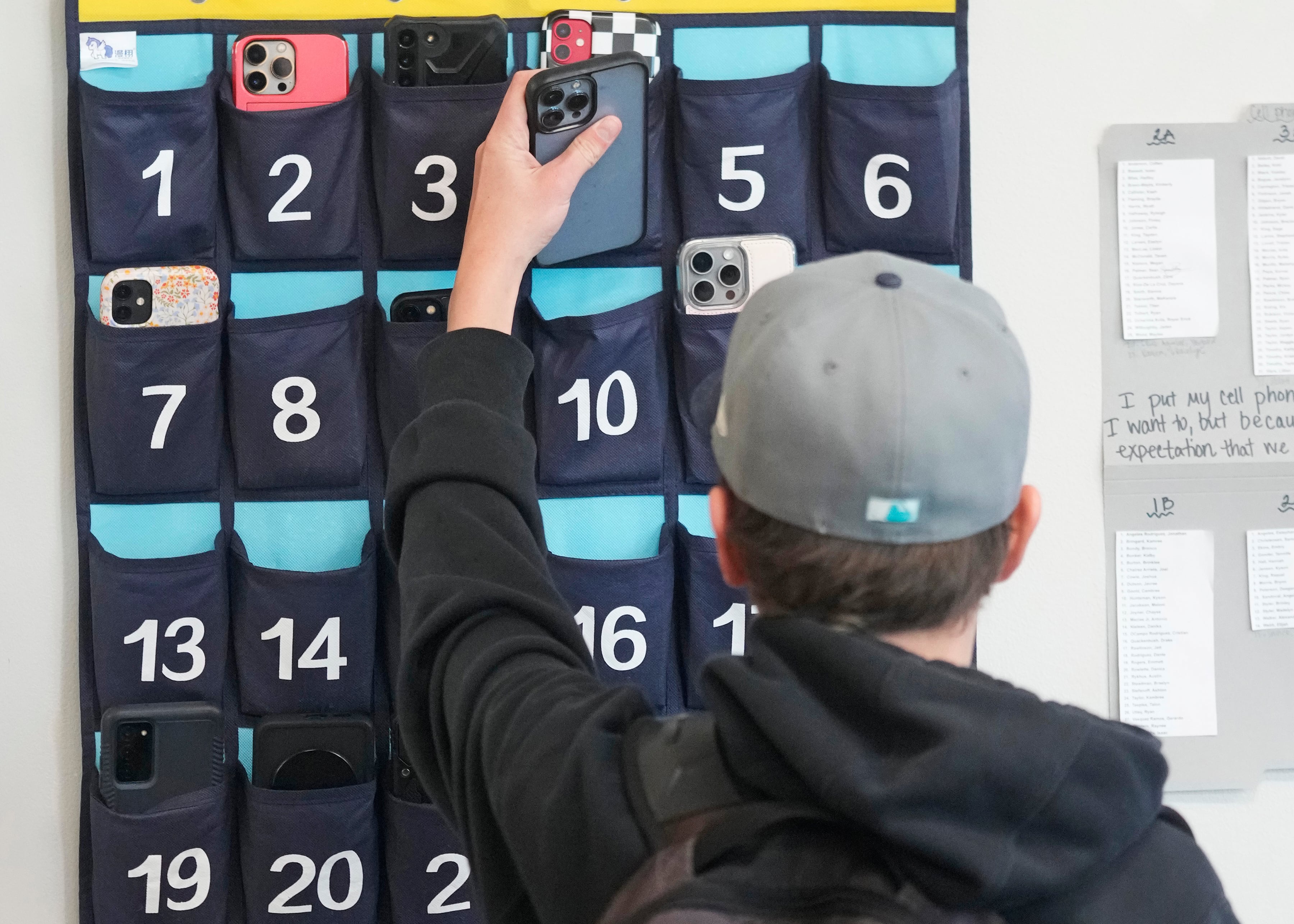
A few states have provided money for districts to buy lockable phone storage pouches or other storage solutions. New York, for example, plans to spend $13.5 million. But states have typically provided no cash. New Hampshire lawmakers stripped a proposed $1 million from their bill.
“Providing some specific money for this would kind of ease some of those implementation challenges,” Hoffman said. ”That said, most states have not."
___
Associated Press writers Becky Bohrer in Juneau, Alaska; Susan Haigh in Hartford, Connecticut; Jack Dura in Bismarck, North Dakota; and Kate Payne in Tallahassee, Florida; contributed to this report.