Vice President Kamala Harris on Saturday urged Americans to take action during “a critical point in our nation’s history” as thousands of protesters demonstrated across the country against new limits to abortion rights making their way through the courts.
Saturday’s nationwide rallies were sparked by the U.S. Supreme Court’s actions the day before, when the high court intervened to delay rule changes that would have limited the way the abortion drug mifepristone could be used and dispensed. The limits were paused while the court reviews the case more thoroughly.
Harris made a surprise stop in Los Angeles at one of the rallies, where she called the latest upheaval over abortion rights a further incursion by conservatives into myriad “fundamental rights” many Americans thought they had.
“And so this is a moment that history will show required each of us — based on our collective love of our country — to stand up, and fight for, and protect our ideals. That’s what this moment is,” she said Saturday, speaking to several hundred demonstrators from the steps of City Hall. “When you attack the rights of women in America, you are attacking America.”
Some of the protesters voiced their anger at the steps of the nation's high court, which took Friday's action at the request of the federal Justice Department. The agency asked the high court to lift restrictions on mifepristone imposed by an appellate court in Texas earlier in the week. The decision by the appellate court reduced the window of time when the drug could be used and prevented the drug from being dispensed by mail.
Critics of the Texas and appellate court decisions, including pharmaceutical companies, viewed the courts’ actions as a dangerous intrusion into the authority of the FDA, which regulates how medications are sold and used in the United States.
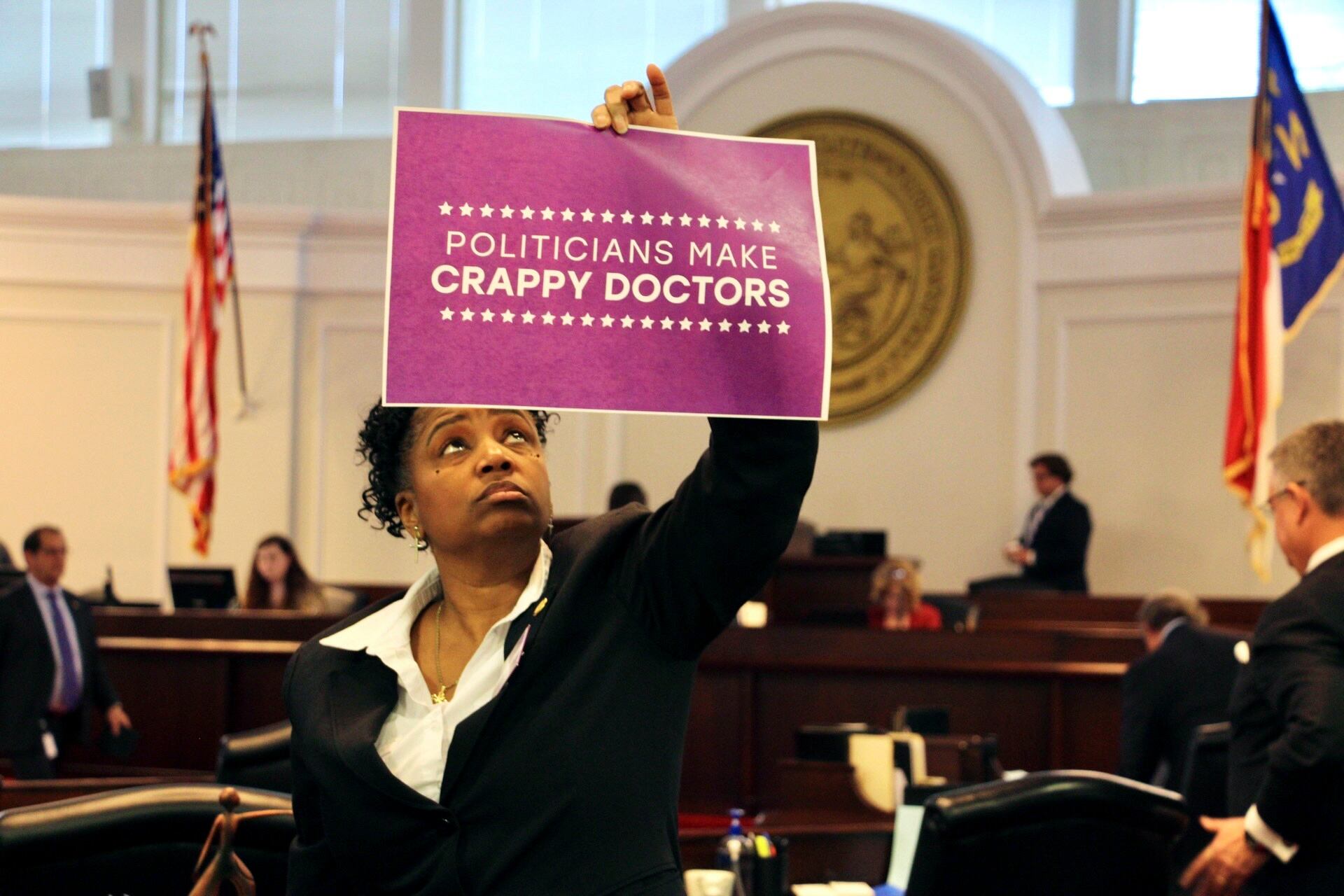
Demonstrators in New York City stood behind a sign with a four-letter expletive directed at Texas, where a federal judge set off the latest salvo in the battle over abortion. They held signs urging the government to defend medication abortions.
But the crowd was modest, attracting a little more than 100 people outside the picturesque public library along Fifth Avenue.
Still, the demonstrators attracted looks from passersby along the busy thoroughfare, some briefly joining the group to lend their voices.
“It can be hard to get people out, because people are being bombarded with all kinds of assaults on their bodies and people are tired and poor,” said Viva Ruiz, who said she helped organize the rally.
“The news cycle is so fast that when one thing happens something terrible happens the next day. So it’s hard to sustain the momentum or the energy for people to be on the streets,” Ruiz said.
With few exceptions, many of the rallies — organized under the banner of a group calling itself “Bigger than Roe” — were held in smaller cities.
Since last year's reversal of Roe v. Wade, the 1973 Supreme Court decision that legalized the right to an abortion, more than a dozen states have effectively outlawed abortion, while additional states have moved to further tighten abortion laws.
On Thursday, the GOP-dominated Florida Legislature moved to became the latest state to ban abortions after six weeks of pregnancy.
Restrictions on the delivery and use of mifepristone, part of a two-drug regimen to end a pregnancy, would be a further blow to abortion rights advocates. The other drug, misoprostol, can be used on its own, but doing so is less effective than using both drugs in combination.
When mifepristone was initially approved, the FDA limited its use to up to seven weeks of pregnancy. It also required three in-person office visits: the first to administer mifepristone, the next to administer the second drug, misoprostol, and the third to address any complications.
If the appeals court’s action stands, those would again be the terms under which mifepristone could be dispensed.
States that support abortion rights, including California and New York, have begun stockpiling misoprostol to assure their states have adequate supplies. Washington state is among those stockpiling a supply of mifepristone or its generic form. And Massachusetts Democratic Gov. Maura Healey said the administration is dedicating $1 million to help providers contracted with the Department of Public Health buy additional quantities of mifepristone.
More than 5.6 million women in the U.S. had used mifepristone as of June 2022, according to the FDA. In that period, the agency received 4,200 reports of complications in women, or less than one-tenth of 1% of women who took the drug.