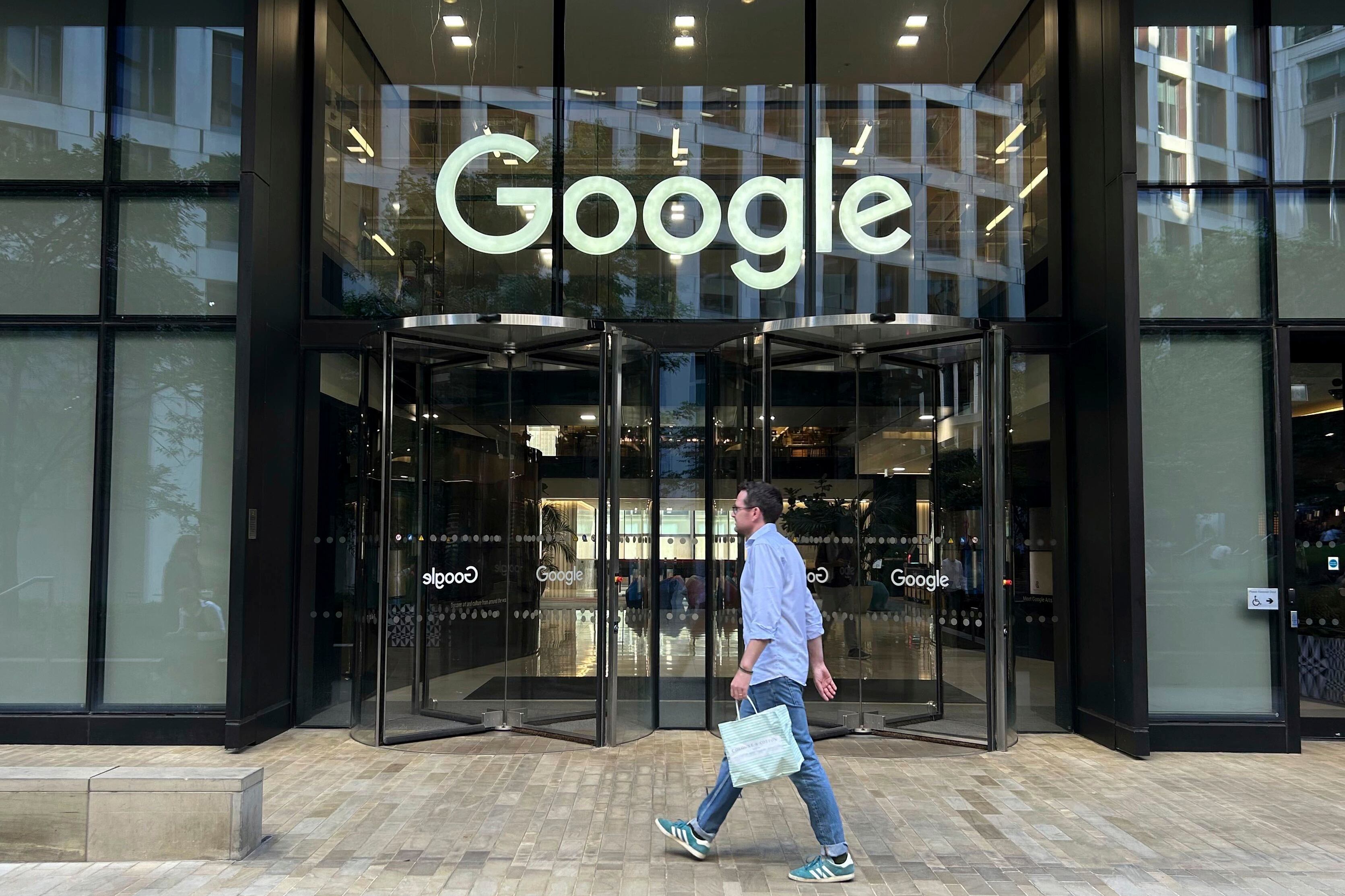
WASHINGTON (AP) — Google is confronting an existential threat as the U.S. government tries to break up the company as punishment for turning its revolutionary search engine into an illegal monopoly.
The drama began to unfold Monday in a Washington courtroom as three weeks of hearings kicked off to determine how the company should be penalized for operating a monopoly in search. In its opening arguments, federal antitrust enforcers also urged the court to impose forward-looking remedies to prevent Google from using artificial intelligence to further its dominance.
“This is a moment in time, we’re at an inflection point, will we abandon the search market and surrender them to control of the monopolists or will we let competition prevail and give choice to future generations,” said Justice Department attorney David Dahlquist.
The proceedings, known in legal parlance as a “remedy hearing,” are set to feature a parade of witnesses that includes Google CEO Sundar Pichai.
The U.S. Department of Justice is asking a federal judge to order a radical shake-up that would ban Google from striking the multibillion dollar deals with Apple and other tech companies that shield its search engine from competition, share its repository of valuable user data with rivals and force a sale of its popular Chrome browser.
Google’s attorney, John Schmidtlein, said in his opening statement that the court should take a much lighter touch. He said the government’s heavy-handed proposed remedies wouldn’t boost competition but instead unfairly reward lesser rivals with inferior technology.
“Google won its place in the market fair and square,” Schmidtlein said.
The moment of reckoning comes four-and-a-half-years after the Justice Department filed a landmark lawsuit alleging Google’s search engine had been abusing its power as the internet's main gateway to stifle competition and innovation for more than a decade.
After the case finally went to trial in 2023, a federal judge last year ruled Google had been making anti-competitive deals to lock in its search engine as the go-to place for digital information on the iPhone, personal computers and other widely used devices, including those running on its own Android software.
That landmark ruling by U.S. District Judge Amit Mehta sets up a high-stakes drama that will determine the penalties for Google’s misconduct in a search market that it has defined since Larry Page and Sergey Brin founded the company in a Silicon Valley garage in 1998.
Since that austere start, Google has expanded far beyond search to become a powerhouse in email, digital mapping, online video, web browsing, smartphone software and data centers.
Seizing upon its victory in the search case, the Justice Department is now setting out to prove that radical steps must be taken to rein in Google and its corporate parent, Alphabet Inc.
“Google’s illegal conduct has created an economic goliath, one that wreaks havoc over the marketplace to ensure that — no matter what occurs — Google always wins,” the Justice Department argued in documents outlining its proposed penalties. “The American people thus are forced to accept the unbridled demands and shifting, ideological preferences of an economic leviathan in return for a search engine the public may enjoy.”
Although the proposed penalties were originally made under President Joe Biden's term, they are still being embraced by the Justice Department under President Donald Trump, whose first administration filed the case against Google. Since the change in administrations, the Justice Department has also attempted to cast Google's immense power as a threat to freedom, too.
In his opening statement, Dahlquist noted that top officials from the Justice Department were in the room to watch proceedings. He said their presence indicated that the case had the full support of federal antitrust regulators, both past and present.
“The fact that this case was filed in 2020, tried in 2023, under two different administrations, and joined by 49 states demonstrates the non-partisan nature of this case and our proposed remedies,” Dahlquist said.
Dahlquist also said that Mehta would be hearing a lot about AI — “perhaps more than you want, your honor,” — and said top executives from AI companies, like ChatGPT, would be called to testify. He said the court's remedies should include provisions to make sure that Google's AI product, Gemini, isn't used to strengthen its existing search monopoly.
“We believe that Google can and will attempt to circumvent the court's remedies if it is not included,” Dahlquist said. “Gen AI is Google's next evolution to keep their vicious cycle spinning.”
Schmidtlein, Google's attorney, said rival AI companies had seen enormous growth in recent years and were doing “just fine."
Google is also sounding alarms about the proposed requirements to share online search data with rivals and the proposed sale of Chrome posing privacy and security risks. “The breadth and depth of the proposed remedies risks doing significant damage to a complex ecosystem. Some of the proposed remedies would imperil browser developers and jeopardize the digital security of millions of consumers," Google lawyers said in a filing leading up to hearings.
The showdown over Google's fate marks the climax of the biggest antitrust case in the U.S. since the Justice Department sued Microsoft in the late 1990s for leveraging its Windows software for personal computers to crush potential rivals.
The Microsoft battle culminated in a federal judge declaring the company an illegal monopoly and ordering a partial breakup — a remedy that was eventually overturned by an appeals court.
Google intends to file an appeal of Mehta's ruling from last year that branded its search engine as an illegal monopoly but can't do so until the remedy hearings are completed. After closing arguments are presented in late May, Mehta intends to make his decision on the remedies before Labor Day.
The search case marked the first in a succession of antitrust cases that have been brought against a litany of tech giants that include Facebook and Instagram parent Meta Platforms, which is currently fighting allegations of running an illegal monopoly in social media in another Washington D.C. trial. Other antitrust cases have been brought against both Apple and Amazon, too.
The Justice Department also targeted Google's digital advertising network in a separate antitrust case that resulted last week in another federal judge's decision that found the company was abusing its power in that market, too. That ruling means Google will be heading into another remedy hearing that could once again raise the specter of a breakup later this year or early next year.
___
Liedtke reported from San Francisco.