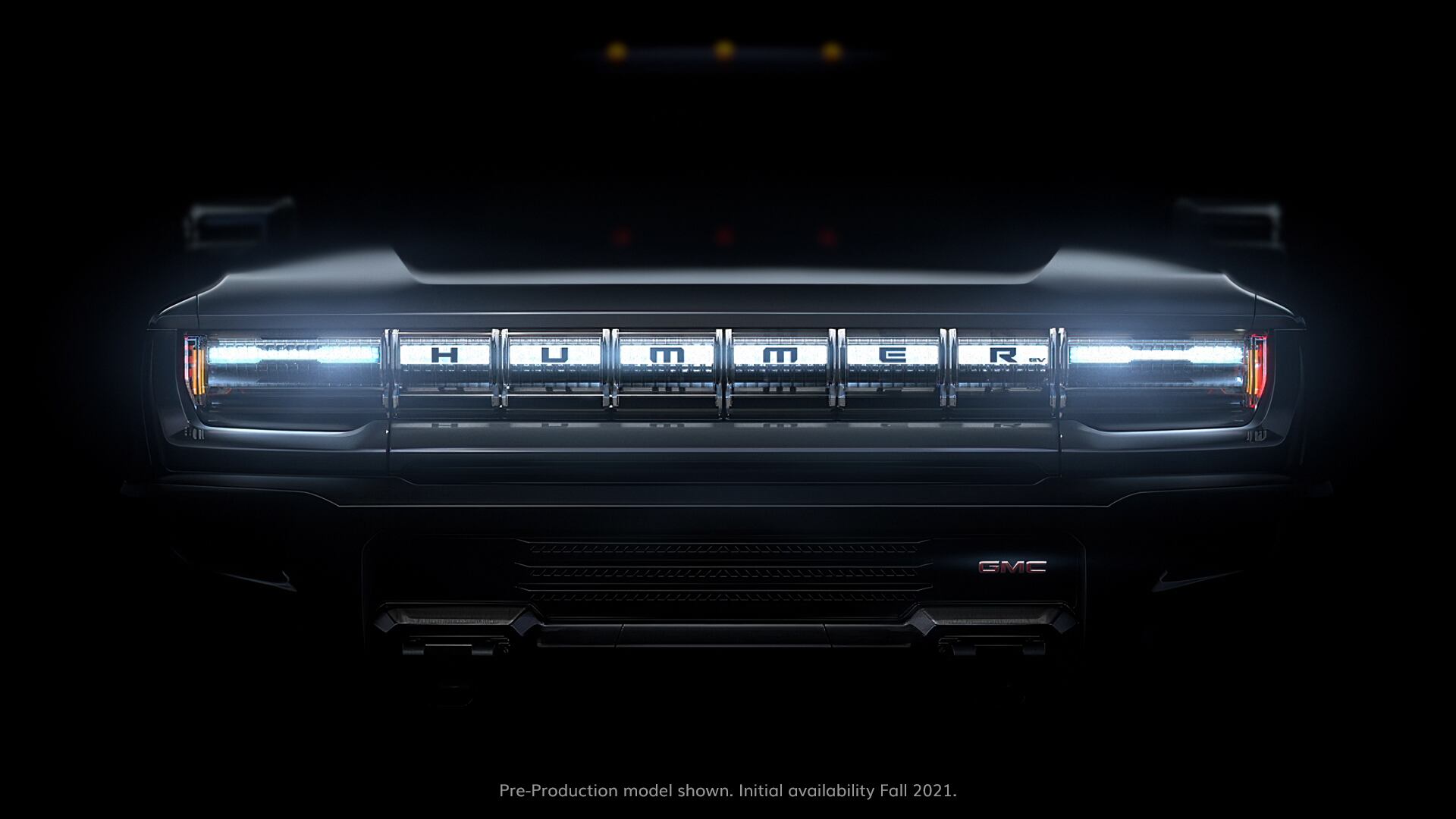
Hummer – the indecently named, jumbo SUV synonymous with American supersize-me gas-gluttony – is returning to dealerships.
And it's coming back not with a roar, but with a whirr.
GMC this week confirmed rumors that it plans to launch its "Quiet Revolution" with a fully electric version of its iconic, double-parking luxo-truck starting in 2021.
The vehicle, set to make its debut this May, promises to be a sharp departure from the lumbering Hummer H1, H2, and H3, which were discontinued last decade amid soaring prices at the pump and sinking prices in General Motors ($GM) stock. (The military-inspired H1 was felled by new emission standards.)
Where those internal combustion predecessors were about the look, like a gym rat doing bicep curls in a mirror, the Hummer EV isn't skipping leg-day: The Hummer EV will race from 0 to 60 in three seconds, GM says, rivaling Tesla's Model X luxury SUV and the forthcoming high-end pickup from EV startup Rivian. It will feature 11,500 pound-feet of torque, more than its apparent Tesla and Rivian rivals. And it will boast an eye-popping 1,000 horsepower, nearly twice as much as the Model X, and an apparent 25 percent more than Rivian
"GMC builds premium and capable trucks and SUVs and the GMC HUMMER EV takes this to new heights," Duncan Aldred, vice president of Global Buick and GMC, said in a statement.
The truck will be built at General Motors' Detroit-Hamtramck assembly center in Michigan, the company's first manufacturing plant dedicated entirely to building electric vehicles. It will be GM's second all-electric vehicle, joining the Chevrolet Bolt hatchback – a vehicle that the Hummer could likely straddle.
The return of the Hummer is a twist on the EV playbook being followed by GM's crosstown rival, Ford ($F). Both companies, rather than trying to warm consumers to an entirely new vehicle, are instead focusing on some of their most iconic brands. Ford is leading its ambitious, $11.5 billion electrification drive with a version of the Mustang, followed by battery-powered versions of its two most popular vehicles: the F-Series pickup, in partnership with Rivian, and the Transit utility van.
GM, with its Hummer, is veering down a slightly different path: It's reviving a brand deeply familiar to drivers – and ingrained in American culture – but one that doesn't overlap with the fossil-fueled vehicles that generated nearly $111 billion in revenue last year, led in the U.S. by its bestselling Chevrolet Silverado pickup.
"What GM has done has given themselves a chance to, in essence, write a brand new story – to present something that doesn't overlap with the Silverado," said Brett Smith, director of technology at the Center for Automotive Research. "Whether it's Ford or Chevy or Dodge, those products have incredibly strong history, an incredibly important image amongst their buyers. And, yes, Hummer has some other images, too, but it's been gone for 12 years. So though it has some positive, some negative baggage, it's something they can remold and remake. It allows them to say, 'This is a different product.'"
Details about the Hummer EV remain scant. While GM, in announcing the transformation of the Detroit-Hamtramck plant into a hub for EVs – including the forthcoming Cruise Origin self-driving vehicle – described the vehicle as a "pickup," a GMC spokesman would say only that it's a "truck."
The vehicle, though, like Tesla's Model X and upcoming Cybertruck, and the anticipated pickup from Rivian, is expected to be targeted at high-end buyers – a return of the Hummer military-luxury complex.
"To have a battery that big, to have that much technology in there – over time those battery costs may come down, but right now they're very expensive," Smith said. "So they have to be positioned as very unique, lifestyle-luxury products."
That's not new: Roughly three-quarters of pickup owners say that, at most, they take their vehicle offroad or use it for towing once a year. The Silverado and its GMC companion, the Sierra, can retail for more than $60,000 with premium options. But the Hummer EV will almost certainly reach a far different market segment than "typical" Tesla buyers: less affluent, more heavily male, slightly older, and far more concentrated in America's interior.
"It's going to be tough for any of these companies to go head-to-head with Tesla in some of the consumer segments. But that is one area that might give GM an opportunity: folks that aren't necessarily buying it only for the environmental or technology-cool – the Tesla-cool factor – but are looking for something that is a really intriguing product," Smith said. "For those buyers, there's a whole new world that they can be exploring."