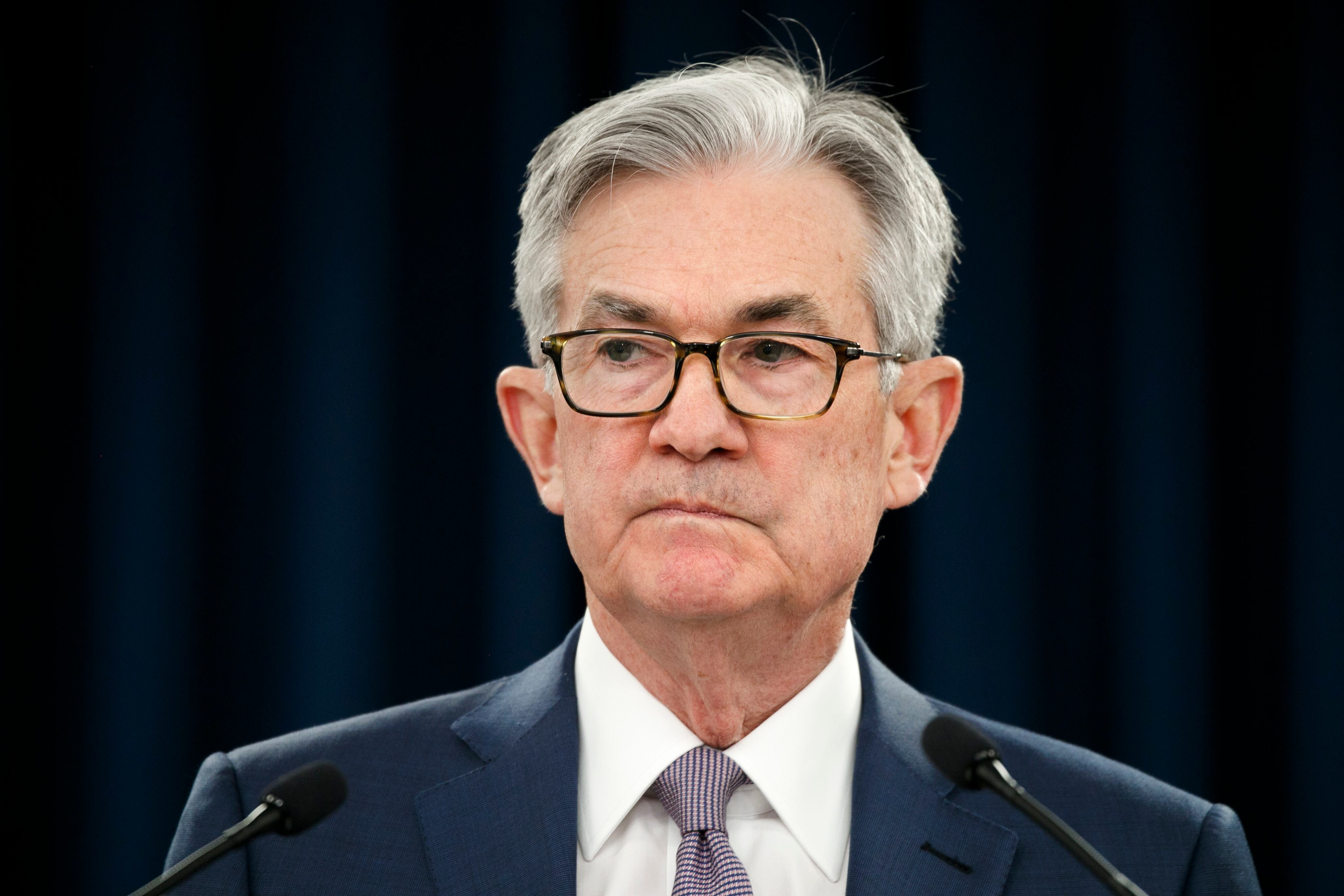
In this March 3, 2020 file photo, Federal Reserve Chair Jerome Powell pauses during a news conference in Washington. Powell provided a bleak outlook for the U.S. economy in remarks Wednesday, May 13, and urged Congress and the White House to act further to offset the damage from the viral outbreak. (AP Photo/Jacquelyn Martin, File)
By Christopher Rugaber
Federal Reserve Chair Jerome Powell warned Wednesday of the threat of a prolonged recession resulting from the worldwide COVID-19 outbreak and urged Congress and the White House to act further to prevent long-lasting economic damage.
The Fed and Congress have taken far-reaching steps to try to counter what is likely to be a severe downturn resulting from the widespread shutdown of the U.S. economy. But Powell cautioned that widespread bankruptcies among small businesses and extended unemployment for many people remain a serious risk.
“We ought to do what we can to avoid these outcomes,” Powell said.
Additional rescue aid from government spending or tax policies, though costly, would be “worth it if it helps avoid long-term economic damage and leaves us with a stronger recovery,” he said.
Powell spoke a day after House Speaker Nancy Pelosi, a California Democrat, proposed a $3 trillion aid package that would direct money to small businesses, state and local governments and other beleaguered institutions. This money would come on top of roughly $3 trillion in earlier financial assistance that the government has provided. The Fed itself has also intervened by slashing interest rates to near zero and creating numerous emergency lending programs.
Yet Trump administration officials have said they want to see how previous aid packages affect the economy. And Republican leaders in Congress have expressed skepticism about allowing significantly more spending right now.
“Deeper and longer recessions can leave behind lasting damage to the productive capacity of the economy,” the chairman warned in his prepared remarks before holding an online discussion with the Peterson Institute for International Economics. “Avoidable household and business insolvencies can weigh on growth for years to come.”
He said the Fed would “continue to use our tools to their fullest” until the viral outbreak subsides, but he gave no hint of what the Fed's next steps might be.
Powell repeated his previous warnings that the Fed can lend money to solvent companies to help carry them through the crisis. But a longer downturn could threaten to bankrupt previously healthy companies without more help from the government.
Powell’s downbeat view contrasted with a speech Monday by Charles Evans, president of the Federal Reserve Bank of Chicago. Evans sketched a more upbeat outlook and suggested that “it’s reasonable to assume a legitimate return to growth in the second half” of this year and into 2021.
In his remarks Wednesday, the Fed chairman underscored some of the harsh impacts of the recession. Among those working in February, nearly 40 percent of households earning less than $40,000 a year lost a job in March, Powell said.
Wealthfront’s CFO Alan Iberman talks the $2.05B IPO and the major moment for robo banking as the company bets on AI, automation, and “self-driving money."
A rare magnum of Dom Pérignon Vintage 1961 champagne that was specially produced for the 1981 wedding of Prince Charles and Lady Diana has failed to sell during an auction. Danish auction house Bruun Rasmussen handled the bidding Thursday. The auction's house website lists the bottle as not sold. It was expected to fetch up to around $93,000. It is one of 12 bottles made to celebrate the royal wedding. Little was revealed about the seller. The auction house says the bids did not receive the desired minimum price.
The New York Times and President Donald Trump are fighting again. The news outlet said Wednesday it won't be deterred by Trump's “false and inflammatory language” from writing about the 79-year-old president's health. The Times has done a handful of stories on that topic recently, including an opinion column that said Trump is “starting to give President Joe Biden vibes.” In a Truth Social post, Trump said it might be treasonous for outlets like the Times to do “FAKE” reports about his health and "we should do something about it.” The Republican president already has a pending lawsuit against the newspaper for its past reports on his finances.
OpenAI has appointed Slack CEO Denise Dresser as its first chief of revenue. Dresser will oversee global revenue strategy and help businesses integrate AI into daily operations. OpenAI CEO Sam Altman recently emphasized improving ChatGPT, which now has over 800 million weekly users. Despite its success, OpenAI faces competition from companies like Google and concerns about profitability. The company earns money from premium ChatGPT subscriptions but hasn't ventured into advertising. Altman had recently announced delays in developing new products like AI agents and a personal assistant.
President Donald Trump says he will allow Nvidia to sell its H200 computer chip used in the development of artificial intelligence to “approved customers” in China. Trump said Monday on his social media site that he had informed China’s leader Xi Jinping and “President Xi responded positively!” There had been concerns about allowing advanced computer chips into China as it could help them to compete against the U.S. in building out AI capabilities. But there has also been a desire to develop the AI ecosystem with American companies such as chipmaker Nvidia.