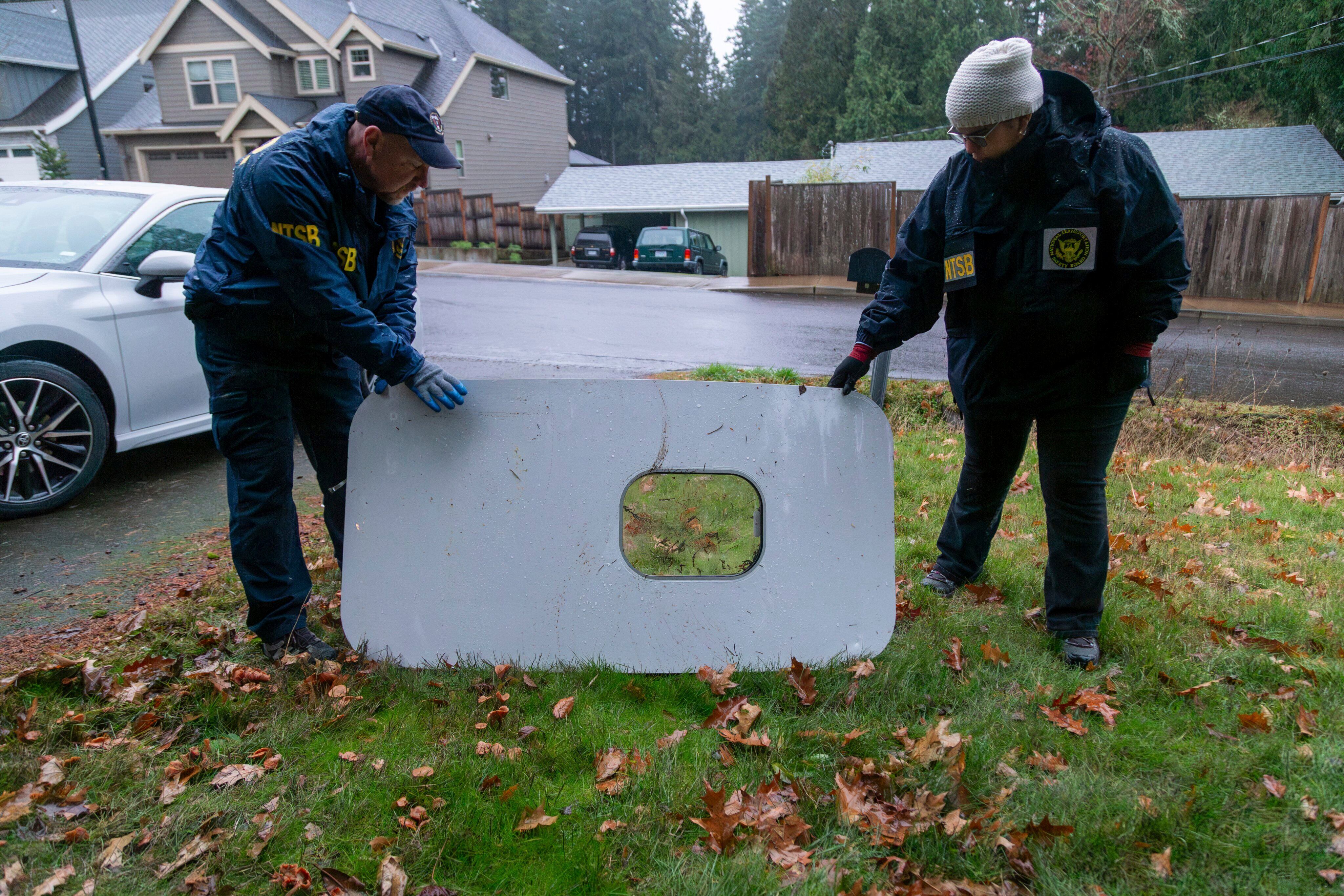
This photo released by the National Transportation Safety Board shows the door plug from Alaska Airlines Flight 1282 on Monday, Jan. 8, 2024, in Portland, Ore. A panel used to plug an area reserved for an exit door on the Boeing 737 Max 9 jetliner blew out Jan. 5, shortly after the flight took off from Portland, forcing the plane to return to Portland International Airport. (National Transportation Safety Board via AP)
Federal officials are investigating whether Boeing failed to make sure a panel that blew off a jetliner in midflight last week was safe and manufactured to meet the design that regulators approved.
The Federal Aviation Administration said Thursday that the investigation is focusing on plugs used to fill spots for extra exits when those doors are not required on Boeing 737 Max 9 jetliners.
The plug that blew off an Alaska Airlines Max 9 was found near Portland, Oregon, and will be be examined in a government laboratory.
“This incident should have never happened and it cannot happen again,” the FAA said in a statement. “Boeing’s manufacturing practices need to comply with the high safety standards they’re legally accountable to meet.”
The FAA notified Boeing of the investigation in a letter dated Wednesday and asked it to respond within 10 business days.
The agency said Boeing's response should include “the root cause of the encountered condition(s)" and steps the company is taking to prevent a recurrence.
The FAA has grounded Max 9 jets, including all 65 operated by Alaska and 79 used by United Airlines until Boeing can develop inspection guidelines and planes can be examined. Alaska has canceled all flights by Max 9s through Saturday.
Investigators with the National Transportation Safety Board said this week they have not been able to find four bolts that are used to help secure the 63-pound door plug. They are not sure whether the bolts were there before the plane took off.
Despite a hole in the side of the plane, pilots were able to return to Portland and make an emergency landing. No serious injuries were reported.

Some small grocery stores and neighborhood convenience stores are eager for the U.S. government shutdown to end and for their customers to start receiving federal food aid again. Late last month, the Trump administration froze funding for the SNAP benefits that about 42 million Americans use to buy groceries. The U.S. Department of Agriculture says about 74% of the assistance was spent last year at superstores like Walmart and supermarkets like Kroger. Around 14% went to smaller stores that are more accessible to SNAP beneficiaries. A former director of the United Nations World Food Program says SNAP is not only a social safety net for families but a local economic engine that supports neighborhood businesses.
Andy Baehr, Head of Product at CoinDesk Indices, breaks down crypto’s Black Friday crash, Bitcoin dipping under $100K, and what’s driving the market rout.
Billionaire Warren Buffett warned shareholders Monday that many companies will fare better than his Berkshire Hathaway in the decades ahead as Father Time catches up
Chris Marquette of POLITICO breaks down how the FAA is cutting flights and facing a critical shortage of air‑traffic controllers amid the government shutdown.
Dr. Manuele Aufiero, CEO & Co‑Founder of Sizable En a groundbreaking undersea energy‑storage technology powering the global shift to clean, scalable power.
Paul Fipps, President of Global Customer Operations at ServiceNow, breaks down the company’s earnings beat, 5‑for‑1 stock split and booming enterprise AI demand