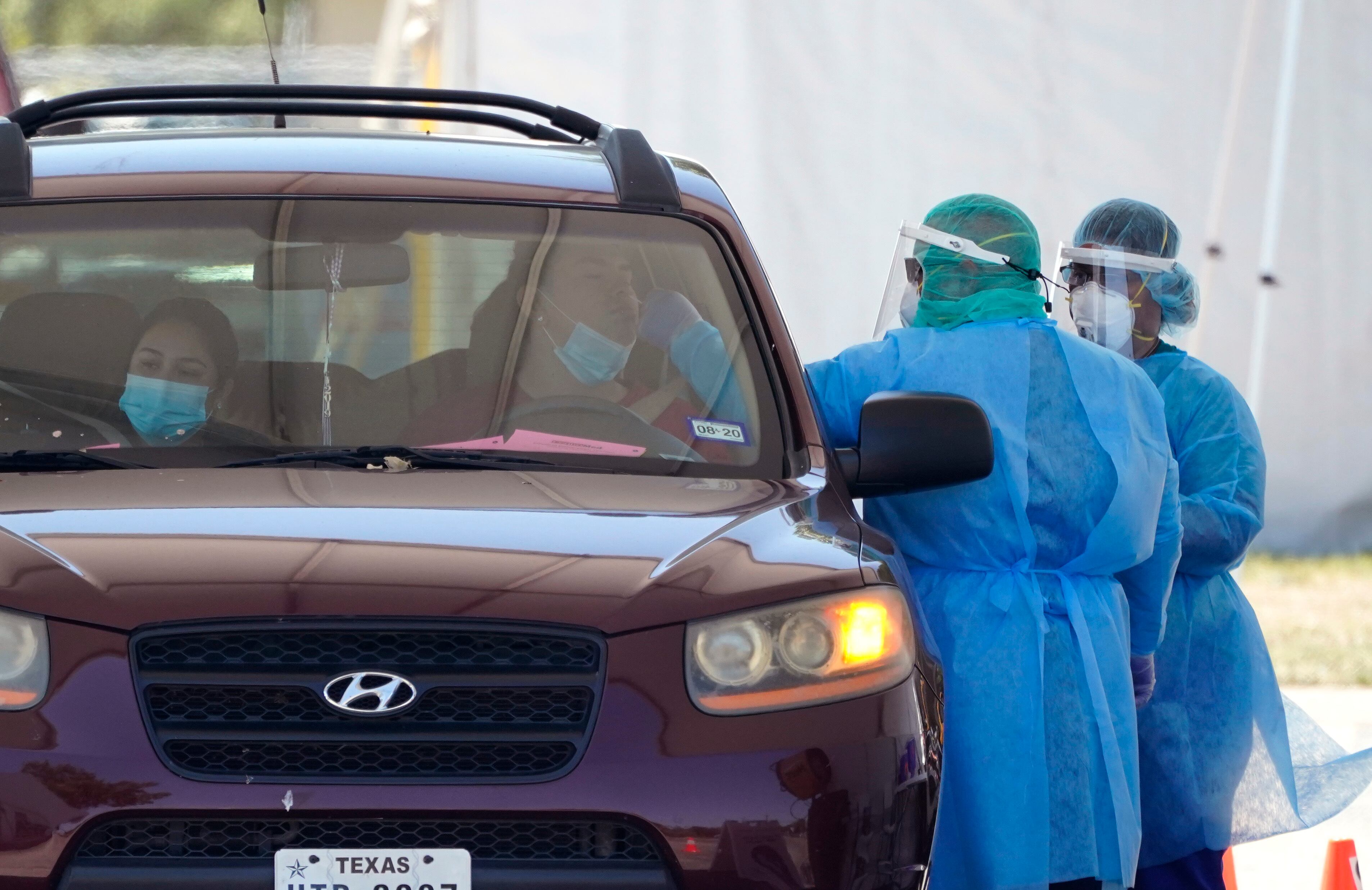
In this Aug. 14, 2020, file photo, medical personnel administer COVID-19 testing at a drive-thru site in San Antonio. The number of Americans newly diagnosed with the coronavirus is falling — a development experts credit at least partly to increased wearing of masks — even as the outbreak continues to claim nearly 1,000 lives in the U.S. each day. (AP Photo/Eric Gay, File)
By Carla K. Johnson and Adam Geller
The number of Americans newly diagnosed with the coronavirus is falling — a development experts credit at least partly to increased wearing of masks — even as the outbreak continues to claim nearly 1,000 lives in the U.S. each day.
About 43,000 new cases are being reported daily across the country, down 21 percent from early August, according to data compiled by Johns Hopkins University. While the U.S., India, and Brazil still have the highest numbers of new cases in the world, the downward trend is encouraging.
"It's profoundly hopeful news," said Dr. Monica Gandhi, an infectious-diseases expert at the University of California, San Francisco, who credits the American public's growing understanding of how the virus spreads, more mask-wearing and, possibly, an increasing level of immunity.
"Hopefully all those factors are coming into play to get this virus under control in this country that's really been battered by the pandemic," she said.
The virus is blamed for more than 5.7 million confirmed infections and about 178,000 deaths in the U.S. Worldwide, the death toll is put at more than 810,000, with about 23.7 million cases.
Jeffrey Shaman, a public health expert at Columbia University, said he is skeptical enough people are immune to significantly slow the spread. But he agreed that changes in Americans' behavior could well be making a difference, recalling the impact that people's actions had in containing Ebola in West Africa several years ago.
"Ebola stopped for reasons we didn't anticipate at the time. It was so horrifying that people stopped touching each other," Shaman said. Something similar may be happening with the coronavirus, he said.
"I know I don't have nearly the number of contacts that I used to," Shaman said. "But if we relax that, if we get complacent, will we just see another outbreak?"
The decline in newly reported cases in the U.S. comes even as deaths from the virus remain alarmingly high. Over the past two weeks, officials have reported an average of 965 deaths a day from COVID-19, down from 1,051 a day in early August.
Deaths from the coronavirus are a lagging indicator — they trail new infections because of the time it takes for people to get sick and succumb to the disease.
The percentage of tests coming back positive for the disease has also declined over the past two weeks, from 7.3 percent to 6.1 percent. But that comes as the total number of tests administered has fallen from its August peak of more than 820,000 a day, leveling off in recent weeks at about 690,000 a day.
The situation has improved dramatically in several states that struggled with high caseloads earlier this summer.
In Arizona, for example, officials reported 859 new cases Tuesday, down from a peak of 5,500 in late June. More than 2,000 people arrived at the state's hospitals showing symptoms of the virus on a single day in early July. This week, that number has been less than 1,000.
In Florida, where more than 10,000 people have died, the state reported 2,600 new virus cases Tuesday. Earlier in the summer, it was regularly reporting more than 10,000 new cases.
Malinda Coler, 37, of San Francisco, said she has been diligent about mask wearing and other preventive measures, less to protect herself than a best friend who has a compromised immune system, with severe arthritis psoriasis.
"So I wear a damned mask and get infuriated when others don't," she said.
It's not clear what will happen to case numbers as more school districts bring students back to classrooms and colleges reopen their campuses. In recent weeks, schools including the University of North Carolina, Michigan State, and Notre Dame have moved instruction online after outbreaks on their campuses.
Officials at the University of Tennessee at Knoxville said Monday that four students are facing disciplinary proceedings after three hosted off-campus parties with no mask or other distancing and another left isolation to meet with others despite testing positive for the virus.
"If the facts reported to the university are accurate, these students will face at least suspension from the university, and potentially greater penalties," Chancellor Donde Plowman wrote.
___
Associated Press writers Mae Anderson, Nicky Forster, and John Zenor contributed to this story.
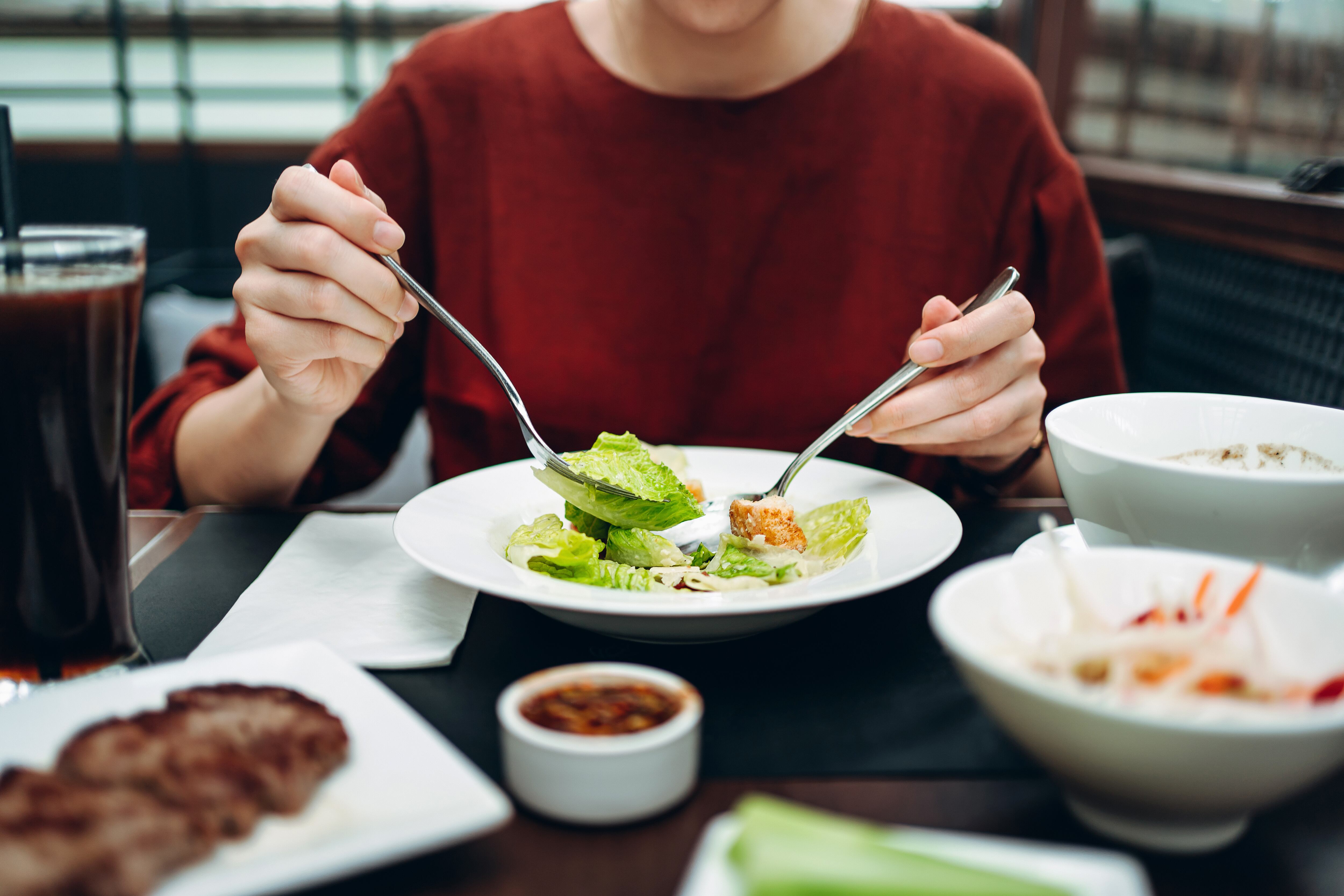
Ellen Fitzsimmons-Craft, assistant professor of psychiatry at Washington University School of Medicine, joins Cheddar News to discuss how chatbots can help prevent eating disorders and the research that uncovered these findings.
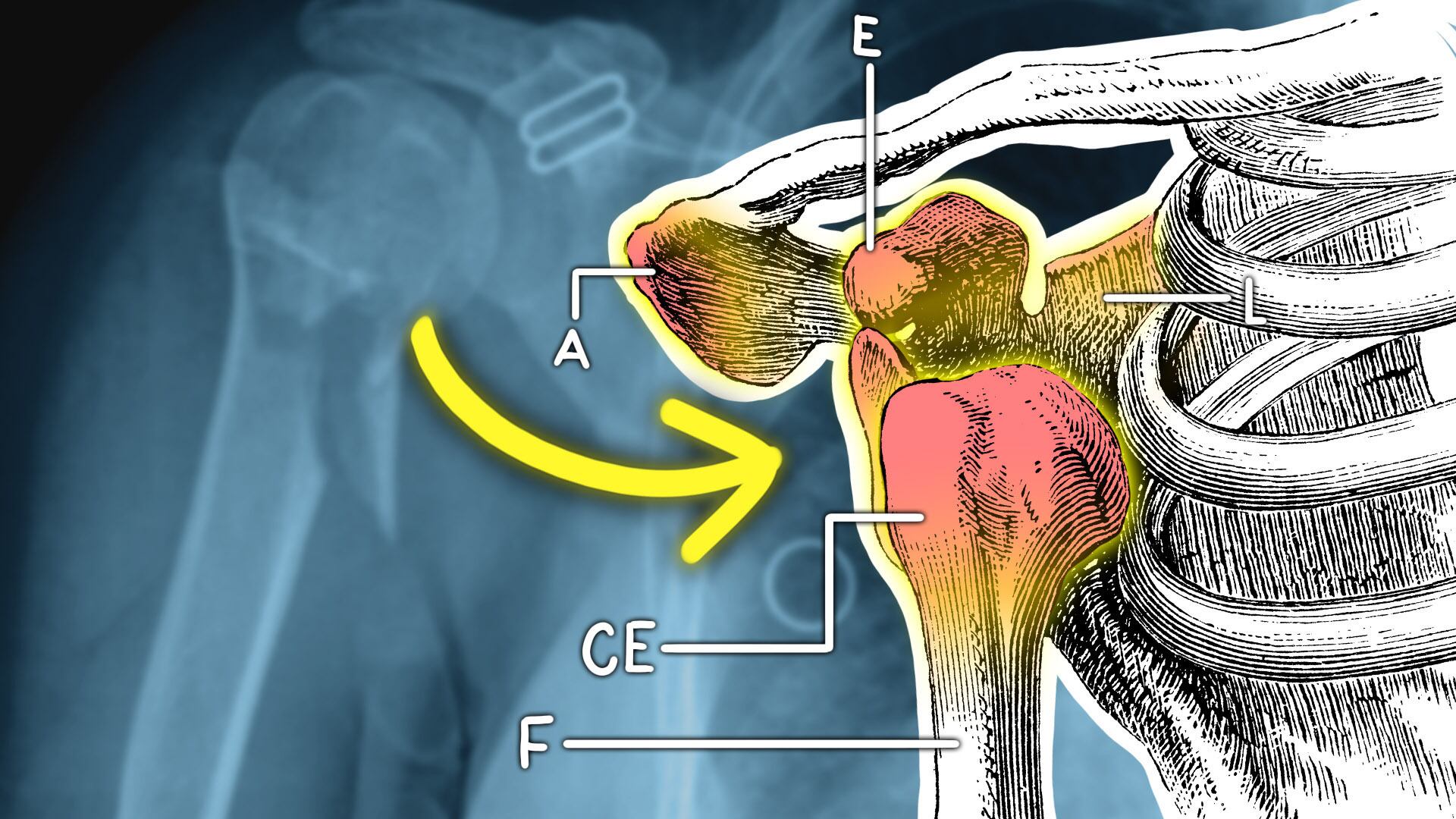
Shoulder injuries are one of the most common orthopedic injuries – and they're also one of the most commonly ignored. But chimpanzees, with whom we share nearly 99% of our DNA, don’t encounter the same issues we do. So why are human shoulders such a design disaster? Well, we can trace the answer back to a very particular moment in our evolution.
As the Omicron variant continues to sweep across the country. The US Supreme Court is expected to hear arguments at the end of this week on whether or not the Biden administration can force private companies to vaccinate or test millions of their employees. In addition, the National Nurses United has spearheaded legal action to protect nurses and health care workers, patients, and the public while on the job. President of the National Nurses Union, Zenei Cortez, joined Cheddar to discuss more.
Digital medical care provider Pear Therapeutics rang the closing bell on the Nasdaq Friday and President and CEO Dr. Corey McCann, joined Cheddar to talk about how the company plans to grow the business of software-based therapeutics and how the first FDA authorized prescription digital therapeutics company will go about treating illnesses like insomnia and addiction. "These really are pieces of software. In many cases, they're apps and in the cases of our addiction products, these are based on something called cognitive behavioral therapy or CBT," he said. "These products change the patient's brain circuitry to help them be abstinent, to help them stay in treatment, and that's exactly what we see in randomized clinical trials and that's what we see in the real world." He also addressed the ongoing mental health crises brought on by the pandemic. **copy updated to remove IPO information as Pear Therapeutics went public in December**
Jake Carbone, senior data analyst at InfluenceMap joins Cheddar News to talk about a new report by The Guardian and InfluenceMap that reveals how companies are creating fossil fuel ads designed to look like Google search results.
Satellite launch service Virgin Orbit has gone public on the Nasdaq via a SPAC merger with NextGen Acquisitions with a valuation of about $3.2 billion. CEO Dan Hart joined Cheddar's "Between Bells" from in front of his LauncherOne rocket in New York City's Times Square to talk about what's next after the IPO, an upcoming "Above the Clouds" mission to deliver commercial and national security payloads, and the benefits of their rockets being launched from commercial 747 aircraft. "We can launch anywhere in the world," he said. "There are almost 80 space agencies across the world, for instance, and about 10 of them have space launch. We can give them a space flight capability overnight by taking a runway and turning it into a spaceport."
The year 2021 saw numerous natural disasters around the world, including extreme heat and wildfires, rare deep freezes, and historic flooding. This year's United Nations COP26 conference was key for getting world leaders on board with emissions reductions and other climate-focused policies as the UN Secretary-General said the agency's report on global warming is a 'code red for humanity.' In the U.S., President Joe Biden has focused most of his domestic agenda on slashing emissions and building climate-focused infrastructure. Guests from The Economist, UNC-Chapel Hill, Global Rescue, and more join Cheddar Climate's year-end special to discuss how the climate changed in 2021, and what to expect in 2022.
Digital mental health company Little Otter recently announced it closed a $22 million Series A round. Little Otter was founded in 2020 by a mother-daughter team, which based the company on the idea that a child's mental health can only be addressed by treating the whole family through technology available to everyone. Little Otter CEO and co-founder Rebecca Egger and her mother, Little Otter Chief Medical and Scientific Officer and co-founder Dr. Helen Egger joined Cheddar News' Closing Bell to discuss.
Among all the other events of the last few years, you may have missed this one: Spermageddon. This is the fun name for the idea that sperm counts among mainly ‘Western’ men are in freefall. The Spermageddon hype began with the publication of a 2017 study showing a nearly 60% drop in overall sperm counts in men living in North America, Europe, Australia, and New Zealand.
But four years later, it seems that Spermageddon has been overblown. By a lot. And all that hype has obscured the real issue behind declining male fertility.
Covid-19 has changed the way we view wellness. Jillian Hughes, communications director of Mental Health America, joins Cheddar News to discuss breaking the stigma around mental health. Justin Davis, CEO and co-founder of Spectrum Labs, weighs in on how social media impacts our wellbeing. Lastly, Precision Nutrition CEO Timothy Jones advices us on what trends to watch in 2022.