By Carla K. Johnson and Adam Geller

The number of Americans newly diagnosed with the coronavirus is falling — a development experts credit at least partly to increased wearing of masks — even as the outbreak continues to claim nearly 1,000 lives in the U.S. each day.

About 43,000 new cases are being reported daily across the country, down 21 percent from early August, according to data compiled by Johns Hopkins University. While the U.S., India, and Brazil still have the highest numbers of new cases in the world, the downward trend is encouraging.

"It's profoundly hopeful news," said Dr. Monica Gandhi, an infectious-diseases expert at the University of California, San Francisco, who credits the American public's growing understanding of how the virus spreads, more mask-wearing and, possibly, an increasing level of immunity.

"Hopefully all those factors are coming into play to get this virus under control in this country that's really been battered by the pandemic," she said.

The virus is blamed for more than 5.7 million confirmed infections and about 178,000 deaths in the U.S. Worldwide, the death toll is put at more than 810,000, with about 23.7 million cases.

Jeffrey Shaman, a public health expert at Columbia University, said he is skeptical enough people are immune to significantly slow the spread. But he agreed that changes in Americans' behavior could well be making a difference, recalling the impact that people's actions had in containing Ebola in West Africa several years ago.

"Ebola stopped for reasons we didn't anticipate at the time. It was so horrifying that people stopped touching each other," Shaman said. Something similar may be happening with the coronavirus, he said.

"I know I don't have nearly the number of contacts that I used to," Shaman said. "But if we relax that, if we get complacent, will we just see another outbreak?"

The decline in newly reported cases in the U.S. comes even as deaths from the virus remain alarmingly high. Over the past two weeks, officials have reported an average of 965 deaths a day from COVID-19, down from 1,051 a day in early August.

Deaths from the coronavirus are a lagging indicator — they trail new infections because of the time it takes for people to get sick and succumb to the disease.

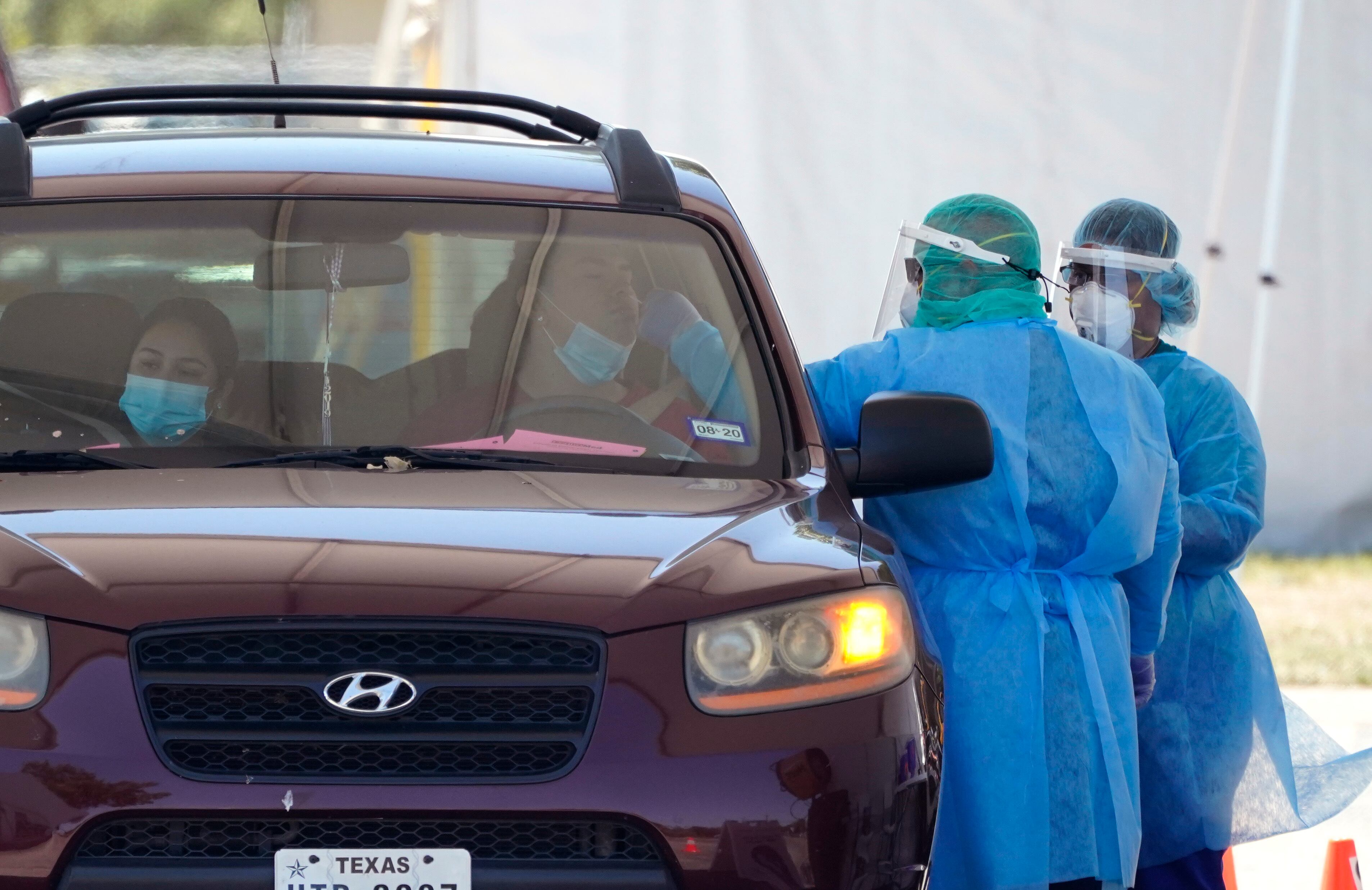
The percentage of tests coming back positive for the disease has also declined over the past two weeks, from 7.3 percent to 6.1 percent. But that comes as the total number of tests administered has fallen from its August peak of more than 820,000 a day, leveling off in recent weeks at about 690,000 a day.

The situation has improved dramatically in several states that struggled with high caseloads earlier this summer.

In Arizona, for example, officials reported 859 new cases Tuesday, down from a peak of 5,500 in late June. More than 2,000 people arrived at the state's hospitals showing symptoms of the virus on a single day in early July. This week, that number has been less than 1,000.

In Florida, where more than 10,000 people have died, the state reported 2,600 new virus cases Tuesday. Earlier in the summer, it was regularly reporting more than 10,000 new cases.

Malinda Coler, 37, of San Francisco, said she has been diligent about mask wearing and other preventive measures, less to protect herself than a best friend who has a compromised immune system, with severe arthritis psoriasis.

"So I wear a damned mask and get infuriated when others don't," she said.

It's not clear what will happen to case numbers as more school districts bring students back to classrooms and colleges reopen their campuses. In recent weeks, schools including the University of North Carolina, Michigan State, and Notre Dame have moved instruction online after outbreaks on their campuses.

Officials at the University of Tennessee at Knoxville said Monday that four students are facing disciplinary proceedings after three hosted off-campus parties with no mask or other distancing and another left isolation to meet with others despite testing positive for the virus.

"If the facts reported to the university are accurate, these students will face at least suspension from the university, and potentially greater penalties," Chancellor Donde Plowman wrote.

___

Associated Press writers Mae Anderson, Nicky Forster, and John Zenor contributed to this story.

Share:
More In Science
Amazon Funds Amogy to Commercialize Ammonia-Powered Cargo-Shipping Vessels, Decarbonize Transportation
Amazon is betting that ammonia could be the fuel of the future, participating in a Series A round for the Brooklyn-based company Amogy in December. Amogy aims to de-carbonize transportation with a clean energy system that uses ammonia as a renewable fuel. Amogy is partnering with Amazon on its first commercial product - an ammonia-powered cargo-shipping vessel. Amogy CEO Seonghoon Woo joins Cheddar Climate to discuss.
Congressional Democrats Demand Answers From Crypto Miners Over Environmental Impact
Cryptocurrency is expected to become a part of our daily lives — but what sort of environmental impact does it have? As the U.S. becomes the crypto mining capital of the world, climate advocates are worried about mining companies reopening old coal plants, using massive amounts of energy, wasteful hardware, and more. Congressional Democrats led by Senator Elizabeth Warren are demanding answers from mining firms about their electricity use and waste levels. John Belizaire, CEO of Soluna Computing, joins Cheddar Climate to discuss the congressional letters, how crypto mining can become a green industry, and more.
Indirect Driver Assistance Monitoring Significantly Worse Than Camera-Based Systems: Report
Driver assistance monitoring systems are meant to keep the driver's eyes on the road, but according to a report from AAA, different ways of monitoring provide significantly different results. The study found that direct camera-based systems that scanned the driver's eye movements were faster and more reliable than those indirect systems that looked at steering-wheel input. Megan McKernan, the manager of automotive services for the Automobile Club of Southern California, joined Cheddar to discuss the findings. "Triple-A is recommending that automakers include both direct and indirect systems just to really prevent consumers from trying to misuse these systems," she said, noting that neither system on its own is not foolproof.
Wave Neuroscience Tech Looks to Improve Brain Care for Pro Athletes
Wave Neuroscience is a neurological health tech company that specializes in clinical and at-home personalized brain stimulation technology. Erik Won, president and chief medical officer and Fred Walke, CEO, joined Cheddar's Opening Bell to discuss their company's hopes for allowing patients to identify and treat unique brain disorders while empowering them to understand their unique neurological makeups — including for the high-stress positions of professional athletes. "We have a mobile device that provides a very light stimulation that gives them a therapy that gives them confidence so there's a just knowing that they're doing something for it," said Walke. "But it also helps them get back into a rhythm. It helps their brain synchronize around certain frequencies that that we target, and it helps them really understand that they've done everything they can to get to their highest level of success."
Lawmakers Look Into Bitcoin Mining Companies' Energy Use
Democratic lawmakers are now calling on Bitcoin mining companies in the U.S. to assess how much electricity they use and how it could all potentially impact residents and the environment in the near future. Since its conception, crypto mining has been at the center of a debate. The question is: Is crypto mining playing a key role in renewable energy or could it totally derail U.S. climate goals? Host of The Wendy O show Wendy O, joined Cheddar to discuss more.
Athletic Greens Raises $115 Million to Expand Footprint of Nutritional Drink
Nutritional supplement beverage company Athletic Greens has achieved unicorn status. The company announced a new $115 million funding round, bringing its valuation to $1.2 billion. The company's flagship product AG1 combines 75 different vitamins, minerals, and other nutrients into one daily serving. Athletic Greens says it is poised to reach the millions of consumers who are currently driving the health and wellness market's exponential growth. Athletic Greens founder and CEO Chris Ashenden joins Cheddar News' Closing Bell to discuss.
Northeast Recovering From Weekend Snow Storm
A powerful winter storm hit the Northeast over the weekend leaving 100,000 New Yorkers in the dark as well as snowfall up to 30.9 inches in parts of Massachusetts. The nor'easter hit with blizzard conditions of wind speed and poor visibility.
Load More