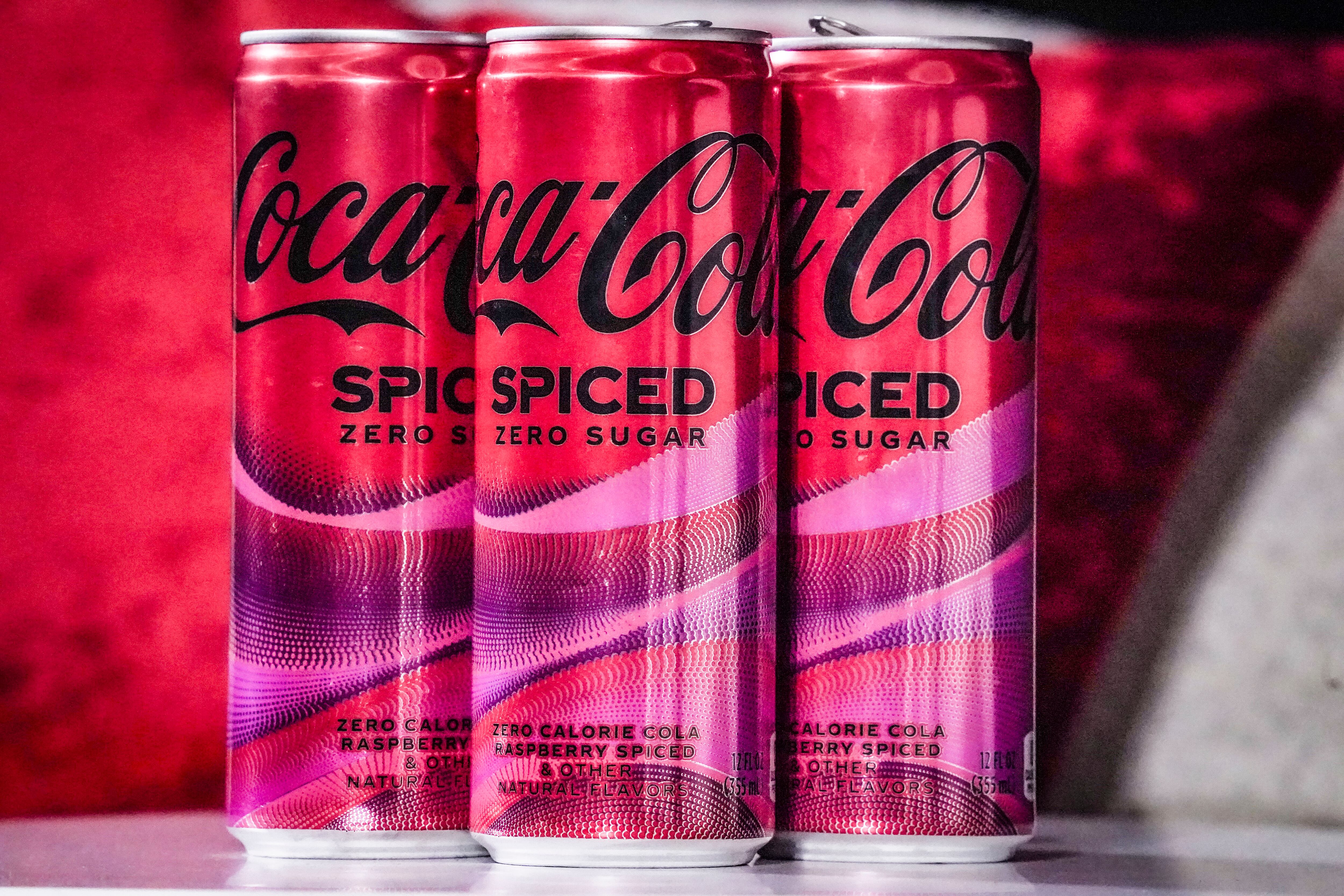
Cans of Coca-Cola Spiced, the beverage company's first new permanent offering to its North American portfolio in three years, are introduced at a livestream media event, Tuesday, Feb. 6, 2024, in New York. (AP Photo/Bebeto Matthews)
From Flamin’ Hot Cheetos to Sweet Heat Starburst, America’s snacks are getting spicier. Now, Coca-Cola wants in on the trend.
On Wednesday, the Atlanta beverage giant introduced Coca-Cola Spiced, the first new permanent offering to its North American portfolio in three years. Coca-Cola Spiced and Coca-Cola Spiced Zero Sugar will go on sale in the U.S. and Canada on Feb. 19.
Coca-Cola Spiced doesn’t have a lot of heat. The main flavor drinkers will notice is a hint of raspberry. Coke won’t name the spices it added – it guards its recipes closely – but they taste like amped-up versions of the spices in regular Coke.
“If you go to the aisles, you’ll see the amount of spiciness has gone up because consumers’ taste palettes have evolved. We realized that could be an opportunity for us,” Coca-Cola’s North American marketing chief Shakir Moin told The Associated Press in a recent interview. “Can we dial up something which is already part of our formula and bring in a taste profile that is interesting, unique, and brings in the next generation of consumers?”
Coke has been exploring ways to get younger drinkers excited about its signature cola. In 2022, it launched Coca-Cola Creations, a series of eight limited-edition Coke flavors in colorful cans and bottles. Coke experimented with adding hints of coconut, strawberry, watermelon and other flavors to the drinks.
The latest example, Coca-Cola Happy Tears, contains salt and mineral flavors. It will be sold only through TikTok on Feb. 17 in the U.S. and Great Britain.
Moin said customer research for Coca-Cola Creations fed into the development of Coca-Cola Spiced. It usually takes Coca-Cola at least a year to develop a new beverage, he said, but Coca-Cola Spiced took just seven weeks. Moin said the company hopes to replicate that speed with future new products.
“Consumers are moving faster. The market is moving forward faster. We’ve got to be faster than the speed of the market,” he said.
Orangetheory Fitness is redefining the future of workouts with smarter tech, strength-based programming, and community-driven studios built for what’s next.
Spain's government has fined Airbnb 64 million euros or $75 million for advertising unlicensed tourist rentals. The consumer rights ministry announced the fine on Monday. The ministry stated that many listings lacked proper license numbers or included incorrect information. The move is part of Spain's ongoing efforts to regulate short-term rental companies amid a housing affordability crisis especially in popular urban areas. The ministry ordered Airbnb in May to remove around 65,000 listings for similar violations. The government's consumer rights minister emphasized the impact on families struggling with housing. Airbnb said it plans to challenge the fine in court.
Roomba maker iRobot has filed for Chapter 11 bankruptcy protection, but says that it doesn’t expect any disruptions to devices as the more than 30-year-old company is taken private under a restructuring process. iRobot said that it is being acquired by Picea through a court-supervised process. Picea is the company's primary contract manufacturer. The Bedford, Massachusetts-based anticipates completing the prepackaged chapter 11 process by February.
Serbia’s prosecutor for organized crime has charged a government minister and three others with abuse of position and falsifying of documents related to a luxury real estate project linked to U.S. President Donald Trump’s son-in-law Jared Kushner. The charges came on Monday. The investigation centers on a controversy over a a bombed-out military complex in central Belgrade that was a protected cultural heritage zone but that is facing redevelopment as a luxury compound by a company linked to Kushner. The $500 million proposal to build a high-rise hotel, offices and shops at the site has met fierce opposition from experts at home and abroad. Selakovic and others allegedly illegally lifted the protection status for the site by falsifying documentation.
Wealthfront’s CFO Alan Iberman talks the $2.05B IPO and the major moment for robo banking as the company bets on AI, automation, and “self-driving money."
A rare magnum of Dom Pérignon Vintage 1961 champagne that was specially produced for the 1981 wedding of Prince Charles and Lady Diana has failed to sell during an auction. Danish auction house Bruun Rasmussen handled the bidding Thursday. The auction's house website lists the bottle as not sold. It was expected to fetch up to around $93,000. It is one of 12 bottles made to celebrate the royal wedding. Little was revealed about the seller. The auction house says the bids did not receive the desired minimum price.


