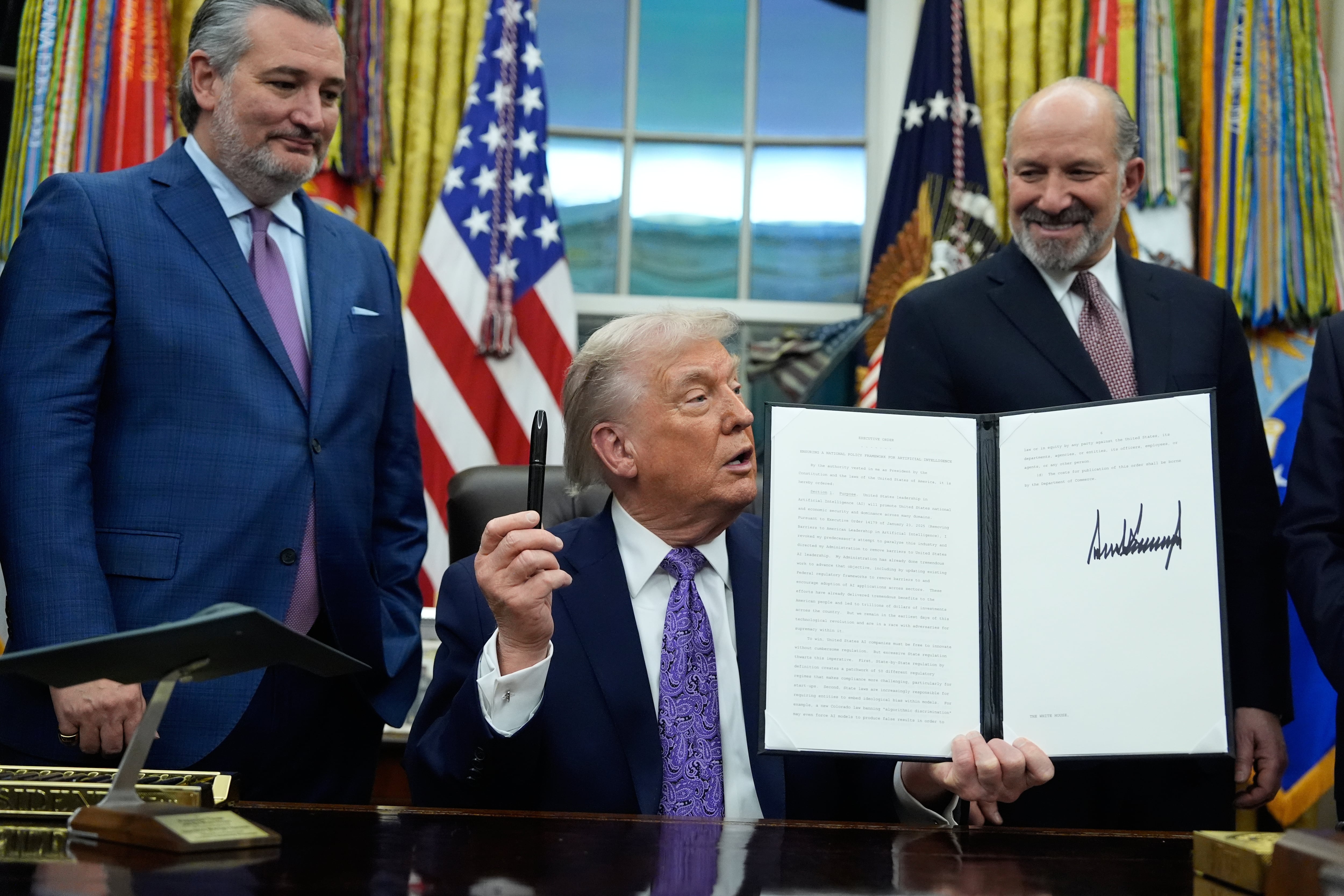
WASHINGTON (AP) — The chairman of a House committee that pushed for the law demanding TikTok be spun off from its Chinese owners has requested an urgent briefing from the White House, one day after Trump signed an executive order supporting a proposed deal that would put the popular social video platform under U.S. ownership.
In a statement released Friday, Rep. John Moolenaar, the chairman of the Select Committee on the Chinese Communist Party, praised the proposed deal as “an important step” in transitioning ownership of the TikTok platform to American hands but he emphasized that “divestment was not the law’s only requirement.”
“The law also set firm guardrails that prohibit cooperation between ByteDance and any prospective TikTok successor on the all-important recommendation algorithm, as well as preclude operational ties between the new entity and ByteDance,” Moolenaar said.
The Michigan Republican’s statement marks the first congressional effort to conduct oversight into the negotiations over TikTok, coming nearly two weeks after Chinese and American officials met in Spain to discuss a framework divestment deal for TikTok. Trump on Thursday signed an executive order providing support for the deal, and said Chinese President Xi Jinping agreed to move forward with negotiations.
The White House didn’t immediately respond to an inquiry from the Associated Press regarding the urgent briefing.
It’s more than the algorithm
Much is still unknown about the actual deal in the works, but the new U.S. venture would license the famed ByteDance-owned algorithm that currently keeps TikTok users engaged. U.S. tech giant Oracle, a confirmed partner in the U.S. investment consortium that would own TikTok, would audit the copy of the algorithm and monitor it for security purposes.
Vice President JD Vance on Thursday assured the public that the deal would not only keep TikTok operating but also protect Americans’ data privacy as required by law. Moolenaar on Friday said he would like to know more.
While algorithms are valuable assets, the real value of TikTok is its users, which is likely why the consortium won’t just start from scratch to build a new app, said computer scientist Bart Knijnenburg, an associate professor at Clemson University who has studied how recommendation systems steer people to online content.
Knijnenburg said all algorithms are biased in some way and if the administration is serious about retraining the TikTok algorithm to avoid Chinese influence, it should push for “radical openness” in TikTok’s mechanics so that users have a window into how bias might be influencing their feeds.
More than politics, Knijnenburg said the biggest problem with TikTok’s algorithm is that it’s geared toward addictive engagement and overuse.
“Moving it to the U.S. is not going to magically solve these types of problems,” he said. “Any company might put undue influence on these applications and from a business perspective, the best way to engage users is to make them addicted to watching these videos, which is not a good idea.”
ByteDance’s representation in the new venture
Craig Singleton, senior China fellow at the Washington-based think tank Foundation for Defense of Democracies, doubts that the deal, as revealed so far, complies with the law.
“The law is clear: divestiture means severance, not supervision,” Singleton said. “A board seat for ByteDance or any continued role in maintaining the algorithm would flout Congress’s mandate.”
Though the details have yet to be finalized, the U.S. investment group’s controlling stake in the new venture would be around 80%. While ByteDance is expected to have a stake in the new venture, it would be less than 20% — a portion of the ownership reserved for foreign investors. The board running the new platform would be controlled by U.S. investors. ByteDance will be represented by one person on the board, but that individual will be excluded from any security-related matters.
Singleton argues that a board foothold by ByteDance is not merely symbolic. “ByteDance’s reported role as the largest single shareholder in a restructured TikTok U.S. venture, combined with a board seat, ensures continuing Chinese influence over the app,” he said. “Plainly put, ByteDance on the board means Beijing in the building.”
Is TikTok undervalued in this deal?
Vance said he expects the new U.S.-based TikTok to be valued at about $14 billion, describing it as a “good deal” for investors who must ultimately decide “what they want to invest in and what they think is the proper value.”
That’s a “surprisingly low” valuation, said Daniel Keum, a management professor at Columbia University’s business school.
Keum said it’s possible that “politics overrode the business case” or that the licensing structure, which hasn’t yet been disclosed, could have been designed with high fees or profit-sharing that depressed the value of TikTok’s app in the U.S.
Keum said TikTok had an early edge in attracting youth to its innovative video-sharing format, but its competitiveness has “fundamentally eroded” as social media creators and influencers increasingly post their videos on many different apps.
As TikTok’s popularity soared among young Americans in the past several years, U.S. lawmakers grew concerned that Beijing — viewed by many on the Capitol Hill as the biggest geopolitical rival to the U.S. — could use the platform to influence public discourse in the United States or spy on its users.
“ByteDance has shown time and again that it is a bad actor, and the Chinese Communist Party’s ultimate goal is to see America divided and weakened,” Moolenaar said in his statement. “That is why, on an overwhelming bipartisan basis, Congress required ByteDance to divest control of TikTok.”
President Joe Biden signed legislation passed by Congress last year that would ban TikTok unless ByteDance sold its U.S. assets to an American company by early this year. The U.S. Supreme Court in January unanimously upheld the TikTok law.
Trump, after he returned to the White House, has repeatedly signed orders that have allowed TikTok to keep operating in the U.S. as his administration tries to reach an agreement for the sale of the company.
On Friday, the Chinese Foreign Ministry didn’t provide any new information but repeated China’s position on TikTok.
“The Chinese government respects the will of enterprises and welcomes them to conduct sound commercial negotiations based on market rules, reaching solutions that comply with Chinese laws and regulations and achieve a balanced outcome of interests,” said Guo Jiakun, a ministry spokesperson. “We hope the U.S. will provide an open, fair, and non-discriminatory business environment for Chinese enterprises investing in the United States.”
__
AP Writer Matt O’Brien contributed to this report