Nearly a year since the first of two 737 Max planes went down, Boeing has begun providing financial compensation to hundreds of bereaved loved ones. Formally launched last week, the Boeing Financial Assistance Fund (BFAF) is set to pay out a total of $50 million to nearly 350 families.
"We are not looking to the financial wherewithal of the family or any passenger lost in those two accidents. All lives are equal and everyone will receive the same amount of money," said Kenneth Feinberg, BFAF's co-administrator.
Each family will get roughly $145,000 from the fund.
Lion Air flight 610, which crashed off the coast of Indonesia on October 29, 2018, was the first 737 Max plane to crash and killed all 189 people on board. Just five months later, 157 people were killed on another 737 Max plane, Ethiopian Airlines flight 302, which went down shortly after takeoff in Ethiopia's capital, Addis Ababa. The back-to-back crashes led to a global grounding of all 737 Max planes, disturbing air travel worldwide.
In the subsequent months, investigators and a company probe found that Boeing did not provide proper training for the plane's anti-stall software, called MCAS, which malfunctioned and sent the planes into nosedives. Federal regulators also came under fire for allowing an easing of inspection scrutiny on new aircrafts at the time.
"The recent 737 MAX tragedies weigh heavily on all of us at Boeing, and we continue to extend our deepest sympathies to the families and loved ones of all those on board," Dennis Muilenburg, Boeing's president and CEO, said in a statement. "The opening of this fund is an important step in our efforts to help affected families."
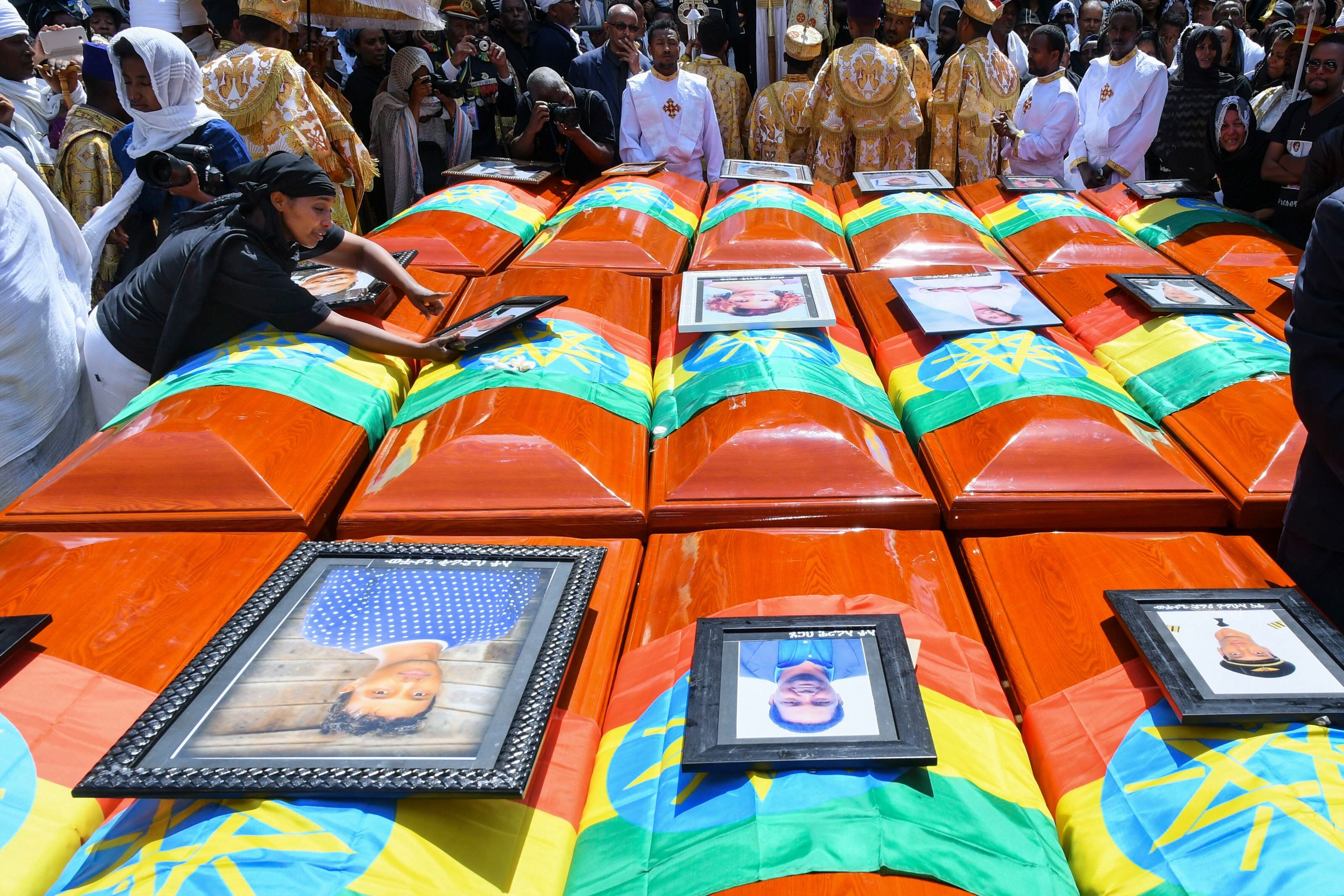
<i>Family members mourn at a burial service for the victims of the Ethiopian Airlines plane crash in Addis Ababa, Ethiopia in March. Photo Credit: STR/EPA-EFE/Shutterstock</i>
Feinberg and co-administrator Camille Biros were hired by Boeing to manage the BFAF. The two veteran attorneys have extensive resumes, having previously administered the September 11th Victim Compensation Fund of 2001, the Gulf Coast Claims Facility for victims of the Deepwater Horizon Oil Spill in 2010, and the One Fund Boston for victims of the 2013 Boston Marathon bombing, among others.
Families can receive the BFAF voluntarily and receiving funds does not bar recipients from pursuing separate damages through litigation.
"This is a separate stand alone assistance program," Feinberg said. Money will be dispersed "without any precondition, without any requirements, without any promises … to be used as each family may so decide."
The $50 million fund is half of the $100 million that Boeing pledged to provide following the two accidents. The other $50 million will be used to support development programs in the impacted communities, Boeing said in a press release.
Ford is recalling more than 355,000 of its pickup trucks across the U.S. because of an instrument panel display failure that’s resulted in critical information, like warning lights and vehicle speed, not showing up on the dashboard.
The Rev. Al Sharpton is set to lead a protest march on Wall Street to urge corporate America to resist the Trump administration’s campaign to roll back diversity, equity and inclusion initiatives. The New York civil rights leader will join clergy, labor and community leaders Thursday in a demonstration through Manhattan’s Financial District that’s timed with the anniversary of the Civil Rights-era March on Washington in 1963. Sharpton called DEI the “civil rights fight of our generation." He and other Black leaders have called for boycotting American retailers that scaled backed policies and programs aimed at bolstering diversity and reducing discrimination in their ranks.
President Donald Trump's administration last month awarded a $1.2 billion contract to build and operate what's expected to become the nation’s largest immigration detention complex to a tiny Virginia firm with no experience running correction facilities.
Chipmaker Nvidia is poised to release a quarterly report that could provide a better sense of whether the stock market has been riding an overhyped artificial intelligence bubble or is being propelled by a technological boom that’s still gathering momentum.
Cracker Barrel said late Tuesday it’s returning to its old logo after critics — including President Donald Trump — protested the company’s plan to modernize.
Low-value imports are losing their duty-free status in the U.S. this week as part of President Donald Trump's agenda for making the nation less dependent on foreign goods. A widely used customs exemption for international shipments worth $800 or less is set to end starting on Friday. Trump already ended the “de minimis” rule for inexpensive items sent from China and Hong Kong, but having to pay import taxes on small parcels from everywhere else likely will be a big change for some small businesses and online shoppers. Purchases that previously entered the U.S. without needing to clear customs will be subject to the origin country’s tariff rate, which can range from 10% to 50%.
Southwest Airlines will soon require plus-size travelers to pay for an extra seat in advance if they can't fit within the armrests of one seat. This change is part of several updates the airline is making. The new rule starts on Jan. 27, the same day Southwest begins assigning seats. Currently, plus-size passengers can pay for an extra seat in advance and later get a refund, or request a free extra seat at the airport. Under the new policy, refunds are still possible but not guaranteed. Southwest said in a statement it is updating policies to prepare for assigned seating next year.
Cracker Barrel is sticking with its new logo. For now. But the chain is also apologizing to fans who were angered when the change was announced last week.