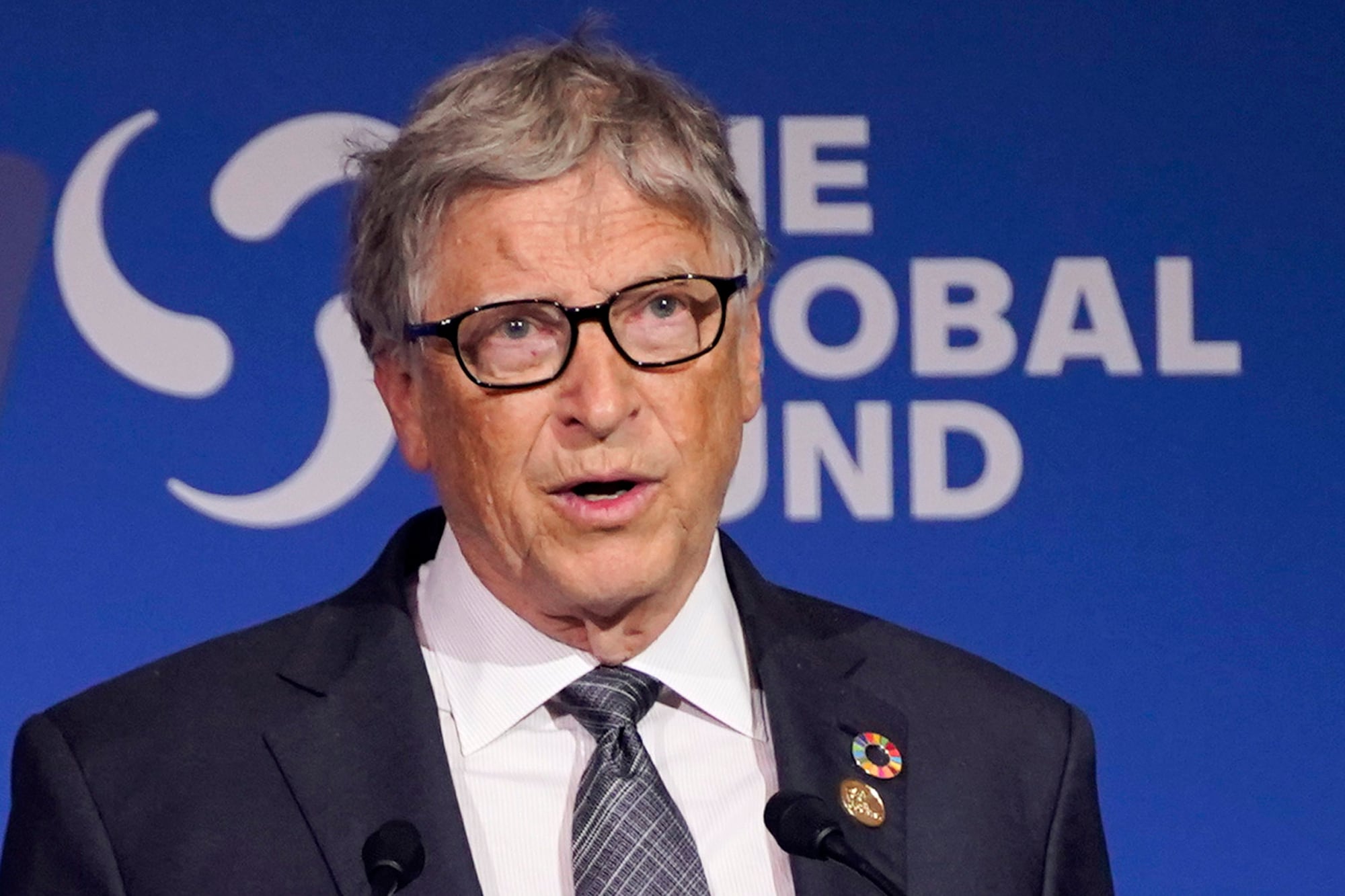
INDIAN WELLS, Ca. (AP) — Bill Gates is pledging 99% of his remaining fortune to the Gates Foundation, which will spend it all within 20 years. The funds will be delivered over time and will allow the foundation to spend another $200 billion by the time it closes in 2045.
“There’s still a little bit more that goes to the kids and some portion that, you know, I won’t be wanting for anything for my consumption,” Gates said. Even his climate-related investments, “all of the profits that come from that work go into the Gates Foundation.”
In interviews with The Associated Press, Gates spoke about the foundation’s past work and future goals. His responses have been edited for length.
On making one of the largest pledges in the history of U.S. philanthropy:
“I hope other people wallop me. Even today, there’s probably a dozen people richer than I am, because I don’t count the money that I’ve already got in the foundation. I have just a bit over $100 billion outside of the foundation. I’d love to be beat in all of this work. Somebody should try and pay more taxes than I did, and save more lives than I did, and give more money than I did, and be smarter than I’ve been.”
On closing the foundation in 2045, earlier than had been planned:
“I think 20 years is the right balance between giving as much as we can to make progress on these things and giving people a lot of notice that now this money will be gone. It will be spent. Hopefully, many of these diseases are eradicated, so nobody even knows, ‘What was malaria? What was polio?’ in the years ahead. You know, some foundations, if they’ve been around 50 or 60 years, who knows how their work relates to the intent of the person who started that foundation? And I do think there’ll be more rich people in the future than there are today. So yes, it will create a vacuum in 20 years, and we’re letting people know way in advance that’s what this will look like.”
On investor Warren Buffett’s annual gifts to the foundation:
“It’s by some measures the most generous gift ever given and a real vote of confidence from Warren, who’s a great friend and has always given me phenomenal advice and is very driven by these inequity issues. And that was in 2006, and so it’s two years later that I give up my full-time work at Microsoft, and I move over. And I’ve been full time at the foundation since 2008 for the rest of my life. It’s my final, second career. You know, Warren, it’s hard to overstate the impact he’s had on me.”
On the Giving Pledge, a commitment for billionaires to give away more than half their wealth, that Gates, Buffett and Melinda French Gates founded in 2010:
“That was a big hope, that the societal expectation for anybody who has a lot of money would be that they give the majority of it away, and that basically everyone would join into that. Now, we’re not at that level, but I think year by year, people are saying, ‘Hey, the fairness of this system, the legitimacy of this system really benefits if those who both through skill and luck, the system has rewarded them, that they put a lot of their resources and even, some of their time and energy into improving society.’”
On cuts to health and foreign aid funding by the U.S. and other countries:
“Many things now are making it less clear how much progress we’ll make in these 20 years we have remaining. The donors are being somewhat less generous as they feel squeezed by an aging population and demands for Ukraine, both refugee costs, defense costs, a lot of things. And so telling the story of the success and the moral and geopolitical value of taking 1% of rich country budgets and saying, ‘No, this is to save lives for very, very, very little money.’ We’re going to have to renew people’s understanding and prioritization of these things in order to keep that piece. We have a lot of things we’re optimistic about because we have new tools, new ways of protecting women from getting HIV, new ways of killing mosquitoes... And so it’s incredible to come up with these low-cost things and tragic if we can’t get them out to everyone who needs them. So, it’s going to require renewing that commitment of those who are well off to help those who are in the greatest need.”
On Melinda French Gates stepping down from the Gates Foundation last year:
“Melinda has made a phenomenal contribution to the foundation, helping us pick the right people and being in partnerships, traveling the world, bringing her perspective to things. I can’t say enough good things about how she got us off on the right track. When we divorced, we hoped — I hoped — that she would choose to stay. She stayed for a period of time, continued to do great work, and then chose to do the philanthropy on her own.”
On criticism of the foundation’s power and the lack of a formal mechanism to incorporate public feedback:
“Our work is for saving children’s lives. So it’s true, if they have other priorities, it’s hard to influence my commitment to not having mothers bleed to death or kids not dying from malaria. To be honest, the number of civil society actors that are in here trying to influence the work we do is so tiny. It’s unbelievable. I mean, I could almost list their names on one piece of paper. Where are these people? We want more people second-guessing our work, criticizing our work. I mean, what’s their idea about malnutrition? What’s their idea on how to deal with these funding cuts? What do they want us to do?”
____
The Associated Press receives financial support for news coverage in Africa from the Gates Foundation and for news coverage of women in the workforce and in statehouses from Melinda French Gates’ organization, Pivotal Ventures.
___
Associated Press coverage of philanthropy and nonprofits receives support through the AP’s collaboration with The Conversation US, with funding from Lilly Endowment Inc. The AP is solely responsible for this content. For all of AP’s philanthropy coverage, visit https://apnews.com/hub/philanthropy.