By Philip Marcelo
It could be a cold, grim New Year for thousands of migrant families living in New York City’s emergency shelter system. With winter setting in, they are being told they need to clear out, with no guarantee they’ll be given a bed elsewhere.
Homeless migrants and their children were limited to 60 days in city housing under an order issued in October by Mayor Eric Adams, a move the Democrat says is necessary to relieve a shelter system overwhelmed by asylum-seekers crossing the southern U.S. border.
That clock is now ticking down for people like Karina Obando, a 38-year-old mother from Ecuador who has been given until Jan. 5 to get out of the former hotel where she has been staying with her two young children.
Where she will end up next is unclear. After that date, she can reapply for admission to the shelter system. A placement might not happen right away. Her family could wind up getting sent to one of the city's huge tent shelters far from where her 11-year-old son goes to school.
“I told my son, ‘Take advantage. Enjoy the hotel because we have a roof right now,’” Obando said in Spanish outside Row NYC, a towering, 1,300-room hotel the city converted into a shelter for migrants in the heart of the theater district. “Because they’re going to send us away and we’re going to be sleeping on the train, or on the street.”
A handful of cities across the U.S. dealing with an influx of homeless migrants have imposed their own limits on shelter stays, citing a variety of reasons, including spiraling costs, a lack of space and a desire to put pressure on people to either find housing on their own, or leave town entirely.
Chicago imposed a 60-day shelter limit last month and is poised to start evicting people in early January. In Massachusetts, Gov. Maura Healey, a Democrat, has capped the number of migrant families in emergency shelters at 7,500.
Denver had limited migrant families to 37 days but paused the policy this month in recognition of winter’s onset. Single adults are limited to 14 days.
In New York, the first families were expected to reach their 60-day limits just days after Christmas, but the mayor’s office said those migrants will receive extensions through early January. Roughly 3,500 families have been issued notices so far.
Unlike most other big cities, New York has a decades-old “ right to shelter ″ obligating the city to provide emergency housing to anyone who asks.
But officials have warned migrants there is no guarantee they will get to stay in the same hotel, or the same city borough, for that matter.
Adult migrants without children are already subject to a shorter limit on shelter stays: 30 days.
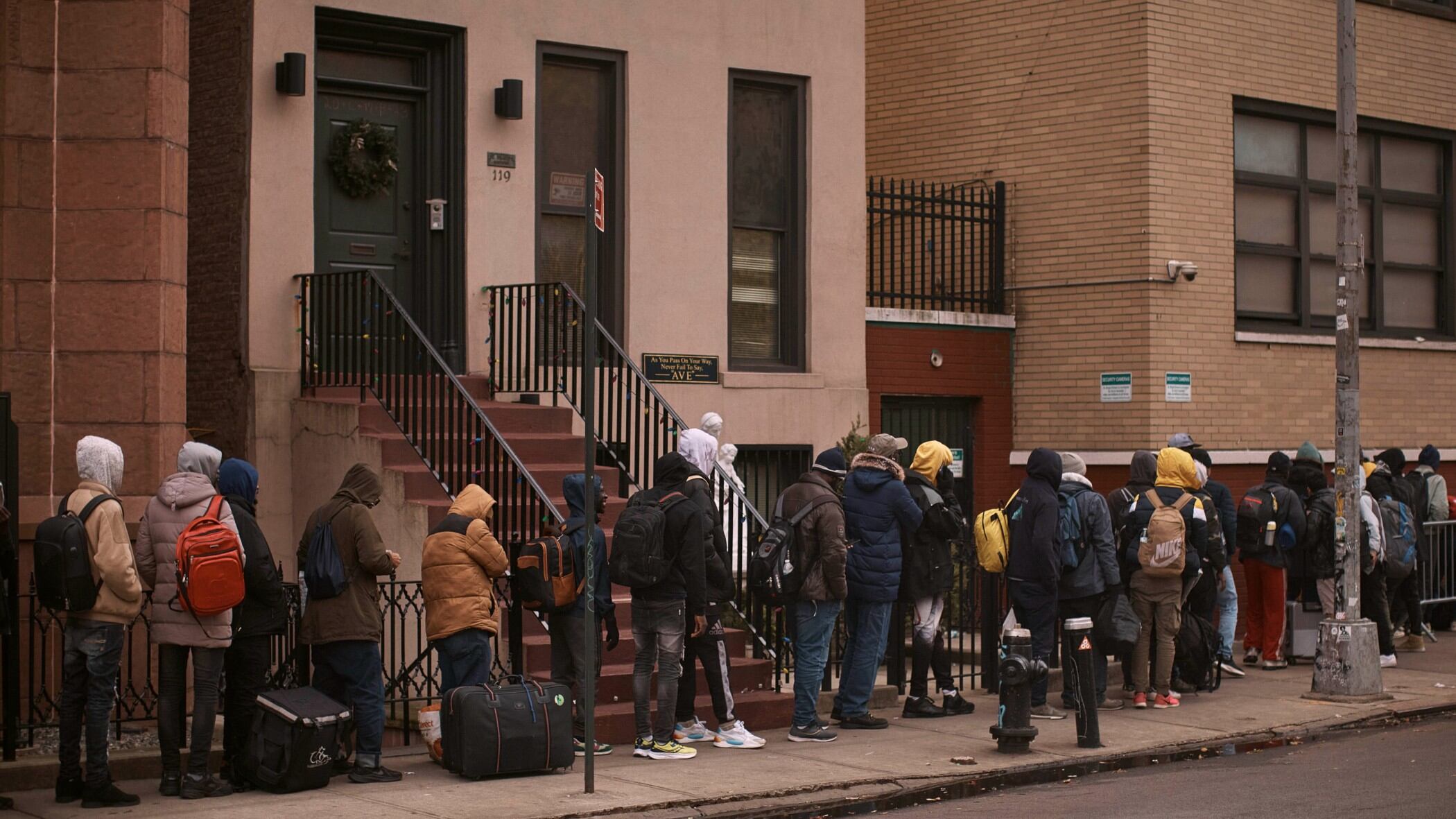
Those who get kicked out and still want help are told to head for the city's so-called “ reticketing center ” that opened in late October in a former Catholic school in Manhattan's East Village.
Dozens of men and women, many with their luggage and other belongings in tow, line up every morning in freezing weather where they must petition for a renewed stay.
They are offered a free, one-way ticket to anywhere in the world. Most people decline.
Some are able to secure another shelter for 30 days, but many others say they leave empty-handed and must line up again the next day to try their luck.
“I’m scared of dying, sleeping on the street,” Barbara Coromoto Monzon Peña, a 22-year-old from Venezuela, said as she spent a second day waiting in line on a recent weekday.
Obando said her eldest son, who is 19, hasn’t been able to find a place to rent since he and his wife exhausted their 30 allowed days at the Row NYC hotel.
“As a mother, it hurts,” she said, breaking down in tears. “He’s sleeping on the train, on the street, in the cold. He’s in a lot of pain, and now it’s our turn. They told me that this country was different, but for me it’s been hell.”
Adams has insisted the city is doing a lot more for migrant families than almost anywhere else. New York is on track to spend billions of dollars opening shelters, paying for hotel rooms, buying meals and offering assistance overcoming bureaucratic hurdles for asylum-seekers.
The mayor also has warned repeatedly that the city's resources are stretched thin, with more than 67,200 migrants still in its care and many more arriving every week.
“We’re doing everything in our power to treat families as humanely as possible,” said Kayla Mamelak, a spokesperson for Adams. “We have used every possible corner of New York City and are quite simply out of good options.”
She stressed that the administration intends to avoid having families sleeping on the streets and said there will be an orderly process for them to request another 60-day stay.
Advocates for immigrants say the end result will still uproot vulnerable families during the coldest months of the year and disrupt schooling for new students just settling into classes.
“It’s maybe the most Grinch move, ever,” said Liza Schwartzwald, a director at the New York Immigrant Coalition. “Sending families with children out like in the middle of winter right after the holiday season is just cruel.”
Adams has stressed that migrant children would not be required to change schools when they move. But some kids could potentially face epic commutes if they are placed in new shelters far from their current schools.
Migrant parents say two months simply isn’t enough time to find a job, get kids settled into childcare or school and save up enough for rent.
Obando, who arrived in the U.S. three months ago, said that outside of the odd cleaning job, she has struggled to find consistent work because there is no one to care for her 3-year-old daughter with her husband still detained at the border in Arizona.
“It’s not that we Ecuadorians come to take their jobs or that we’re lazy,” she said. “We’re good workers. More time, that’s all we ask.”
For Ana Vasquez, a 22-year-old from Venezuela who is eight months pregnant, the situation is more urgent.
Her baby is due in late December, but she has until Jan. 8 to leave the Row NYC, where she has been staying with her sister and two young nieces for the past four months.
“They are going to leave me out in the cold,” Vasquez lamented in Spanish one chilly morning this month outside the hotel. “We don’t have an escape plan. The situation is difficult, even more so with the baby.”
Associated Press writer Liset Cruz contributed to this report.