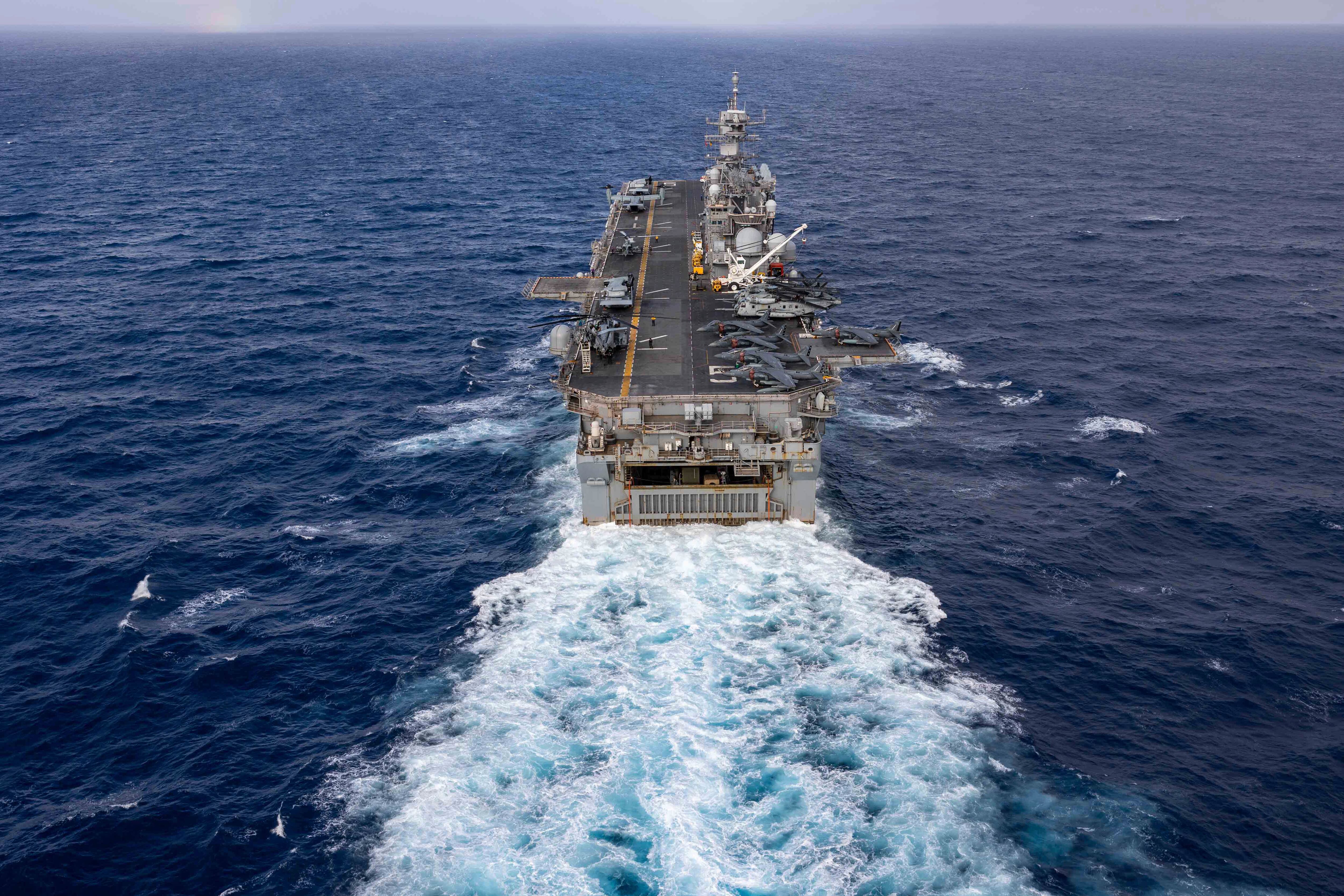
Thousands of Marines backed by advanced U.S. fighter jets and warships are slowly building up a presence in the Persian Gulf. It’s a sign that while America’s wars in the region may be finished, its conflict with Iran over its advancing nuclear program continues to worsen, with no solutions in sight.
The dispatch of the troop-and-aircraft-carrying USS Bataan to the Gulf, alongside stealth F-35 fighters and other warplanes, comes as America wants to focus on China and Russia.
But Washington is seeing once again that while it's easy to get into the Middle East militarily, it's difficult to ever get fully out — particularly as Iran now enriches uranium closer than ever to weapons-grade levels after the collapse of its 2015 nuclear deal with world powers.
There is no sign that diplomacy will revive the deal soon, and Iran in recent weeks has resumed harassing and seizing ships trying to pass through the Strait of Hormuz. Some 20% of the world's oil passes through the narrow waterway connecting the Persian Gulf to the wider world.
For hard-liners in Tehran's theocracy, the move projects power to surrounding nations as part of a wave of assaults attributed to Iran since 2019. It also serves as a warning to the U.S. and its allies that the Islamic Republic has the means to retaliate, particularly as American sanctions result in the seizure of ships carrying Iranian crude oil. Worries over another seizure likely has left a ship allegedly carrying Iranian oil stranded off Texas as no company has yet to unload it.
For the U.S., keeping the Strait of Hormuz open to shipping remains a priority to ensure global energy prices don't spike, particularly as Russia's war on Ukraine pressures markets. Gulf Arab nations need the waterway to get their oil to market and worry about Iran's intentions in the wider region.
Those fears have cemented the longtime American presence in the Persian Gulf. In the two decades that followed the Sept. 11, 2001, attacks, there were at times two different American aircraft carriers patrolling the Gulf to provide fighter jets for the wars in Afghanistan and Iraq, and later for the battle against the Islamic State group.
But slowly, the Pentagon began to wind down the naval presence, leaving a gap of months that brought gasps from Gulf Arab states and commentators worried about Iran. The USS Nimitz sailed out of the Strait of Hormuz in November 2020 as the last American carrier in the Persian Gulf. The last Marine expeditionary unit — an armada carrying Marines, aircraft and vehicles prepared for an amphibious assault — came through in November 2021.
Washington's worries have changed since then. Russia's war on Ukraine shifted some of the American focus back to Europe. China continues its push to control more of the South China Sea, and the U.S. Navy has responded with increased patrols.
In recent months, the U.S. military has again begun dialing up its Mideast presence. It conducted a Strait of Hormuz patrol with the top U.S., British and French naval commanders in the region on board. In late March, A-10 Thunderbolt II warplanes arrived at Al Dhafra Air Base in the United Arab Emirates. The Pentagon ordered F-16 fighters, as well as the destroyer USS Thomas Hudner, to the region. Stealth F-35A Lightning II fighter jets arrived last week.
Now, America will have part of a Marine expeditionary unit in the region for the first time in nearly two years. The deployment of thousands of Marines and sailors consists of both the USS Bataan and the USS Carter Hall, a landing ship.
Those vessels left Norfolk, Virginia, on July 10 on a mission the Pentagon described as being “in response to recent attempts by Iran to threaten the free flow of commerce in the Strait of Hormuz and its surrounding waters.” The Bataan passed through the Strait of Gibraltar into the Mediterranean Sea last week on its way to the Mideast.
While the U.S. military hasn't discussed precisely what it will be doing with the increased presence in the region, the movements have gotten Iran's attention. In recent days, Iranian Foreign Minister Hossein Amirabdollahian called his counterparts in both Kuwait and the United Arab Emirates to say that "we can have peace, stability and progress in the region without the presence of foreigners.”
Iran's army chief, Gen. Abdolrahim Mousavi, said the U.S. deployment would bring only “insecurity and damage” to the region.
“For years, Americans have been in and out of the region with pipe dreams, but the security of the region will only endure with the participation of the regional nations,” Mousavi said, according to Iranian state television.
Iran also made a point to again show off its Abu Mahdi cruise missile, first unveiled in 2020, which could be used to targets ships at sea up to 1,000 kilometers (620 miles) away. The missile is named after Abu Mahdi al-Muhandis, a veteran Iraqi militant who was killed in a 2020 U.S. drone strike in Baghdad alongside Iranian Gen. Qassem Soleimani.
All that raises the risk of conflict, though previous recent buildups of U.S. forces in the region haven't resulted in open warfare. The two sides have been in combat in the past, however. In 1988, America attacked two Iranian oil rigs used for military surveillance and sank or damaged Iranian ships in the largest U.S. naval battle since World War II.
With diplomacy stalled and Iran willing to be more aggressive at sea, the U.S. appears again to be relying on military might to convince Tehran to dial back. But that leaves the rest of the issues between them beyond the seas to continue to fester.