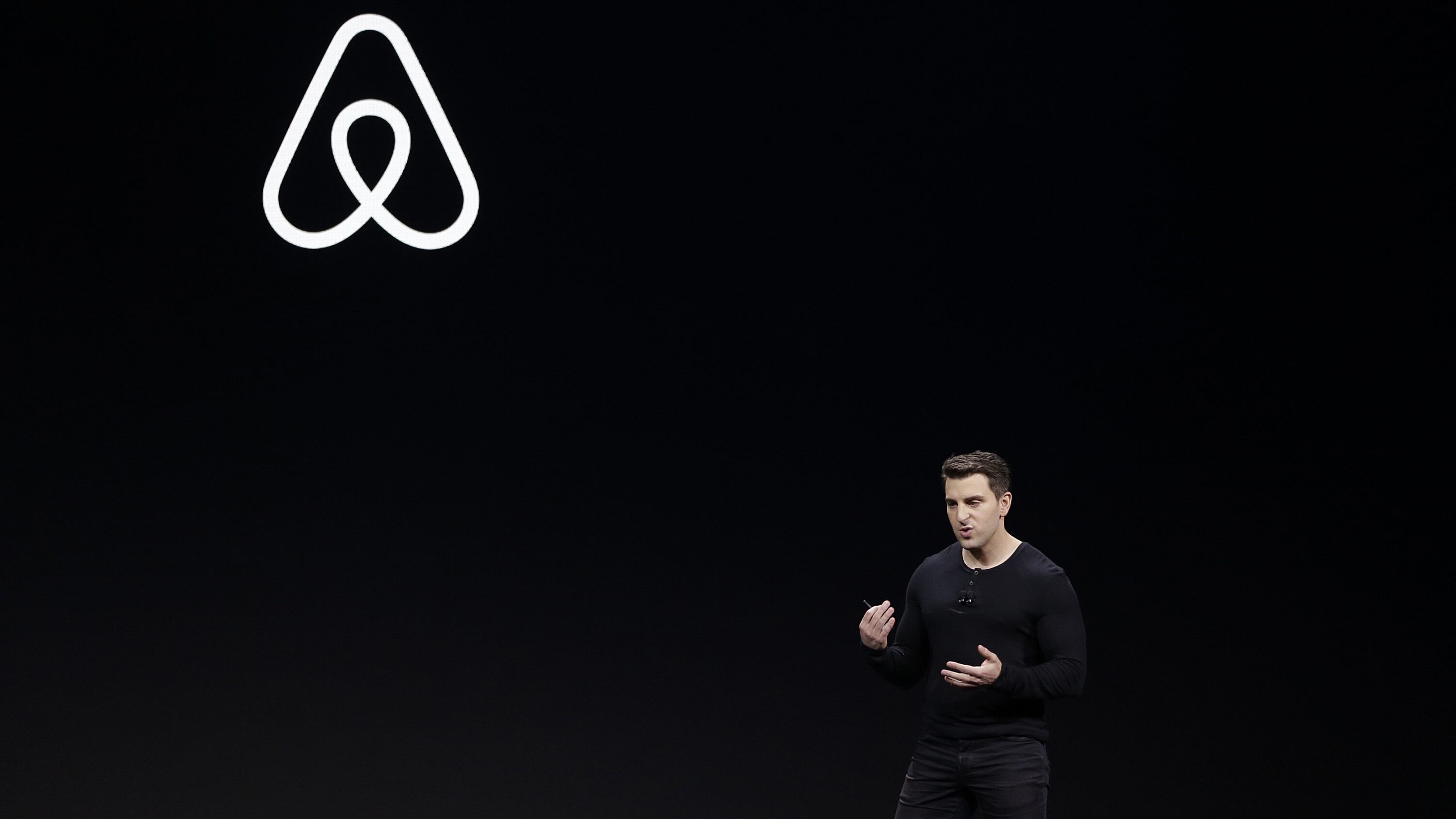
In this Feb. 22, 2018, file photo Airbnb co-founder and CEO Brian Chesky speaks during an event in San Francisco. (AP Photo/Eric Risberg, File)
By Dee-Ann Durbin
Airbnb was losing money even before the pandemic struck and cut its revenue by almost a third, the home-sharing company revealed in documents filed Monday ahead of a planned initial public offering of its stock.
The San Francisco-based company has yet set a date for the IPO but it is laying the groundwork by filing financial records with U.S. security regulators.
The documents show that leading up to the coronavirus outbreak earlier this year, Airbnb was spending heavily on technology and marketing to grow its business.
Its revenue jumped 32% to $4.8 billion in 2019, but it reported a net loss of $674 million that year. The company also lost money in 2018 and 2017.
This year, Airbnb said, revenue fell 32% to $2.5 billion in the first nine months as travelers canceled their plans after the pandemic crippled travel and forced lockdowns around the world.
Airbnb said it currently has 7.4 million listings run by 4 million hosts worldwide. Eighty-six percent of its hosts are outside the U.S. and 55% are women, the company said.
The company said it had 54 million guests in 2019.
Airbnb was founded 12 years ago by Brian Chesky and Joe Gebbia — classmates at the Rhode Island School of Design — and Nate Blecharczyk, a software engineer. Their first listing was Chesky and Gebbia’s apartment in San Francisco.
Scott Trench, host of the BiggerPockets Money Podcast, explores how recent rate cuts, high borrowing costs, and mortgage rates are reshaping U.S. real estate.
A look into how disruption, AI, and global economic trends are transforming the modern supply chain with Jeremy Jansen, Head of Supply Chain at Wells Fargo.
Delta CSO Amelia DeLuca reveals at the Fast Co. Innovation Festival how tech, sustainable aviation fuel, and smart operations are revolutionizing air travel.
Colin & Samir break down YouTube’s $100B payout to creators and explore why nearly a third of Gen Alpha want to be YouTubers — plus what that means for you.