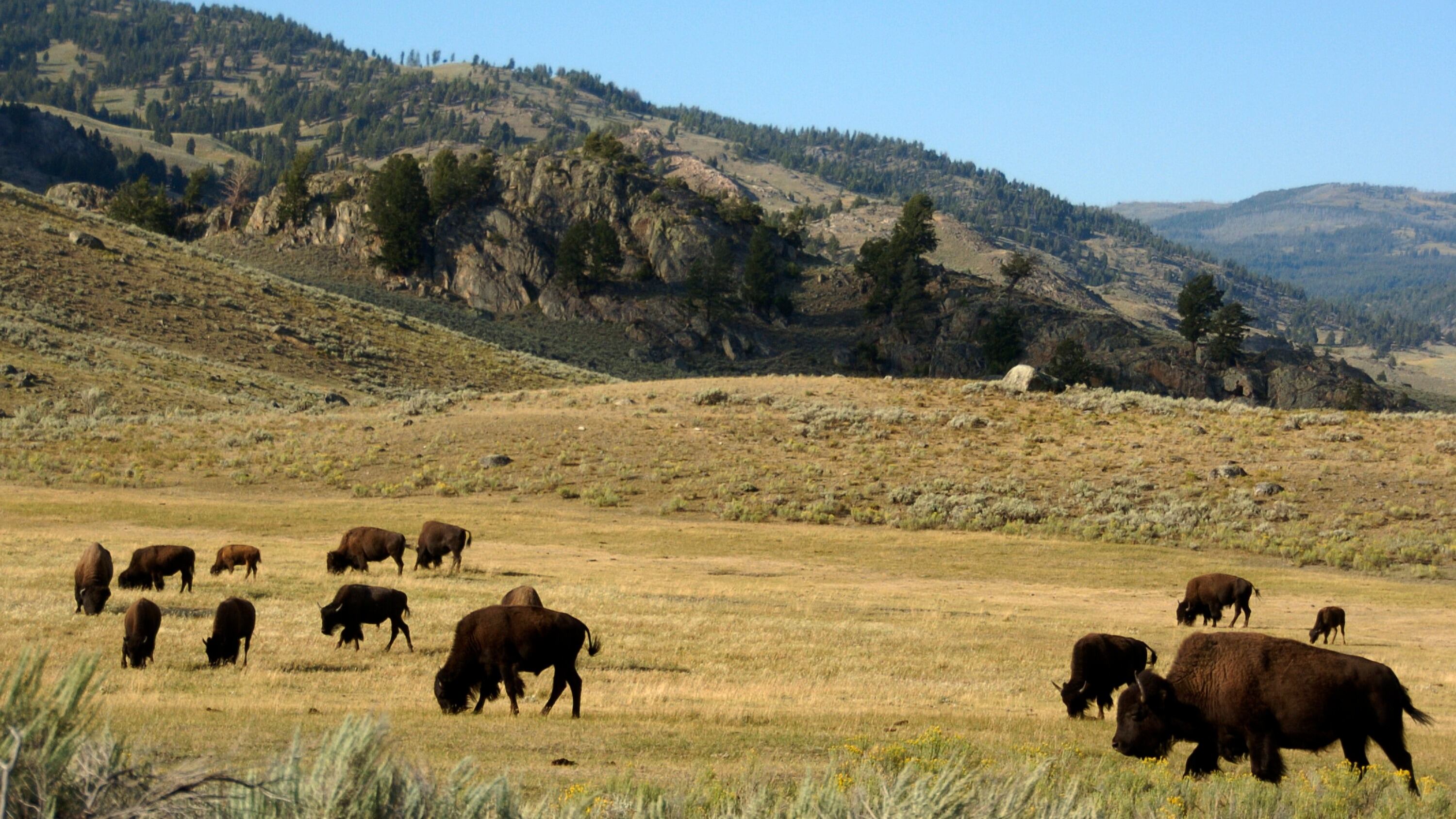
A herd of bison grazes in the Lamar Valley of Yellowstone National Park on Aug. 3, 2016. (AP Photo/Matthew Brown, File)
Yellowstone National Park officials killed a newborn bison because its herd wouldn’t take the animal back after a man picked it up.
The calf became separated from its mother when the herd crossed the Lamar River in northeastern Yellowstone on Saturday. The unidentified man pushed the struggling calf up from the river and onto a roadway, park officials said in a statement Tuesday.
Park rangers tried repeatedly to reunite the calf with the herd but were unsuccessful. Visitors saw the calf walking up to and following cars and people, creating a hazard, so park staff killed the animal, according to the statement.
It's the latest example of Yellowstone visitors getting in trouble or hurt after approaching bison. Park officials euthanized a newborn bison after a similar incident in 2016, when a Canadian man and his son put the calf in their SUV, thinking they could rescue it.
The man pleaded guilty. He was fined $235 and ordered to pay $500 to the Yellowstone Park Foundation Wildlife Protection Fund.
Bison have gored several people in Yellowstone in recent years, often after they got too close to the animals.
Many of Yellowstone’s larger animals — including bison, which can run up to 35 mph (55 kilometers per hour) and weigh up to 2,000 pounds (900 kilograms) — are deceptively dangerous, even when they’re just grazing or resting.
Park rules require visitors to keep at least 25 yards (23 meters) away from wildlife including bison, elk and deer, and at least 100 yards (91 meters) away from bears and wolves.
Park officials are investigating the bison calf incident. The suspect was a white male in his 40s or 50s who was wearing a blue shirt and black pants, the statement said.
Carlo and Baker cover the latest developments after a devastating tornado outbreak over the weekend, plus an eye on Omicron and inflation, and not even Spielberg can save the box office.
Reusable rocket developer Stoke Space Technologies raised $65 million in a Series A round led by Breakthrough Energy Ventures, a firm founded by Bill Gates. Stoke says its reusable rockets provide the satellite industry with low-cost, on-demand access to and from orbit. As companies like SpacX and Blue Origin are also making commitments to rocket reusability, Stoke says it is taking a different approach with a system designed to be 100% reusable, comprised of rockets designed to fly daily, like an airplane. Stoke co-founder and CEO Andy Lapsa joins Cheddar News' Closing Bell to discuss.
Humans are set to return to a place we have not been in nearly 50 years: the moon. NASA's Artemis program is expected to have astronauts back on the lunar surface by 2025. NASA says it will use what it learns on the moon to take the next giant leap - sending the first astronauts to Mars. The Artemis program also includes contributions from private companies like SpaceX, as well as academic research institutions like Georgia Tech. Georgia Tech professor of practice and former NASA astronaut Sandra Magnus joins Future of Space: Humankind's Leap Forward to discuss.
The CDC warns that COVID-19 is rapidly spreading with Omicron variant cases doubling every two days in the United States. How do current vaccines hold up against the new strain, and what does it mean for your upcoming holiday travel? Cheddar News breaks things down with infectious diseases specialist Dr. William Schaffner of Vanderbilt University School of Medicine.
President Joe Biden is expected to meet with his COVID-19 response team as the omicron variant continues to surge across the country. Experts say Delta is driving this surge but Dr. Anthony Fauci says Omicron will take over. Emergency physician Dr. Daniel Fagbuyi joins Cheddar News to discuss.
Omicron is on course to become the dominant COVID strain in the U.S., even as Delta is causing another spike in cases. According to Johns Hopkins University data, cases across the country are up 40% from last month, with New York City as a major hotspot. Outbreaks are now causing Broadway performances to be canceled, colleges and universities to shift to online classes, sports leagues to postpone games, and more. Dr. Jen Caudle, family physician and associate professor at Rowan University, joined Cheddar to discuss the surge in cases and how we can best protect ourselves against the new variant.