By Doug Ferguson
In the city of stars, Wyndham Clark had his own script in mind in the U.S. Open.
In front of him in Los Angeles was Rory McIlroy, one of golf's biggest talents who looked ready to end his perplexing nine-year drought in the majors. Next to him in the final group Sunday was Rickie Fowler, a Southern California native who returned from a three-year slump and was poised to finally win his first major.
Clark carried a message from his late mother — “Play big,” she always told him — and the belief he could compete with anyone on any stage.
No stage was bigger than a U.S. Open on the edge of Beverly Hills. That's where Clark delivered clutch saves, a signature shot that gave him control and the steady nerves to hold off McIlroy and become a major champion.
“I feel like I belong on this stage,” Clark said after closing with an even-par 70 for a one-shot victory over McIlroy. “Even two, three years ago when people didn’t know who I was, I felt like I could still play and compete against the best players in the world.”
He won in only his seventh start in a major — his previous best was a tie for 75th — and it came six weeks after he captured his first PGA Tour title at Quail Hollow.
“It's gone faster than I thought as far as just starting to do some stuff mentally that I’ve never done before, but I feel like I’m one of the best players in the world,” Clark said “Obviously this just shows what I believe can happen.”
The final act was two putts from 60 feet on the 18th hole at Los Angeles Country Club, and the 29-year-old Clark pumped his fist when it settled a foot away. He tapped that in for a par, maybe the easiest shot he had all day.
Left in his wake was a collection of big names.
Scottie Scheffler, the No. 1 player in the world, couldn't catch him. Neither could British Open champion Cameron Smith. Fowler was playing in the final group of a major for the third time. Clark was playing in the final round of a major for the third time, and the previous two occasions he was done in time for lunch.
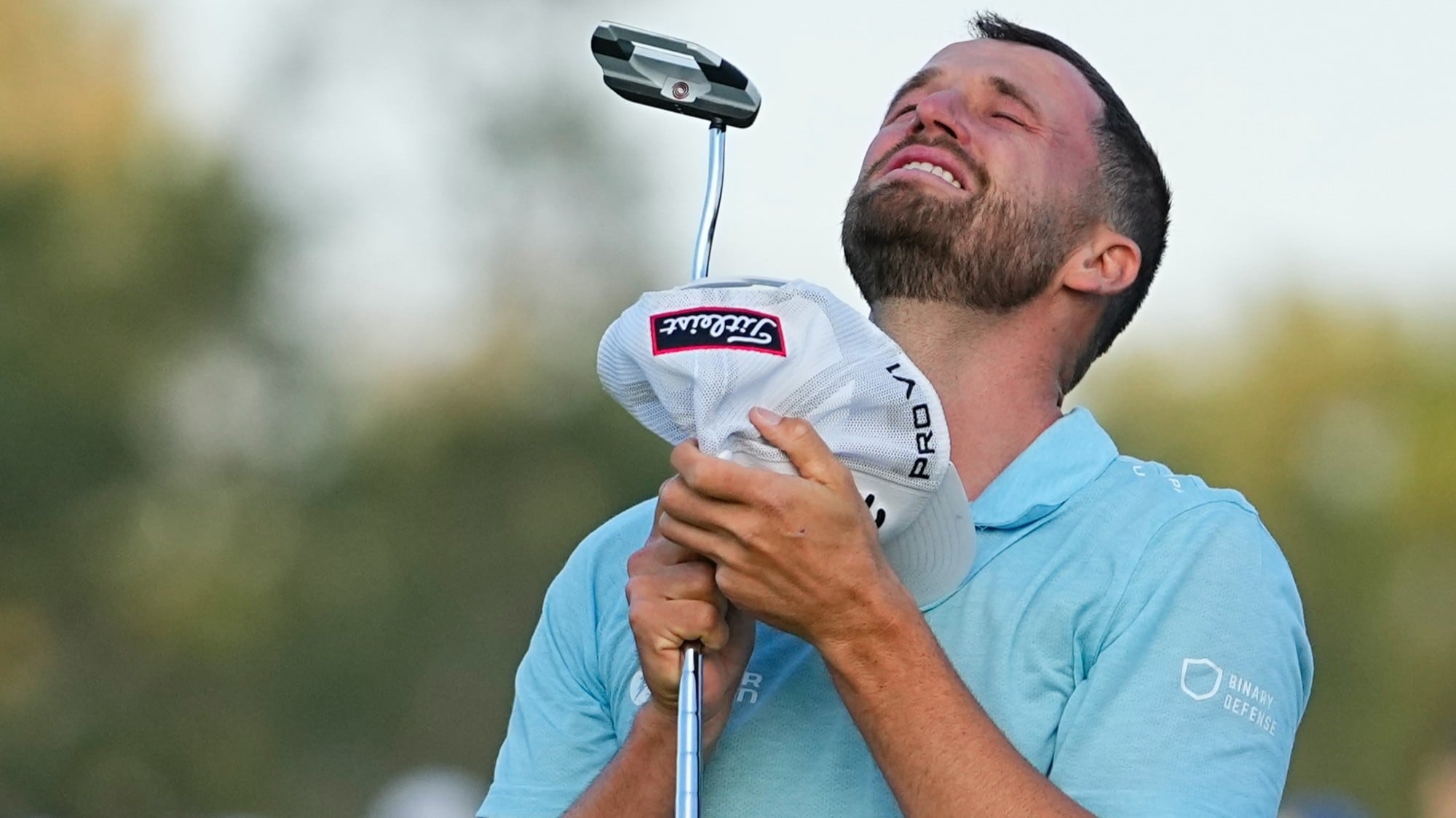
Clark let loose his emotions at the end, looking to the blue sky in tears and covering his face with his cap as he sobbed on the green.
He thought about quitting golf a decade ago when he struggled with the loss of his mother, Lise, to breast cancer. She was who kept him steady in good times and bad. He was thinking about her all week for all kinds of reasons.
“My mom lived in LA for a few years and I’ve had some people come up to me and show pictures of my mom when they knew her back in her 20s and early 30s when she was living here,” said Clark, who was born in Denver. "So it was kind of a special vibe all week being here in LA. My parents got married at Riviera Country Club. I have some roots a little bit in this area.
“All I really wish is that my mom could be here and I could just hug her and we could celebrate together. But I know she’s proud of me.”
For McIlroy, it was more disappointment in his quest to end nine years without a major.
He opened with a birdie and didn't make another the rest of the way. McIlroy played a final round that typically wins a U.S. Open — 16 pars, one bogey. Just not this one. Even as Clark showed signs of cracking during the rugged closing stretch, McIlroy missed fairways and didn't give himself any reasonable birdie chances.
It was similar to St. Andrews last summer at the British Open, when he hit every green and couldn't buy a putt. Instead, he'll face more questions about when he'll win another major.
“When I do finally win this next major, it’s going to be really, really sweet,” McIlroy said. “I would go through 100 Sundays like this to get my hands on another major championship.”
Scheffler missed too many putts early on the back nine and needed help from Clark and McIlroy that never arrived. He also closed with a 70 to finish third, a month after a runner-up finish in the PGA Championship.
Fowler set a U.S. Open record with 23 birdies, but just like so many other majors when he had a chance, he was in reverse before he ever got going — three bogeys in the opening seven holes. He never made up the ground and shot 75.
This day belonged to Clark, who showed remarkable poise and self-belief, not to mention an extraordinary short game and a fairway metal he won't soon forget.
Already with a two-shot lead, he was a yard away from an easy birdie on the par-5 eighth when his approach hit a steep bank of the barranca to the left. Barely able to see his golf ball, Clark took a whack and the ball advanced a few inches deeper into thick grass.
He hammered it again, this time over the green, 70 feet away down a firm and scary putting surface. He chipped that to 3 feet to escape with bogey.
“That up-and-down was the key to the tournament,” he said.
More such shots followed. On the par-3 ninth, he was on the bank of a bunker and chipped away from the flag, using the slope expertly to get it to within 7 feet for another big save. And then he clipped a pitch from a tight lie left of the 11th green to 4 feet for par.
The signature shot was his fairway metal from 282 yards on the par-5 14th to 20 feet that set up a two-putt birdie, giving Clark a three-shot lead with four to play.
But he made the only bogey of the day on the par-3 15th, then found a bunker left of the 16th fairway and whacked his hand on his putter when he missed a 7-foot par putt. His lead down to one shot, he got up-and-down from left of the 17th green to keep the lead.
The USGA allowed thousands of fans to circle the fairway short of the 18th green with so few grandstands, creating a big theater for Clark's finish.
Fowler, still chasing his first major, returned to the 18th green to hug Clark.
“I went back in there and just said, 'Your mom was with you. She'd be very proud,'” Fowler said.
Clark finished at 10-under 270 and along with $3.6 million — his second such cash prize in the last six weeks — he moves to No. 2 in the Ryder Cup standings.
Smith shot 67 to finish fourth. Tommy Fleetwood became the first player with two rounds of 63 in the U.S. Open and finished in a tie for fifth with Fowler and Min Woo Lee (67). Fleetwood also shot 63 at Shinnecock Hills in the final round of 2018.
That was a fitting finish in one respect — a U.S. Open that had the lowest 18-hole scores on Thursday (Fowler and Xander Schauffele at 62) ended with the lowest scoring average for 72 holes (71.76) in U.S. Open history.