After eight daunting months of battling COVID-19, there may be some light at the end of the tunnel as two potential vaccine candidates recently announced promising test results.
Vaccines from Pfizer and Moderna are similar in that they both use emerging technology called messenger ribonucleic acid (mRNA) to reach nearly 95 percent efficacy. Typically, scientists create vaccines by using live or inactivated virus cells, which puts the actual disease into a person’s body. However, with mRNA technology, Pfizer and Moderna were able to avoid that. MRNA carries coded instructions that tell cells what defenses are necessary by appearing as a threat.
Of Course, There's a Catch
The use of the molecule is groundbreaking for a number of reasons. One is the speed at which the vaccines were developed. The other is that the use of mRNA means the vaccines contain no infectious COVID-19 properties that could get patients sick.
However, there is a drawback to the vaccines: they have to be stored in brutally cold temperatures.
Under normal circumstances, vaccines can survive when stored at around 40 degrees Fahrenheit, but for Moderna, the vials must be stored at -4 degrees.
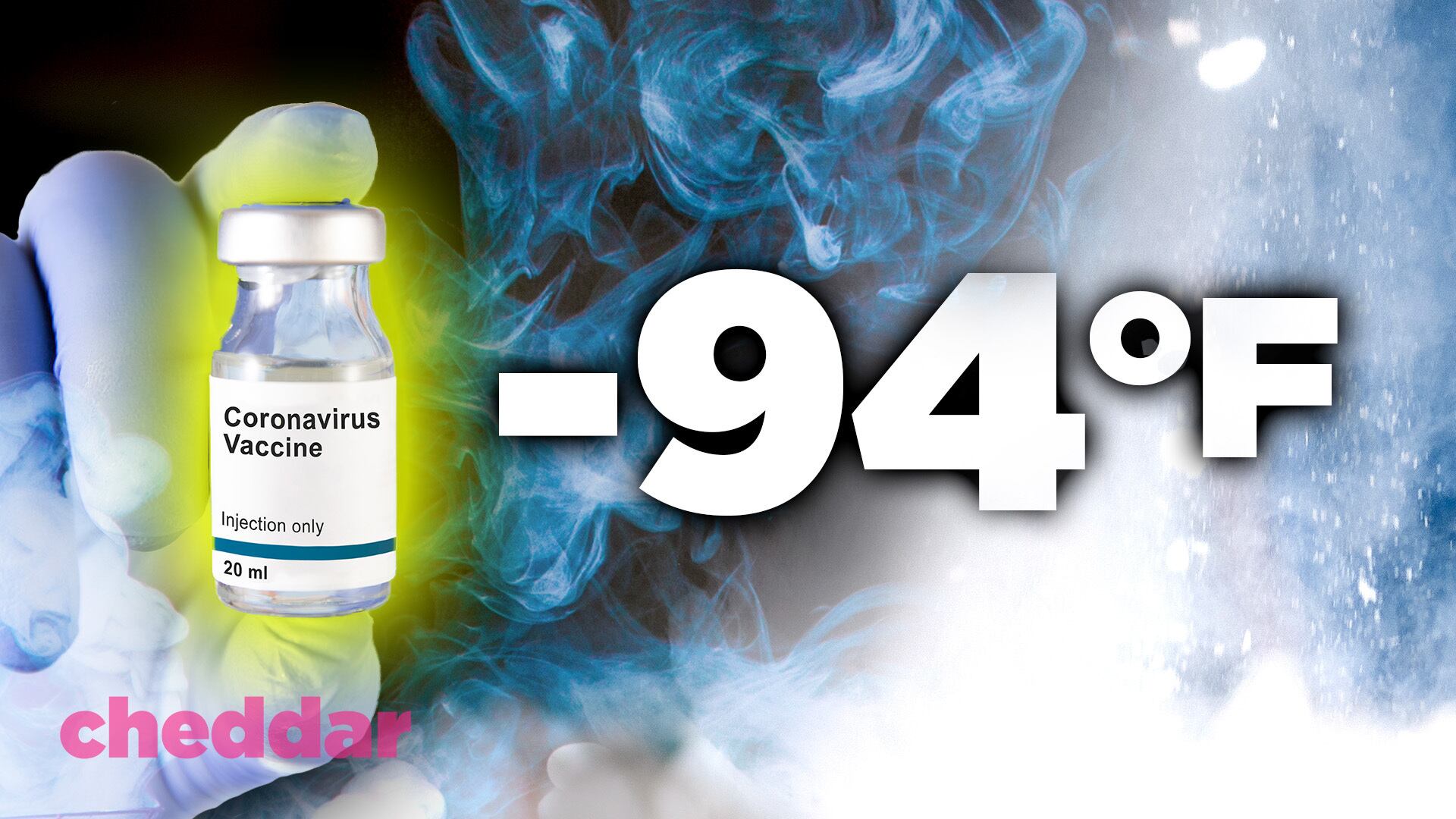
For Pfizer's vaccine, the threshold for keeping an effective dose is even steeper at a staggering -94 degrees. The icy temperatures are necessary to keep the mRNA molecule intact, otherwise it “begins to fall apart and twist around in ways so that it doesn’t become effective,” a representative for the pharmaceutical giant told Cheddar.
Vaccine Storage & Distribution Roadblock
With the need for cold storage comes the obstacle of how to pull off widespread distribution. Most hospitals in the U.S. do not house facilities that meet the requirements to store either the Moderna or Pfizer vaccines for extended periods. Both vaccines are able to survive in typical storing temperatures of 35 to 46 degrees, but their shelf lives are limited that way.
For Pfizer, the vaccine would no longer be effective after five days in normal storage temperatures. Moderna, meanwhile, shows more promise when it comes to effective distribution as it’s vaccines appear to remain effective for a month while stored 35 degrees.
Pfizer has come up with a plan to ship its vaccine in boxes filled with dry ice. The vials will remain protected for up to 15 days -- but the container can only be opened up to two times per day.
This could be a logistical nightmare for parts of the world that don't have sufficient equipment - or enough dry ice - to keep the vaccines. Even in rural America, many hospitals don't have freezers that can keep doses cold enough, particularly for the Pfizer vaccine.
Getting Vaccinated
So what does this mean for you? Once the FDA approves emergency use authorization of either one or both of the vaccines, it looks like they will likely be distributed first among populations that need it the most: frontline healthcare workers, the elderly, and those suffering from underlying health conditions.
Like several existing vaccinations for other conditions, both Pfizer and Moderna require two rounds of treatment in order for the body to build up complete immunity. For those receiving the Pfizer vaccine, patients will need to return for a second dose after three weeks and for those getting the Moderna vaccine, they'll have to go back for round two after four weeks.
Video produced by Ali Larkin. Article written by Lawrence Banton.
Dr. Farhan Bhatti, a family physician and Michigan State lead for the Committee to Protect Health Care, joined Cheddar to discuss the newly discovered and highly transmissible omicron variant of COVID-19. Bhatti said it is too early to draw any conclusions about the new variant but there is concern that it could eventually mutate and develop a resistance to vaccines. "Time will tell, but for now, it looks like, still, the best thing that we can do to try to limit the spread of this disease is make sure everybody gets a vaccine and make sure everybody avoids large gatherings indoors and wears masks during the wintertime especially," he said.
Jill and Carlo cover the latest developments with the Omicron variant that are spooking markets once again. Twitter's @Jack is leaving, SCOTUS takes up abortion rights and the world has a brand new republic.
A CDC panel unanimously endorsed Moderna and Pfizer Covid-19 vaccine boosters for all U.S. adults. This comes after the FDA gave its own authorization for everyone 18 and older, scrapping previous eligibility factors like age and underlying conditions. Dr. Shereef Elnahal, President and CEO of University Hospital and former New Jersey Health Commissioner, joined Cheddar News to break down the development.
The Biden Administration is set to buy 10 million courses of Pfizer's Covid pill if it gains emergency use authorization from the FDA. With this purchase, the U.S. will receive more than 13 million courses of antiviral pills aimed at treating Covid and reducing severe illness and death. Pfizer's pill has been shown to reduce risk of hospitalization and death by 89 percent, proving it could be a key tool in the fight against the pandemic. Dr. Soumi Eachempati, Co-Founder, CEO & CMO of Cleared4, joined Cheddar News to discuss.
Dr. David Dodson, Infectious Disease Specialist at Carden & Dodson MD, joined Wake Up With Cheddar to break down what we know so far about the Omicron Covid-19 variant, and why you shouldn't wait for an Omicron-specific shot to get vaccinated.
Friday saw big sell offs, with the Dow Jones posting its worst day since October 2020, falling 905 points, with the Nasdaq and S&P 500 each tumbling more than two percent as well. Much of that due to investor concerns over the new Covid-19 'Omicron' variant first detected in South Africa. Craig Erlam, senior market analyst at Oanda explains what investors should expect this week.
The ocean is an important topic when it comes to the climate. It plays a vital role in shaping our environment, with rising sea levels causing a 35% increase in natural disasters around the world, affecting 1.7 billion people. Dr. Sylvia Earle has been called perhaps the greatest advocate our oceans have ever had, with Time magazine dubbing her its first 'hero of the planet' and the Library of Congress naming her a living legend. She is also the founder of Mission Blue, an organization that inspires action to explore and protect the ocean. Dr. Earle joined Cheddar Climate for more on the importance of caring for the ocean and its impact on climate change.
Scientists are racing to understand the Omicron variant of covid-19 and find out just how dangerous it really is. Omicron, dubbed a variant of concern by the WHO, was first detected in South Africa last week and has already spread to multiple countries, including the UK, Canada, Australia and more. Dr. Jonathan Javitt, CEO of Nrx and adjunct professor at Johns Hopkins School of Medicine, joined Cheddar to discuss what we know and don't know about this new variant.
The House has officially passed the $1.75 trillion social policy and climate big. This new bill is expected to bring some huge investments into working towards fighting climate change. U.S. President of We Don't Have Time, Sweta Chakraborty, joined Cheddar to discuss more.