Darlene Superville
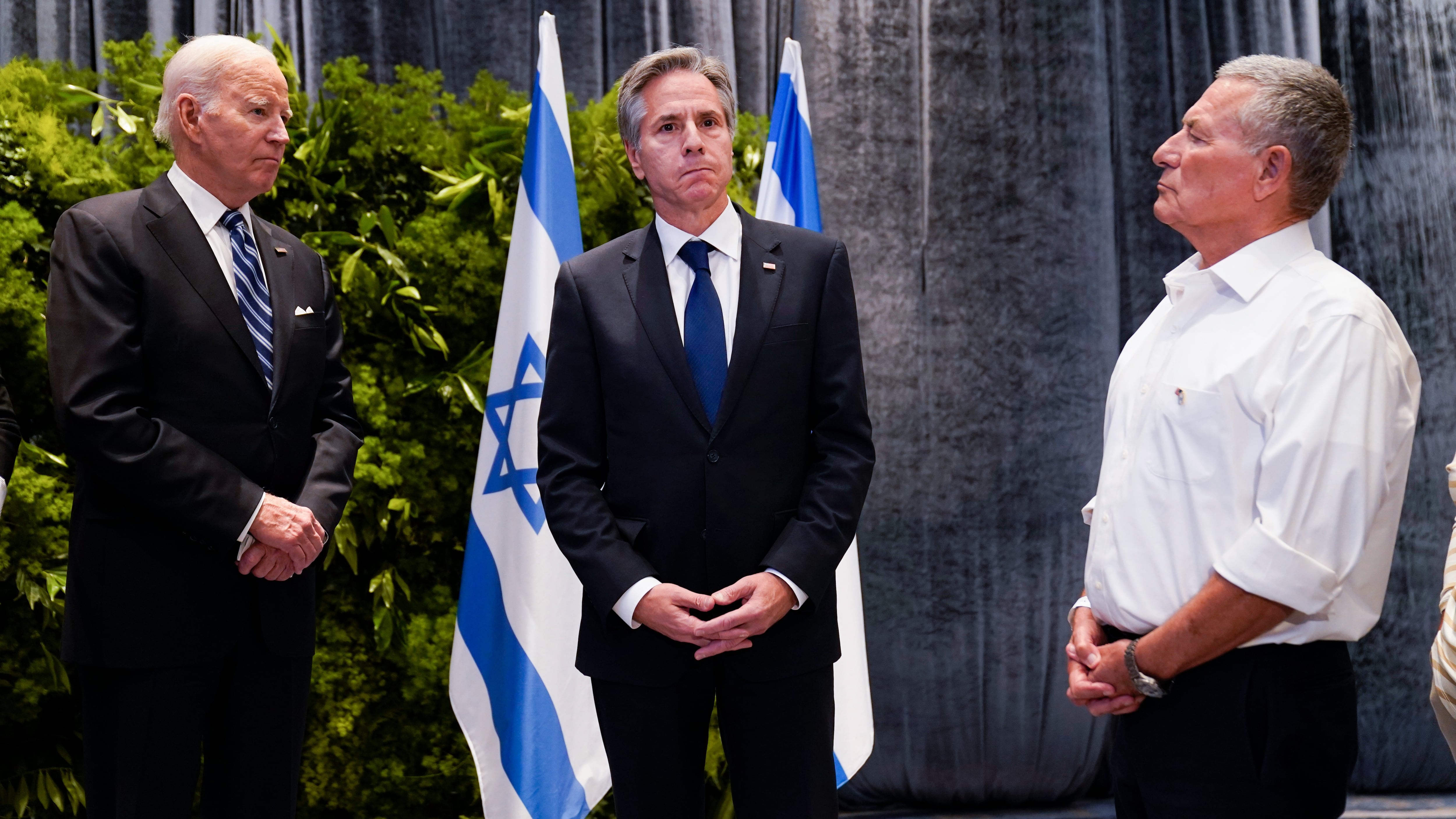
Secretary of State Antony Blinken and Defense Secretary Lloyd Austin said Sunday that the United States expects the Israel-Hamas war to escalate through involvement by proxies of Iran, and they asserted that the Biden administration is prepared to respond if American personnel or armed forces become the target of any such hostilities.
“This is not what we want, not what we're looking for. We don't want escalation,” Blinken said. "We don't want to see our forces or our personnel come under fire. But if that happens, we're ready for it.”
Austin, echoing Blinken, said “what we’re seeing is a prospect of a significant escalation of attacks on our troops and our people throughout the region.”
He said the U.S. has the right to self-defense “and we won't hesitate to take the appropriate action.”
The warning from the high-ranking U.S. officials came as Israel's military response to a deadly Oct. 7 attack by Hamas on civilians in communities in southern Israel entered its third week.
Israeli warplanes struck targets across Gaza overnight and into Sunday, as well as two airports in Syria and a mosque in the occupied West Bank allegedly used by militants as the war threatened to engulf more of the Middle East.
Israel has traded fire with Lebanon’s Hezbollah militant group on a near-daily basis since the war began, and tensions are soaring in the Israeli-occupied West Bank, where Israeli forces have battled militants in refugee camps and carried out two airstrikes in recent days.
The U.S. announced Sunday that non-essential staff at its embassy in Iraq should leave the country.
Blinken, who recently spent several days in the region, spoke of a “likelihood of escalation” while saying no one wants to see a second or third front to the hostilities between Israel and Hamas, which rules Gaza.
The secretary said he expects “escalation by Iranian proxies directed against our forces, directed against our personnel,” and added: “We are taking steps to make sure that we can effectively defend our people and respond decisively if we need to.” Iran is an enemy of Israel.
Blinken, appearing on NBC's “Meet the Press,” noted that additional military assets had been deployed to the region, including two aircraft carrier battle groups, “not to provoke, but to deter, to make clear that if anyone tries to do anything, we're there.”
President Joe Biden, repeatedly has used one word to warn Israel’s enemies against trying to take advantage of the situation: “Don’t.”
Meanwhile, trucks loaded with food, water and other supplies that Palestinians living in Gaza desperately need continued to enter the enclave on Sunday after a key crossing at the border with Egypt was opened a day earlier to allow humanitarian assistance to begin flowing.
But Cindy McCain, executive director of the U.N. World Food Program, said the situation in Gaza remained “catastrophic." She said even more aid needs to be allowed in.
She said her organization was able to feed 200,000 people dinner on Saturday “but that's not enough. That's a drop. We need secure and sustainable access in there, in that region, so we can feed people.”
Four hundred aid trucks were entering Gaza daily before the latest war, she said.
“This is a catastrophe happening and we just simply have to get these trucks in,” she said.
Biden, who was at his home on the Delaware coast, was briefed by his national security team on the latest developments, the White House said. Biden also discussed the situation during separate conversations with Israeli Prime Minister Benjamin Netanyahu and Pope Francis.
Biden and Netanyahu talked about “the need to prevent escalation in the region and to work toward a durable peace in the Middle East," the White House said. Israel has promised a military ground invasion of Gaza to destroy Hamas.
Biden also convened a call with the leaders of Canada, France, Germany, Italy and the United Kingdom to discuss the conflict. Among topics discussed, the White House said the leaders committed to working closely to keep the war from spreading, while seeking a political solution.
The State Department on Sunday ordered non-essential U.S. diplomats and their families at the U.S. Embassy in Iraq and the U.S. consulate in Irbil to leave the country due to the heightened tensions. In an updated message to Americans in Iraq, the department said the security situation in Iraq made it impossible to carry out normal operations.
Austin and McCain spoke on ABC's “This Week.”