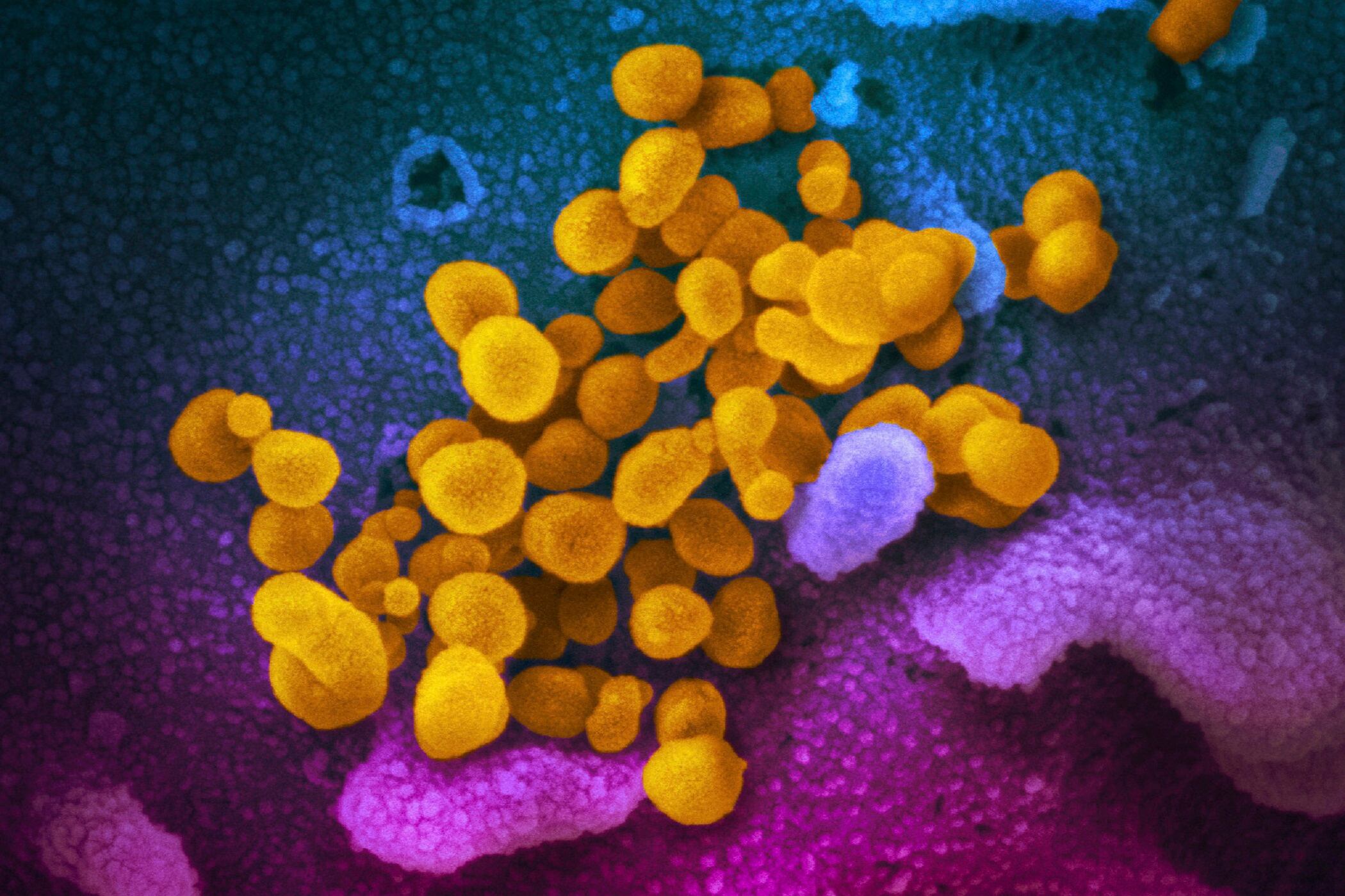
This undated, colorized electron microscope image made available by the U.S. National Institutes of Health in February 2020 shows the Novel Coronavirus SARS-CoV-2, indicated in yellow, emerging from the surface of cells, indicated in blue/pink, cultured in the lab. The sample was isolated from a patient in the U.S. On Thursday, April 21, 2022, scientists reported a U.K. patient with a severely weakened immune system had COVID-19 for almost a year and a half, underscoring the importance of protecting vulnerable people from the coronavirus. (NIAID-RML via AP, File)
By Laura Ungar
A UK patient with a severely weakened immune system had COVID-19 for almost a year and a half, scientists reported, underscoring the importance of protecting vulnerable people from the coronavirus.
There’s no way to know for sure whether it was the longest-lasting COVID-19 infection because not everyone gets tested, especially on a regular basis like this case.
But at 505 days, “it certainly seems to be the longest reported infection," said Dr. Luke Blagdon Snell, an infectious disease expert at the Guy’s & St. Thomas' NHS Foundation Trust.
Their study investigated which mutations arise — and whether variants evolve — in people with super long infections. It involved nine patients who tested positive for the virus for at least eight weeks. All had weakened immune systems from organ transplants, HIV, cancer or treatment for other illnesses. None were identified for privacy reasons.
Repeated tests showed their infections lingered for an average of 73 days. Two had the virus for more than a year. Previously, researchers said, the longest-known case that was confirmed with a PCR test lasted 335 days.
Persistent COVID-19 is rare and different from long COVID.
“In long COVID, it’s generally assumed the virus has been cleared from your body but the symptoms persist,” Snell said. “With persistent infection, it represents ongoing, active replication of the virus.”
Each time researchers tested patients, they analyzed the genetic code of the virus to make sure it was the same strain and that people didn't get COVID-19 more than once. Still, genetic sequencing showed that the virus changed over time, mutating as it adapted.
The mutations were similar to the ones that later showed up in widespread variants, Snell said, although none of the patients spawned new mutants that became variants of concern. There's also no evidence they spread the virus to others.
The person with the longest known infection tested positive in early 2020, was treated with the antiviral drug remdesiver and died sometime in 2021. Researchers declined to name the cause of death and said the person had several other illnesses.
Five patients survived. Two cleared the infection without treatment, two cleared it after treatment and one still has COVID-19. At the last follow-up earlier this year, that patient’s infection had lasted 412 days.
Researchers hope more treatments will be developed to help people with persistent infections beat the virus.
“We do need to be mindful that there are some people who are more susceptible to these problems like persistent infection and severe disease,” Snell said.
Although persistent infections are rare, experts said there are many people with compromised immune systems who remain at risk of severe COVID-19 and who are trying to stay safe after governments lifted restrictions and masks started coming off. And it's not always easy to know who they are, said Dr. Wesley Long, a pathologist at Houston Methodist in Texas, who was not part of the research.
“Masking in crowds is a considerate thing to do and a way we can protect others,” he said.
___
The Associated Press Health and Science Department receives support from the Howard Hughes Medical Institute’s Department of Science Education. The AP is solely responsible for all content.
Andrew Chanin, CEO of investment management firm ProcureAM, joined Cheddar to break down the many industries in the space economy and discuss what trends are driving the most growth. "Right now there's been so much media focus on space tourism. Why? Because last year it really debuted itself to the world," he said. "However it's less than 1 percent of the overall space economy, and there are many other parts of space which are actually driving this area."
Plastic has become the face of global pollution. To date, humans have produced 8.3 billion metric tons of it. Once discarded, plastic doesn’t biodegrade. Instead, it fragments into microplastics smaller than the size of a sesame seed and further into nanoplastics.
These tiny particles of plastic end up everywhere, deep in the ice of Antarctic glaciers or even inside our bodies.
So how much plastic is inside of us? And what does it mean for our health? Let’s find out.
Catching you up on what you Need to Know on Mar 29, 2022, with updates on the snow squall in Pennsylvania that caused a pileup killing three, the teacher's strike in Sacramento heading into week two, Walmart no longer selling tobacco products in select stores, and what meme stocks are up to this week.
Catching you up on what you Need to Know on Mar 28, 2022, with peace talks resuming in Ukraine as early as today, Colorado wildfires causing evacuations, Shanghai, China, ramping up restrictions once again, the Oscars debacle between Will Smith and Chris Rock, and more.
The U.S. market value of the plant-based food industry reached an all-time high last year. According to a new report from the Plant Based Food Association, retail sales of plant-based foods reached $7.4 billion, but questions are arising over whether the industry can sustain the levels of growth it had in the past few years. Julie Emmett, senior director of marketplace development at the Plant Based Food Association, joined Cheddar News' Closing Bell to discuss.
Bowery Farming's vertical growing process allows it to cultivate 13 types of greens — and now, strawberries — in a sustainable way that's also faster than traditional farming. Bowery focuses on sustainability from start to finish, using unique technology to provide plants with what they need at the right time while eliminating waste and cutting down on carbon dioxide emissions. Katie Seawell, Chief Commercial Officer of Bowery Farming, joins Closing Bell to discuss the company's vertical farming process, sustainability focus, fixing the food supply chain, and more.
Nexii, a company based in Canada, is getting some big backing for its sustainable, low-carbon concrete alternative. CEO Stephen Sidwell, joined Cheddar News to talk about the initiatives his company is taking to tackle climate change and scaling up production to meet demand. "Most people don’t realize it, but buildings are the number one contributor to CO2 emissions," he said. "So that's really what we're attacking, the overall CO2 emissions."
Catching you up on what you need to know on March 25, 2022, with Ukrainian forces retaking Kyiv, 300 deaths reported from the bombing of a theater used as a shelter in Mariupol, U.S. regulators ditch a climate review of natural gas projects, the 94th Academy Awards, and more.
New York City Mayor Eric Adams has announced the removal of the mask mandate in school and day-care centers for children under 5. If COVID-19 cases remain low, this change will take place on April 4th. Syra Madad, an infectious disease epidemiologist, joins Cheddar News to discuss.