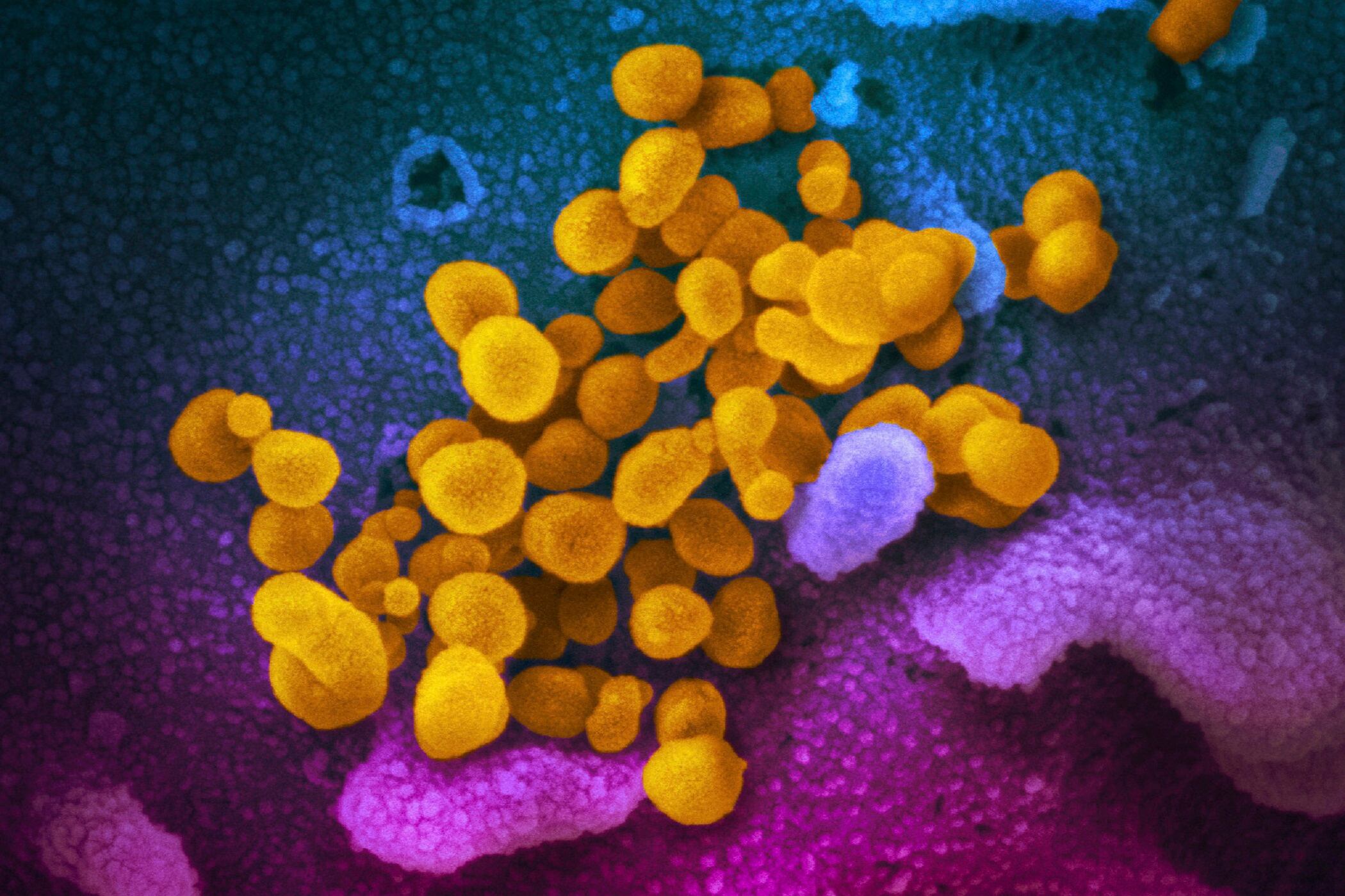
This undated, colorized electron microscope image made available by the U.S. National Institutes of Health in February 2020 shows the Novel Coronavirus SARS-CoV-2, indicated in yellow, emerging from the surface of cells, indicated in blue/pink, cultured in the lab. The sample was isolated from a patient in the U.S. On Thursday, April 21, 2022, scientists reported a U.K. patient with a severely weakened immune system had COVID-19 for almost a year and a half, underscoring the importance of protecting vulnerable people from the coronavirus. (NIAID-RML via AP, File)
By Laura Ungar
A UK patient with a severely weakened immune system had COVID-19 for almost a year and a half, scientists reported, underscoring the importance of protecting vulnerable people from the coronavirus.
There’s no way to know for sure whether it was the longest-lasting COVID-19 infection because not everyone gets tested, especially on a regular basis like this case.
But at 505 days, “it certainly seems to be the longest reported infection," said Dr. Luke Blagdon Snell, an infectious disease expert at the Guy’s & St. Thomas' NHS Foundation Trust.
Their study investigated which mutations arise — and whether variants evolve — in people with super long infections. It involved nine patients who tested positive for the virus for at least eight weeks. All had weakened immune systems from organ transplants, HIV, cancer or treatment for other illnesses. None were identified for privacy reasons.
Repeated tests showed their infections lingered for an average of 73 days. Two had the virus for more than a year. Previously, researchers said, the longest-known case that was confirmed with a PCR test lasted 335 days.
Persistent COVID-19 is rare and different from long COVID.
“In long COVID, it’s generally assumed the virus has been cleared from your body but the symptoms persist,” Snell said. “With persistent infection, it represents ongoing, active replication of the virus.”
Each time researchers tested patients, they analyzed the genetic code of the virus to make sure it was the same strain and that people didn't get COVID-19 more than once. Still, genetic sequencing showed that the virus changed over time, mutating as it adapted.
The mutations were similar to the ones that later showed up in widespread variants, Snell said, although none of the patients spawned new mutants that became variants of concern. There's also no evidence they spread the virus to others.
The person with the longest known infection tested positive in early 2020, was treated with the antiviral drug remdesiver and died sometime in 2021. Researchers declined to name the cause of death and said the person had several other illnesses.
Five patients survived. Two cleared the infection without treatment, two cleared it after treatment and one still has COVID-19. At the last follow-up earlier this year, that patient’s infection had lasted 412 days.
Researchers hope more treatments will be developed to help people with persistent infections beat the virus.
“We do need to be mindful that there are some people who are more susceptible to these problems like persistent infection and severe disease,” Snell said.
Although persistent infections are rare, experts said there are many people with compromised immune systems who remain at risk of severe COVID-19 and who are trying to stay safe after governments lifted restrictions and masks started coming off. And it's not always easy to know who they are, said Dr. Wesley Long, a pathologist at Houston Methodist in Texas, who was not part of the research.
“Masking in crowds is a considerate thing to do and a way we can protect others,” he said.
___
The Associated Press Health and Science Department receives support from the Howard Hughes Medical Institute’s Department of Science Education. The AP is solely responsible for all content.
Alysa McCall, director of conservation outreach and staff scientist at Polar Bears International, joined Cheddar to discuss the ongoing fight to protect polar bears from extinction while world leaders gathered to discuss the climate crisis. McCall explained her organization's mission "to ensure the long term survival of polar bears by helping ensure their arctic sea ice habitat remains intact." McCall said she hopes actionable steps are taken after the UN climate summit to mitigate the crisis and not just more promises.
Moderna reported a massive miss on revenue in its Q3 earnings, taking in $5 billion versus the expected $6.21 billion despite sales of the COVID-19 vaccine. The pharmaceutical giant's stock dropped sharply on the news.
Carlo and Baker discuss the fallout from Tuesday's election and the flashing warning sign for Dems ahead of the midterms. Also, a big 2A case at the Supreme Court, Aaron Rodgers has Covid and is in big trouble, and a first for the MCU.
Carlo and Baker discuss the election results across the country, including a Republican comeback in Virginia -- and possibly NJ -- plus the CDC gives the go-ahead for child vaccinations, Atlanta wins the World Series and more.
Dr. Julie Morita, executive vice president of Robert Wood Johnson Foundation, joined Cheddar to discuss the CDC advisory panel recommending the Pfizer vaccine for children ages 5-11. "We've seen many millions of children getting sick, many hospitalized, many dying because of COVID," Morita said. "And so now we have a new tool that we can use to keep our children safe." She also noted that hesitancy among parents about vaccinating their children will likely fade in time as the childhood vaccine program gets underway.
Matthew Oxenford, Analyst at the Economist Intelligence Unit, joins a special edition of Cheddar Climate, where he discusses the responsibilities big businesses across multiple sectors have when it comes to combating the effects of climate change around the world.
President Joe Biden introduced the Global Methane Pledge on the second day of the United Nations climate summit. The U.S. and the European Union will lead the way when it comes to methane emissions reductions, and close to 100 nations have also signed on. It's seen as the fastest way to slow down global warming and keep nations on track toward meeting the goal of keeping warming just 1.5 degrees Celsius above late 1800s atmospheric levels. Dr. Sweta Chakraborty, U.S. President of climate-focused startup 'We Don't Have Time' joins Cheddar Climate to discuss the importance of the Biden administration's methane regulations -- and the importance of U.S. leadership when it comes to climate issues.
John Paul Mejia, the national spokesperson for the Sunrise Movement, joined Cheddar to talk about what the youth activist group wants to see from President Joe Biden as he attends the COP26 climate summit. Mejia admonished the president for having little to deliver on his own climate agenda domestically while at the conference. "We need the president to follow through with his promises because, frankly, it's a matter of life or death not only for communities here in the United States but also those looking to us around the world," he said.
With COP26 kicking off, roughly 120 world leaders and delegates are in Glasgow, Scotland to hold climate talks this week. As experts continue to warn about the dangers of climate change, ESG investing is more important than ever.
Georges Archibald, Head of Apex Americas at Apex Group joined Cheddar's Opening Bell to discuss.
Roughly 20,000 heads of state, diplomats, and activists will gather in person starting Oct. 31 to address the threat of climate change. The summit, known as COP26, is seen as a crucial step in getting the crisis under control as scientists warn global warming is only getting worse. Carroll Muffett, President and CEO of the Center for International Environmental Law, joined Cheddar to explain the goals of COP26 and why it's so crucial for the world leaders to step up and make new, aggressive climate commitments.