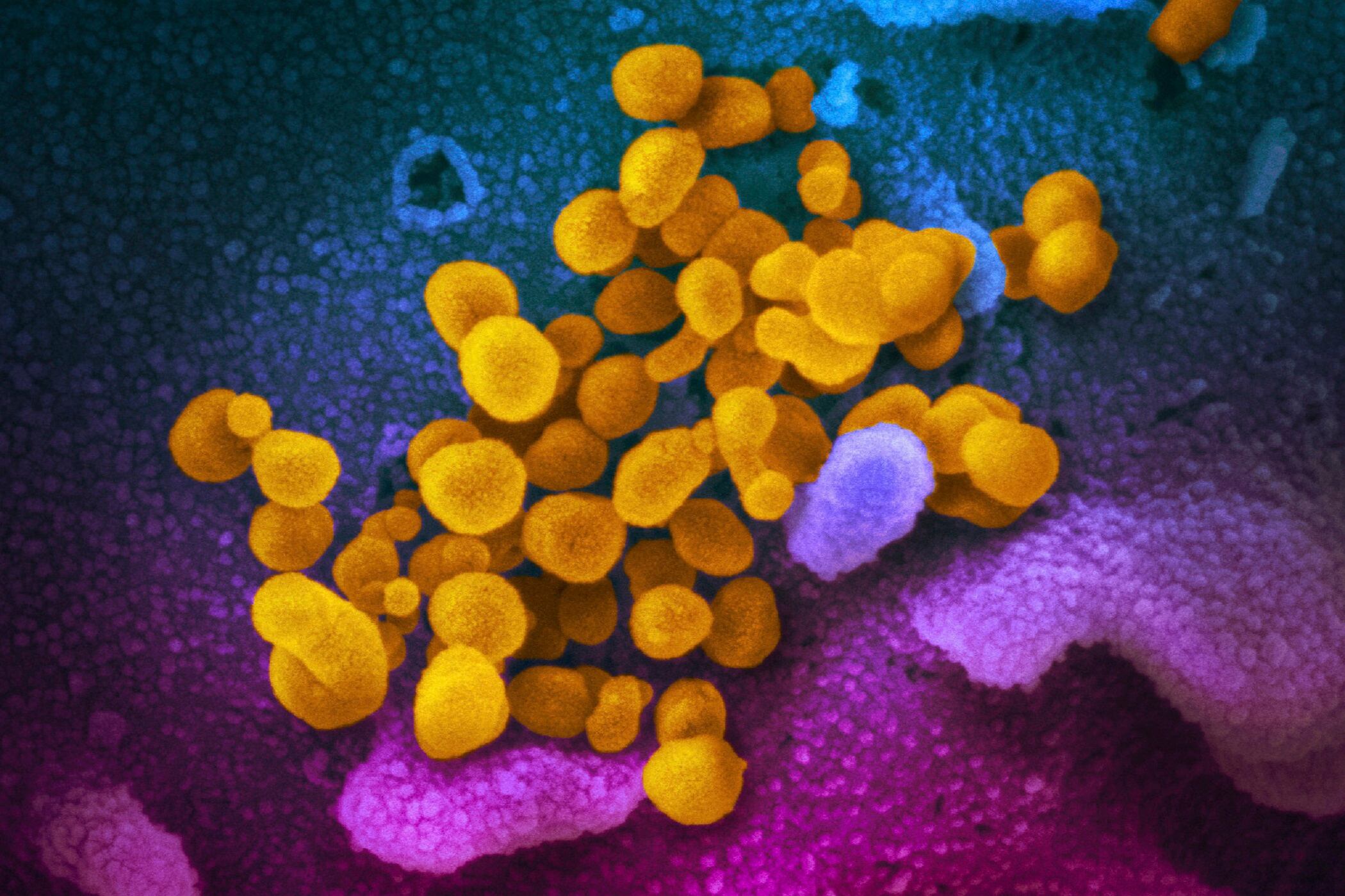
This undated, colorized electron microscope image made available by the U.S. National Institutes of Health in February 2020 shows the Novel Coronavirus SARS-CoV-2, indicated in yellow, emerging from the surface of cells, indicated in blue/pink, cultured in the lab. The sample was isolated from a patient in the U.S. On Thursday, April 21, 2022, scientists reported a U.K. patient with a severely weakened immune system had COVID-19 for almost a year and a half, underscoring the importance of protecting vulnerable people from the coronavirus. (NIAID-RML via AP, File)
By Laura Ungar
A UK patient with a severely weakened immune system had COVID-19 for almost a year and a half, scientists reported, underscoring the importance of protecting vulnerable people from the coronavirus.
There’s no way to know for sure whether it was the longest-lasting COVID-19 infection because not everyone gets tested, especially on a regular basis like this case.
But at 505 days, “it certainly seems to be the longest reported infection," said Dr. Luke Blagdon Snell, an infectious disease expert at the Guy’s & St. Thomas' NHS Foundation Trust.
Their study investigated which mutations arise — and whether variants evolve — in people with super long infections. It involved nine patients who tested positive for the virus for at least eight weeks. All had weakened immune systems from organ transplants, HIV, cancer or treatment for other illnesses. None were identified for privacy reasons.
Repeated tests showed their infections lingered for an average of 73 days. Two had the virus for more than a year. Previously, researchers said, the longest-known case that was confirmed with a PCR test lasted 335 days.
Persistent COVID-19 is rare and different from long COVID.
“In long COVID, it’s generally assumed the virus has been cleared from your body but the symptoms persist,” Snell said. “With persistent infection, it represents ongoing, active replication of the virus.”
Each time researchers tested patients, they analyzed the genetic code of the virus to make sure it was the same strain and that people didn't get COVID-19 more than once. Still, genetic sequencing showed that the virus changed over time, mutating as it adapted.
The mutations were similar to the ones that later showed up in widespread variants, Snell said, although none of the patients spawned new mutants that became variants of concern. There's also no evidence they spread the virus to others.
The person with the longest known infection tested positive in early 2020, was treated with the antiviral drug remdesiver and died sometime in 2021. Researchers declined to name the cause of death and said the person had several other illnesses.
Five patients survived. Two cleared the infection without treatment, two cleared it after treatment and one still has COVID-19. At the last follow-up earlier this year, that patient’s infection had lasted 412 days.
Researchers hope more treatments will be developed to help people with persistent infections beat the virus.
“We do need to be mindful that there are some people who are more susceptible to these problems like persistent infection and severe disease,” Snell said.
Although persistent infections are rare, experts said there are many people with compromised immune systems who remain at risk of severe COVID-19 and who are trying to stay safe after governments lifted restrictions and masks started coming off. And it's not always easy to know who they are, said Dr. Wesley Long, a pathologist at Houston Methodist in Texas, who was not part of the research.
“Masking in crowds is a considerate thing to do and a way we can protect others,” he said.
___
The Associated Press Health and Science Department receives support from the Howard Hughes Medical Institute’s Department of Science Education. The AP is solely responsible for all content.
2021 has been a year filled with extreme weather conditions. Hundreds of thousands of people recently saw the effects of massive tornados that swept across six states. Now, experts say climate change could have played a major role. Jennifer Marlon, research scientist and lecturer at the Yale School of the Environment, joins Cheddar News to discuss.
Anthony Tall, sports agent and president of Miracle Sports Agency, joins Cheddar News to talk about the challenges professional sports leagues are facing amid a surge in coronavirus cases across the U.S.
Extreme weather hit all of us in 2021. Deadly heat hit parts of the U.S. that normally don't even need air conditioning. More than 52,000 wildfires broke out, a terrifying example of what can happen when extreme heat mixes with drought. Hurricane Ida was so powerful it actually briefly reversed the flow of the Mississippi River. Cheddar News did a deep dive into this year's unbelievable weather and how climate change may have impacted it.
With the New Year just around the corner, many people will be making new health and fitness goals. However, after the initial January push, it's easy to drop your resolutions and go back to your old habits. Joan Ifland, CEO of Food Addiction Reset, discusses her best tips for following through with New Year's Resolutions.
Carlo and Baker preview President Biden's address to the nation as Omicron becomes the new dominant Covid strain. Plus, Trump gets booed for getting his booster and the White House gets a new puppy.
Alinda Mashiku, Conjunction Analysis and Risk Assessment Deputy Manager at the NASA Goddard Space Flight Center, joins Future of Space: Humankind's Leap Forward to explain how space debris is threatening operations in space at a time when more satellites are being deployed.
Marshall Smith, Senior Vice President of Space Systems at Nanoracks and Kirk Shireman, Vice President of the Lunar Exploration Campaign at Lockheed Martin join Future of Space: Humankind's Leap Forward to discuss upcoming plans for developing their Starlab commercial space station after being awarded a $160 million contract by NASA.
The CDC recently endorsed the advisory committee's recommendation that people should receive the Pfizer or Moderna COVID vaccines over the Johnson & Johnson shot, leaving some questions and concerns for the public. Epidemiologist Dr. Eric Feigl-Ding, spoke to Cheddar about the shift in the agency's stance, and what it might mean. "If you already have it, any side effects are already long past," he said. "Going forward is what they're saying. That getting a booster you should get the Moderna or the Pfizer booster, and I don't think they're encouraging anyone to get de novo Johnson & Johnson as their first shot anymore."
The billionaire space race took off in 2021, making major strides in space tourism. That growth is only expected to skyrocket in the next year, as the government and private institutions and companies look to shape the final frontier's exploration. Cheddar News dives into the biggest moments of the year in space, and what comes next for space travel and tourism.
Chloe and Halle Bailey are no strangers to hard work. The sisters got their start performing covers on YouTube and have become a force in the music industry. Since then, the two have spread their wings beyond their duo group to individual projects. Now they're coming together to face off in the LG OLED Ultimate Gaming Showdown. Chloe and Halle join Cheddar News to discuss.