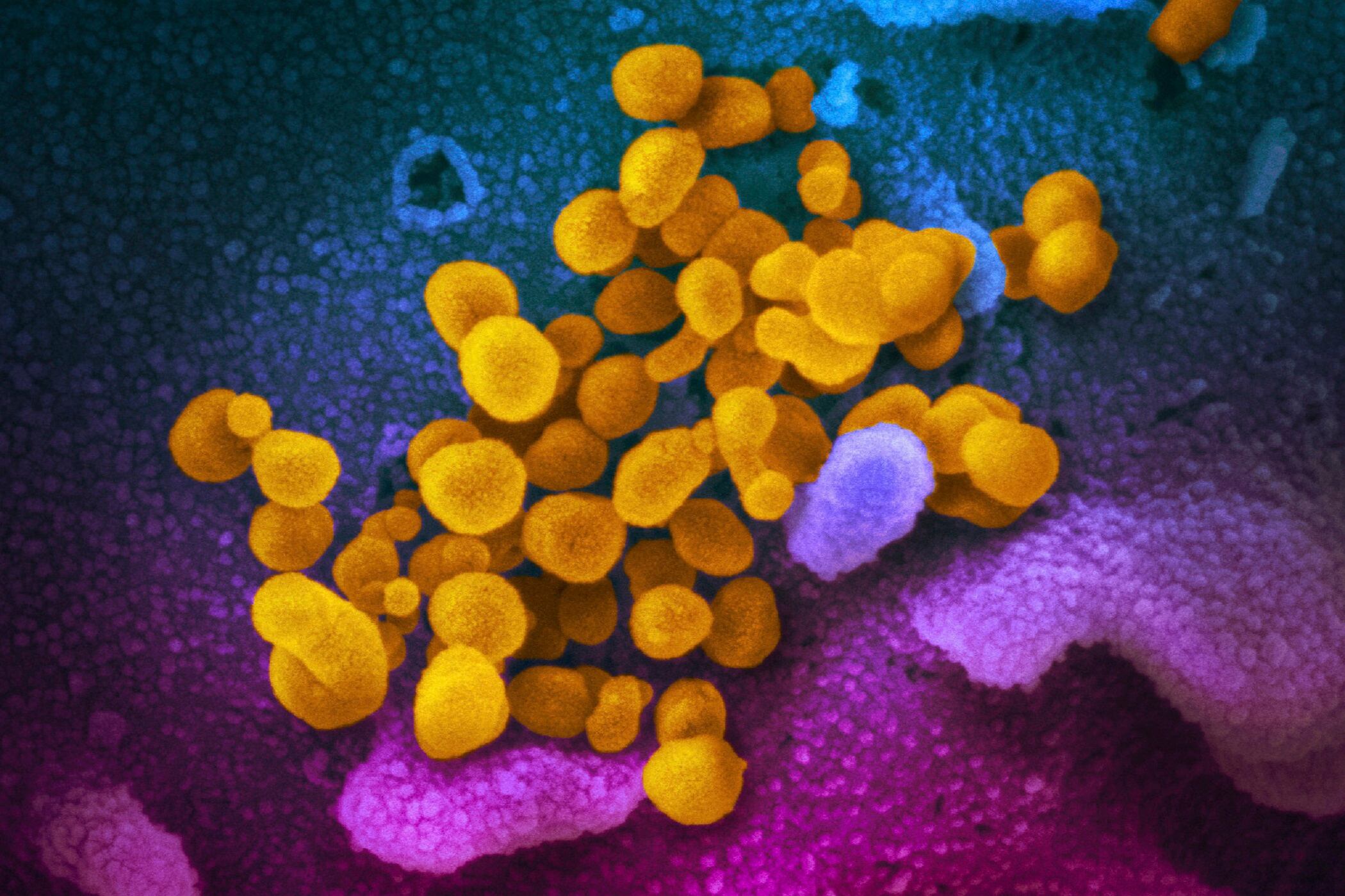
This undated, colorized electron microscope image made available by the U.S. National Institutes of Health in February 2020 shows the Novel Coronavirus SARS-CoV-2, indicated in yellow, emerging from the surface of cells, indicated in blue/pink, cultured in the lab. The sample was isolated from a patient in the U.S. On Thursday, April 21, 2022, scientists reported a U.K. patient with a severely weakened immune system had COVID-19 for almost a year and a half, underscoring the importance of protecting vulnerable people from the coronavirus. (NIAID-RML via AP, File)
By Laura Ungar
A UK patient with a severely weakened immune system had COVID-19 for almost a year and a half, scientists reported, underscoring the importance of protecting vulnerable people from the coronavirus.
There’s no way to know for sure whether it was the longest-lasting COVID-19 infection because not everyone gets tested, especially on a regular basis like this case.
But at 505 days, “it certainly seems to be the longest reported infection," said Dr. Luke Blagdon Snell, an infectious disease expert at the Guy’s & St. Thomas' NHS Foundation Trust.
Their study investigated which mutations arise — and whether variants evolve — in people with super long infections. It involved nine patients who tested positive for the virus for at least eight weeks. All had weakened immune systems from organ transplants, HIV, cancer or treatment for other illnesses. None were identified for privacy reasons.
Repeated tests showed their infections lingered for an average of 73 days. Two had the virus for more than a year. Previously, researchers said, the longest-known case that was confirmed with a PCR test lasted 335 days.
Persistent COVID-19 is rare and different from long COVID.
“In long COVID, it’s generally assumed the virus has been cleared from your body but the symptoms persist,” Snell said. “With persistent infection, it represents ongoing, active replication of the virus.”
Each time researchers tested patients, they analyzed the genetic code of the virus to make sure it was the same strain and that people didn't get COVID-19 more than once. Still, genetic sequencing showed that the virus changed over time, mutating as it adapted.
The mutations were similar to the ones that later showed up in widespread variants, Snell said, although none of the patients spawned new mutants that became variants of concern. There's also no evidence they spread the virus to others.
The person with the longest known infection tested positive in early 2020, was treated with the antiviral drug remdesiver and died sometime in 2021. Researchers declined to name the cause of death and said the person had several other illnesses.
Five patients survived. Two cleared the infection without treatment, two cleared it after treatment and one still has COVID-19. At the last follow-up earlier this year, that patient’s infection had lasted 412 days.
Researchers hope more treatments will be developed to help people with persistent infections beat the virus.
“We do need to be mindful that there are some people who are more susceptible to these problems like persistent infection and severe disease,” Snell said.
Although persistent infections are rare, experts said there are many people with compromised immune systems who remain at risk of severe COVID-19 and who are trying to stay safe after governments lifted restrictions and masks started coming off. And it's not always easy to know who they are, said Dr. Wesley Long, a pathologist at Houston Methodist in Texas, who was not part of the research.
“Masking in crowds is a considerate thing to do and a way we can protect others,” he said.
___
The Associated Press Health and Science Department receives support from the Howard Hughes Medical Institute’s Department of Science Education. The AP is solely responsible for all content.
With a rising number of COVID-19 cases due to the omicron variant, the FDA is making big moves. First, Pfizer's COVID-19 booster has been authorized for those ages 12 to 15. The agency also reduced the amount of time to wait between receiving a second vaccine dose and booster from six months to five. Finally, a third primary series dose of Pfizer's shot is approved for immunocompromised children five to 11 years old. Professor Peter Pitts joins Cheddar News to discuss.
California's new composting law will affect what residents do in their kitchens. As of this week, Californians will have to recycle excess food in an effort to reduce emissions caused by food waste. Cities and counties will turn recycled food into compost or use it as a renewable energy source. California's new law is the largest mandatory residential food waste recycling program in the country. Rachel Wagoner, Director of the California Department of Resources, Recycling and Recovery called the law 'the biggest change to trash' since recycling started in the 1980s. She joined Cheddar Climate to discuss.
Deborah Brosnan, President of Deborah Brosnan & Associates, joins Cheddar Climate, where she explains why global warming brought about 'a year of reckoning' in 2021 and why previously unprecedented weather events could become the norm going forward.
On this episode of Cheddar Reveals, Dr. Anita Gupta, Adjunct assistant professor of anesthesiology and critical care medicine at the Johns Hopkins University School of Medicine, shares her forecast for the healthcare industry in 2022; Waseem Asghar, Ph.D., Associate Professor, Department of Computer & Electrical Engineering and Computer Science, Florida Atlantic University, breaks down the latest progress, trends, and innovations in wearable health tech; Cheddar gets a look at Curiosity Stream's 'Hacking our Biome.'
Dr. Anita Gupta, Adjunct assistant professor of anesthesiology and critical care medicine at the Johns Hopkins University School of Medicine, joins Cheddar Reveals to share her forecast for the healthcare industry in 2022.
Waseem Asghar, Ph.D., Associate Professor, Department of Computer & Electrical Engineering and Computer Science, Florida Atlantic University, joins Cheddar Reveals to break down the latest progress, trends, and innovations in wearable health tech.
Washington DC and the surrounding areas saw a record breaking snow storm Monday as a strong storm system works its way across the eastern U.S. The extreme weather event caused extensive damage in the greater Washington area, leaving thousands in the region without power. Jonathan Porter, Chief Meteorologist, AccuWeather, joined Wake Up with Cheddar to discuss the fierce storm.
Sweta Chakraborty, U.S. President of We Don't Have Time and climate change expert, joins Cheddar News to discuss how mining the proper resources for the clean energy sector is crucial.
Over the past year alone, we've seen an increasing push-back on fossil fuels, legislation to reduce plastic pollution, greater protection over our worlds' forests, and a growing number of companies working to reduce total carbon footprint. To discuss the sustainability trends that defined 2021 and the changes individuals can make in 2022, J.D. Durkin is joined by Ashlee Piper, a sustainability expert and author of 'Give a Sh*t: Do Good. Live Better. Save the Planet,' joins Cheddar News.