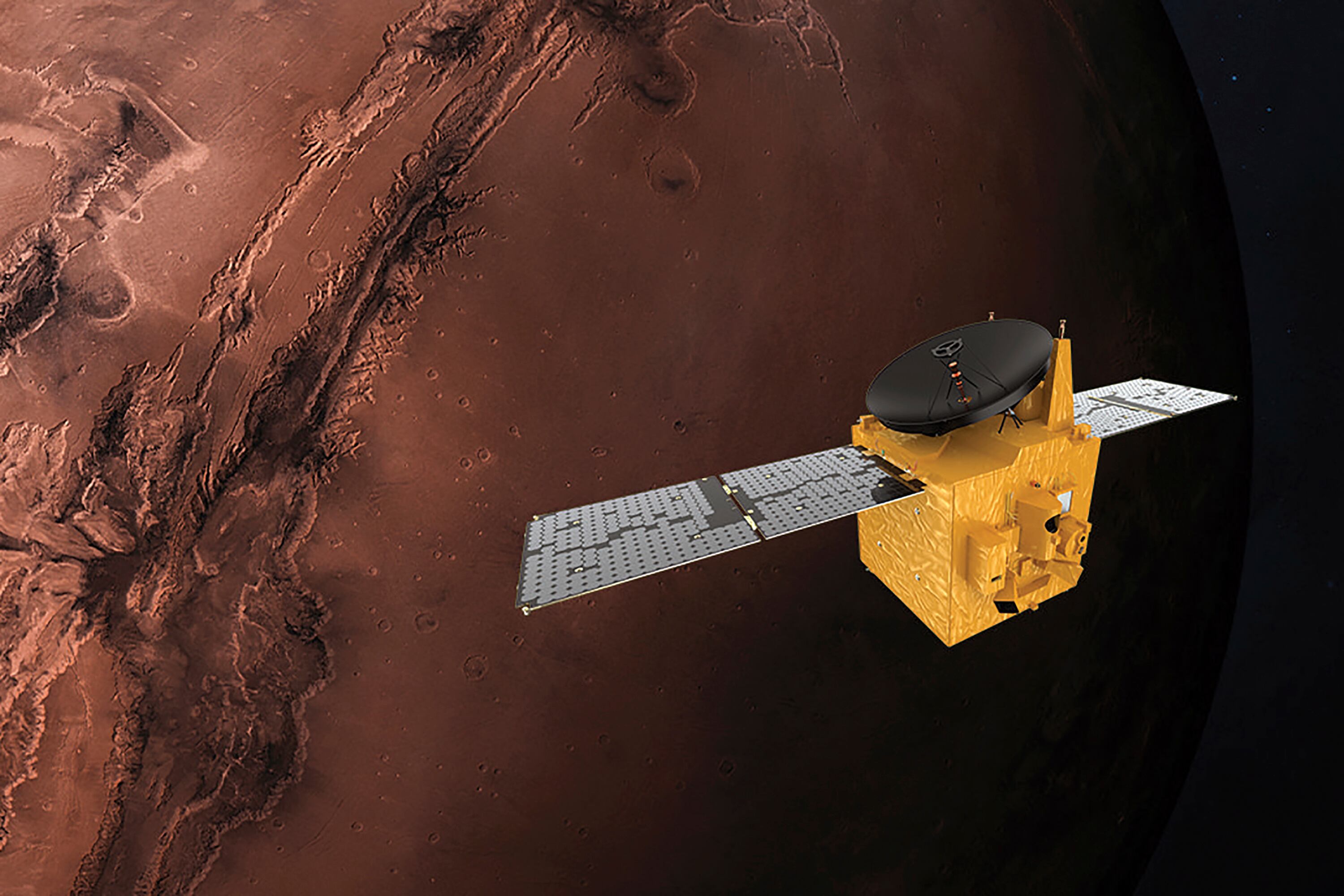
This June 1, 2020, rendering provided by Mohammed Bin Rashid Space Centre shows the Hope probe. The U.S., China and the United Arab Emirates are sending spacecraft to Mars in quick succession beginning this week. (MBRSC via AP)
By Mari Yamaguchi
The liftoff of the United Arab Emirates' Mars orbiter was postponed until Friday due to bad weather at the Japanese launch site.
The orbiter named Amal, or Hope, is the Arab world's first interplanetary mission. The launch was scheduled for Wednesday from the Tanegashima Space Center in southern Japan, but the UAE mission team announced the rescheduled date on Twitter.
Mitsubishi Heavy Industries' H-IIA rocket will carry UAE's craft into space. Mitsubishi launch official Keiji Suzuki had said on Monday a postponement was possible as intermittent lightning and rain were forecast over the next few days.
Heavy rain has fallen for more than a week in large areas of Japan, triggering mudslides and floods and killing more than 70 people, most of them on the southern main island of Kyushu.
Hope is set to reach Mars in February 2021, the year the UAE celebrates 50 years since its formation. A successful Hope mission would be a major step for the oil-dependent economy seeking a future in space.
Hope carries three instruments to study the upper atmosphere and monitor climate change and is scheduled to circle the red planet for at least two years.
Emirates Mars Mission Project Director Omran Sharaf, who joined Monday’s briefing from Dubai, said the mission will provide a complete view of the Martian atmosphere during different seasons for the first time.
Two other Mars missions are planned in the coming days by the U.S. and China. Japan has its own Martian moon mission planned in 2024.
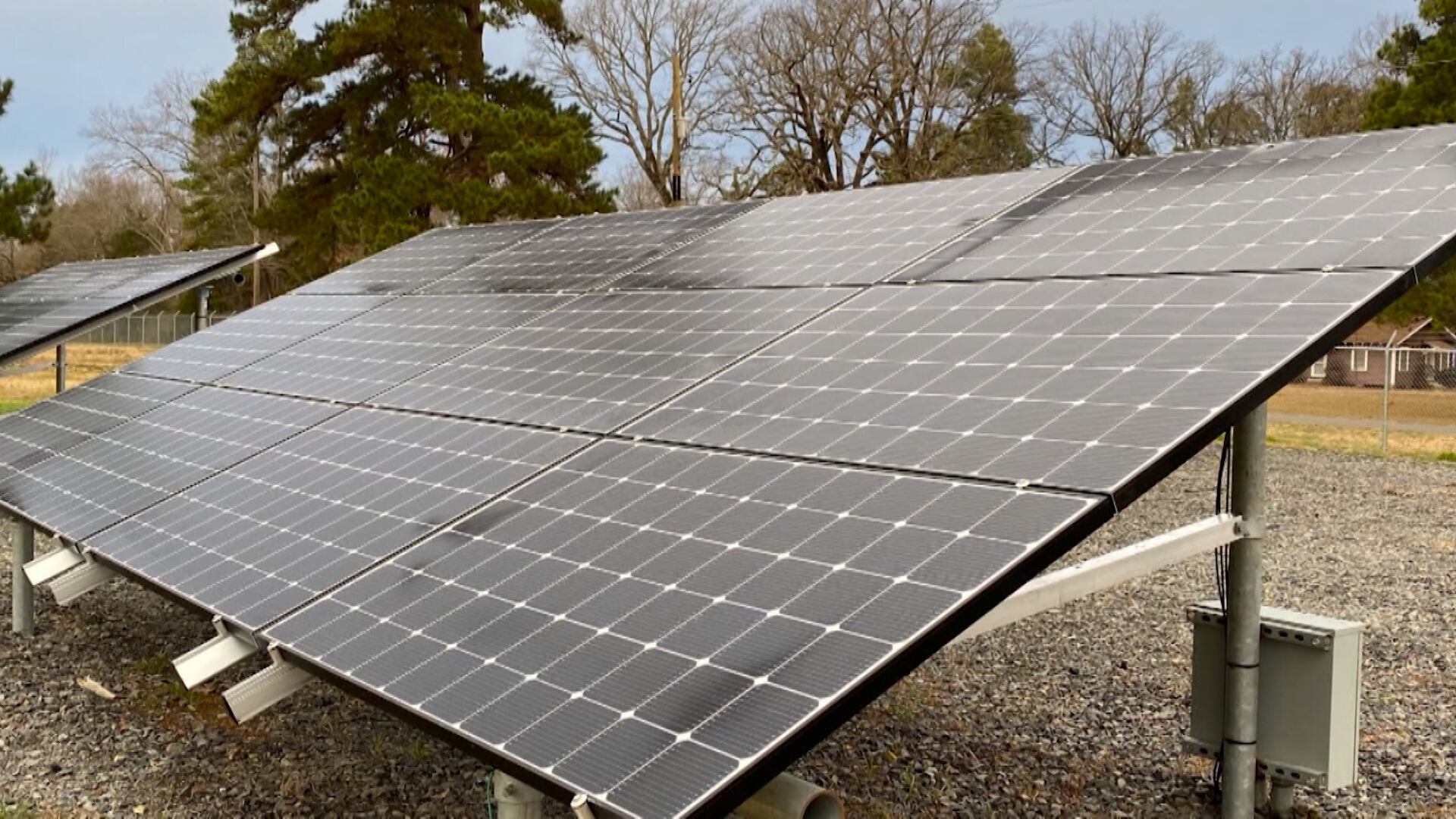
Heila Technologies, a startup that develops hardware and software to integrate renewables and batteries on a microgrid, is helping to power the first clean energy microgrid for Auto Mercado, a top supermarket chain in Costa Rica. The plant will reduce 20 tons of CO2 emissions per year. Heila Technologies CEO Francisco Morocz joins Cheddar Climate to discuss.
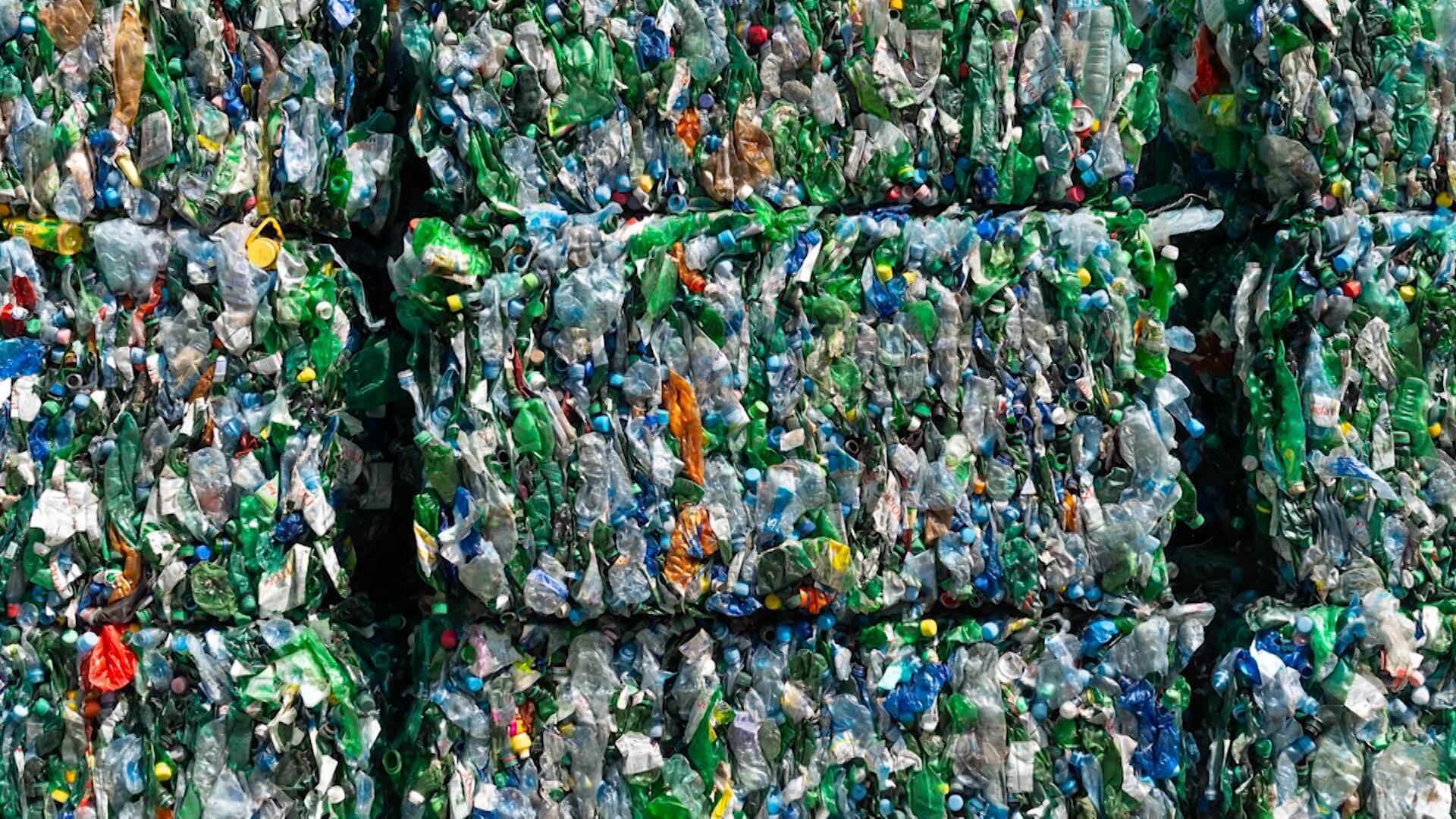
The U.S. has a million-ton problem: each year, hundreds of pounds of plastic waste are produced per person, and that leads to close to 2 million tons of that waste leaking into the environment. Eight million tons end up in the ocean, where it hinders marine life, damages ecosystems, and impacts industry. But in recent years, Congress has introduced measures including the Save our Seas act to try to mitigate the issue and turn our plastic problem around. Sen. Chris Murphy (D-CT) joins Cheddar Climate to discuss why the U.S. is the top global polluter of plastic, what Congress is doing to try to fix the issue, and more.
Daniel Huppmann, researcher at International Institute for Applied Systems Analysis, joins Cheddar Climate, where he explains how the global economy could be 2% bigger by 2100 if the world can hold global warming below 1.5°C.
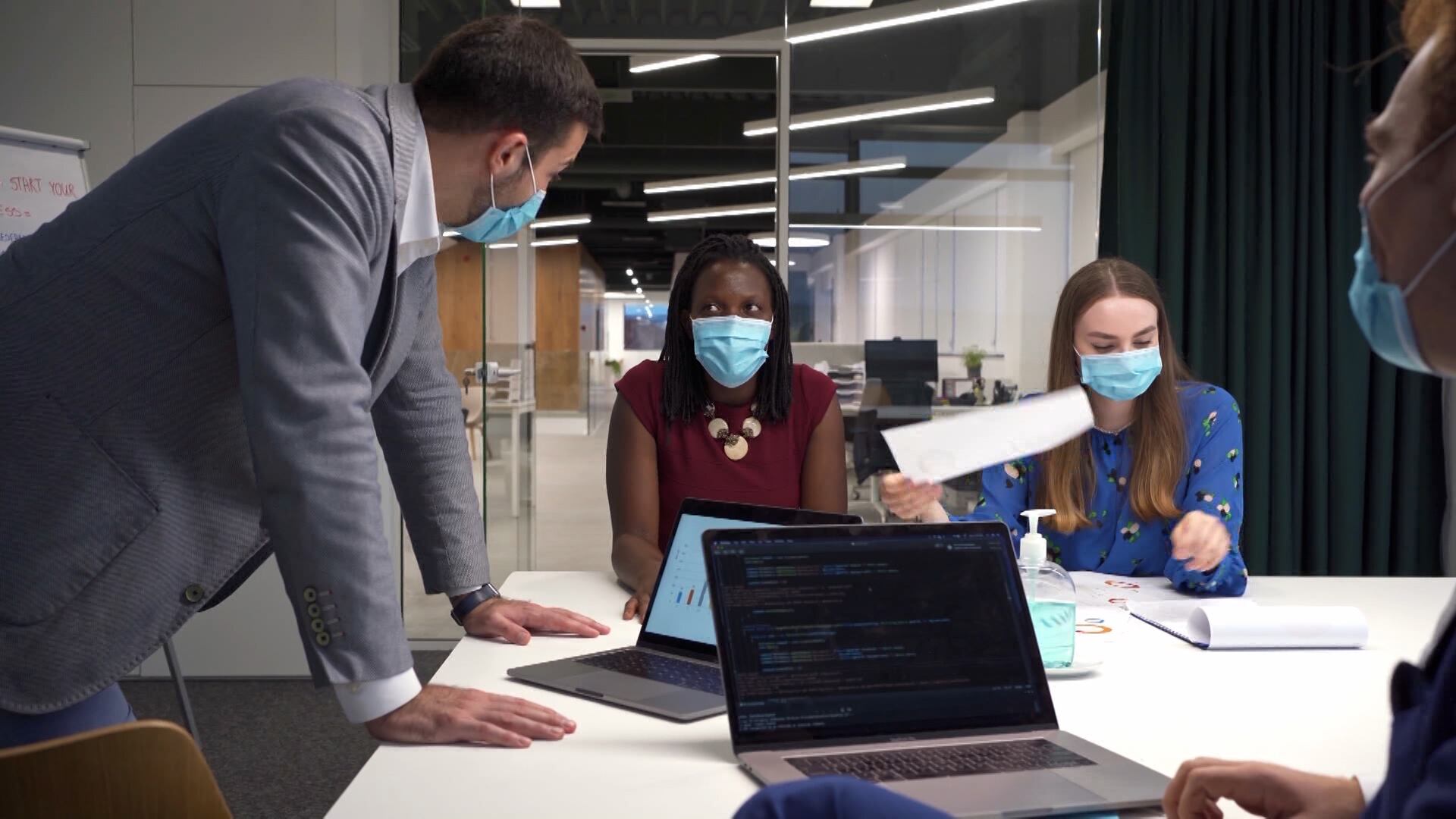
While the World Health Organization strongly advises against a COVID-19 vaccine mandate, national and local governments are moving to make inoculations compulsory. Cheddar News speaks with Dr. Joel Zinberg of the Competitive Enterprise Institute on the issue.
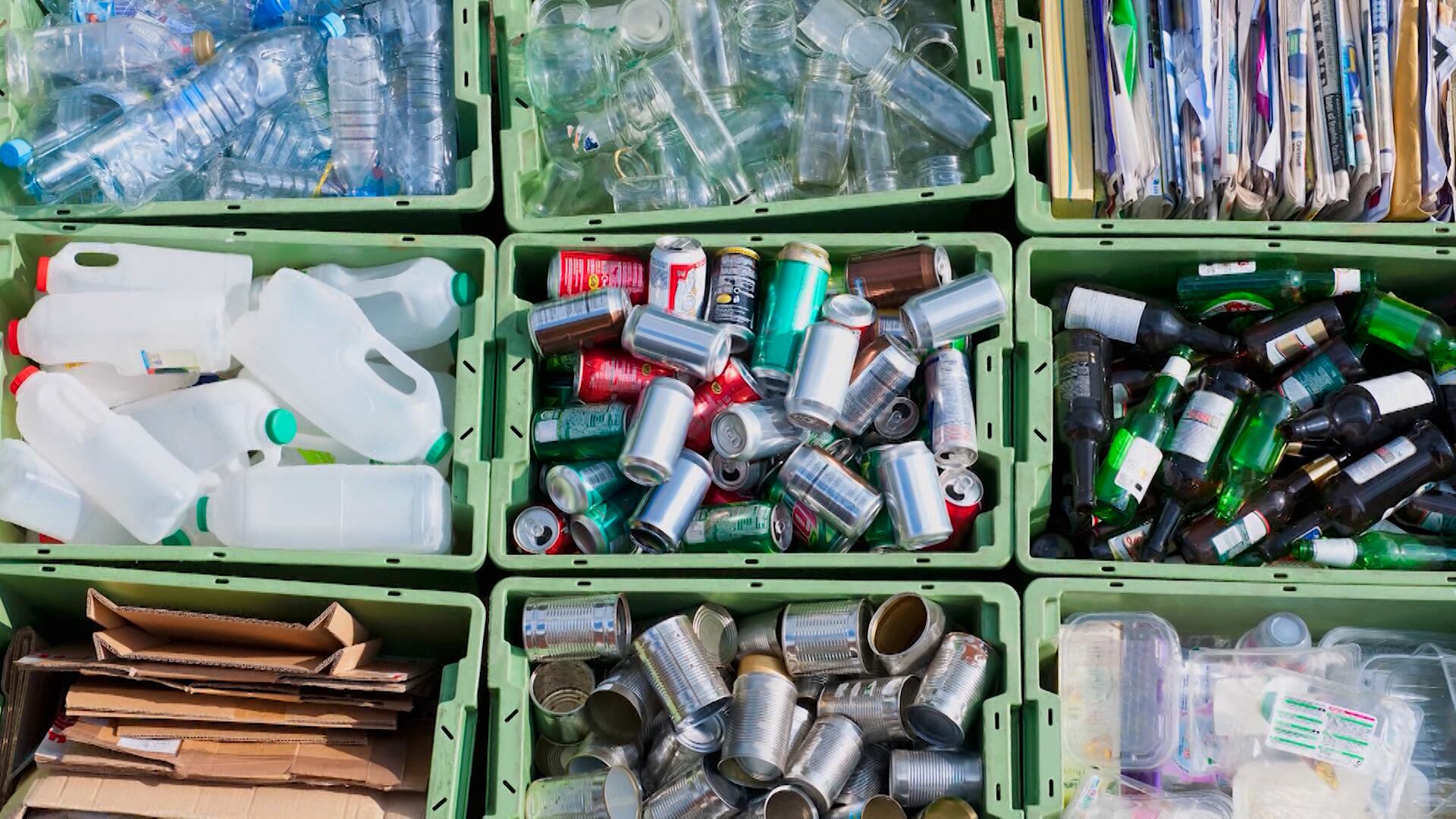
Cheddar breaks down the challenges of plastic recycling and what one company is doing to help offset the negative environmental impact of single-use plastics.
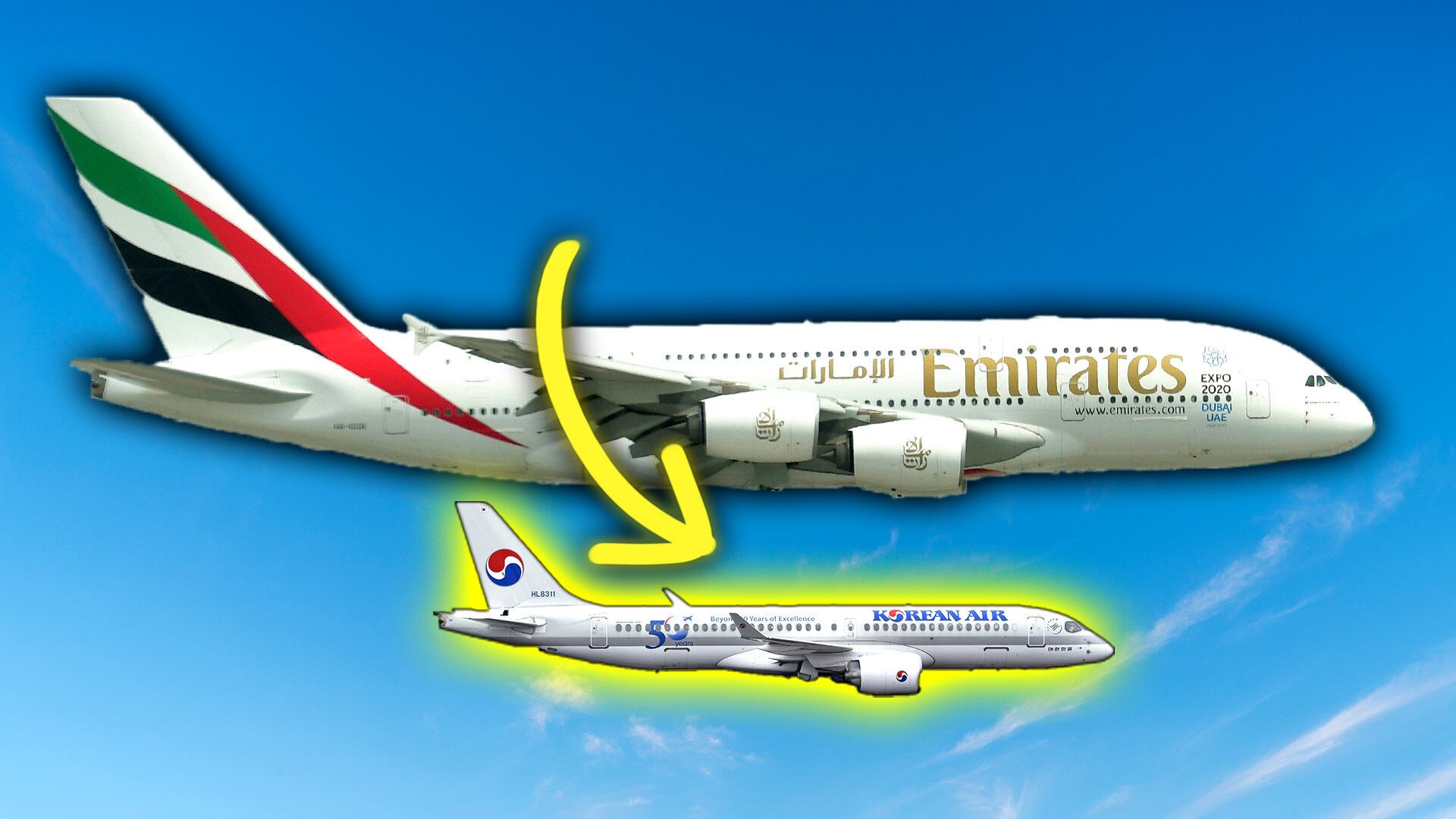
Earlier this year, JetBlue flew its inaugural flight into the United Kingdom. It was a game changer — not only did the airline enter the transatlantic market, but the plane that completed the flight was a single-aisle jet. For decades, flying the distance was synonymous with jumbo jets, but today narrow-body aircraft are now proving they are up for the task — and maybe even the best option. In this episode, Cheddar examines why airlines are betting on narrow-body aircraft.
Carlo and Baker discuss the sweeping new vaccine mandate in NYC that will target all private businesses. Plus, Trump's media venture gets its CEO and more.
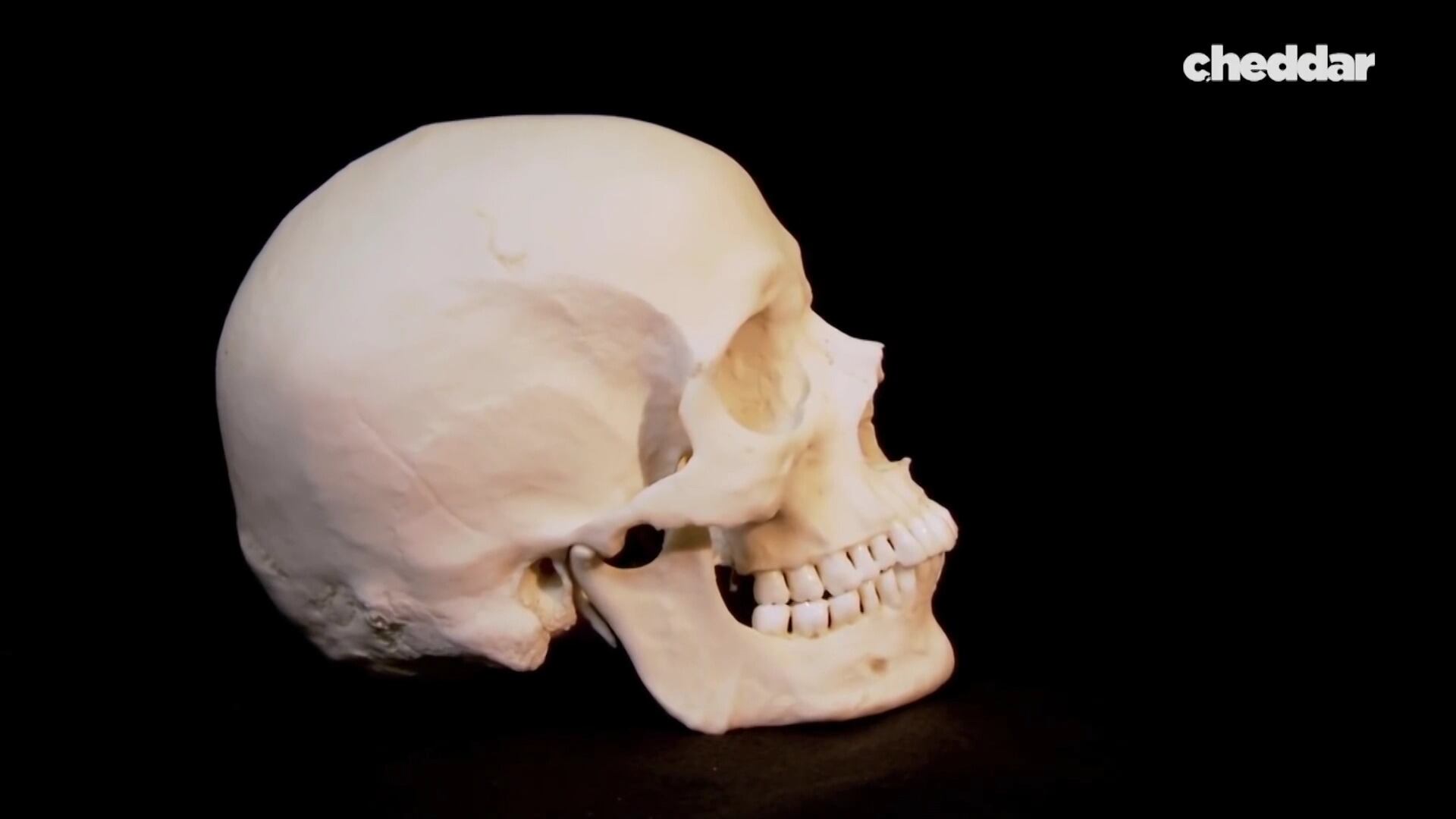
Humans are scientifically the most successful species in the history of planet earth. And for this we can thank our opposable thumbs, proportionally large brains, and our upright posture. But for all our anatomical wonders, we still have some pretty major flaws.