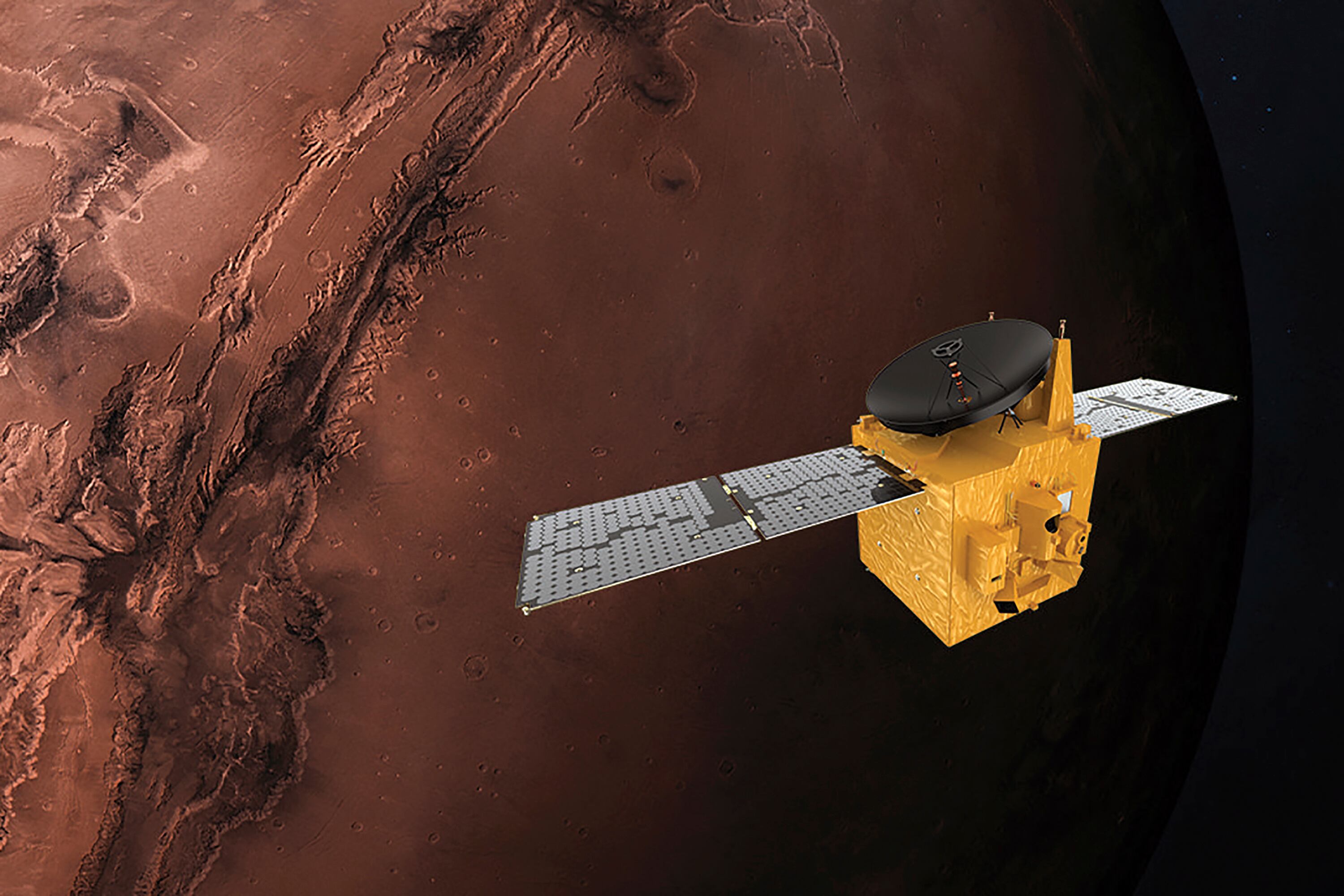
This June 1, 2020, rendering provided by Mohammed Bin Rashid Space Centre shows the Hope probe. The U.S., China and the United Arab Emirates are sending spacecraft to Mars in quick succession beginning this week. (MBRSC via AP)
By Mari Yamaguchi
The liftoff of the United Arab Emirates' Mars orbiter was postponed until Friday due to bad weather at the Japanese launch site.
The orbiter named Amal, or Hope, is the Arab world's first interplanetary mission. The launch was scheduled for Wednesday from the Tanegashima Space Center in southern Japan, but the UAE mission team announced the rescheduled date on Twitter.
Mitsubishi Heavy Industries' H-IIA rocket will carry UAE's craft into space. Mitsubishi launch official Keiji Suzuki had said on Monday a postponement was possible as intermittent lightning and rain were forecast over the next few days.
Heavy rain has fallen for more than a week in large areas of Japan, triggering mudslides and floods and killing more than 70 people, most of them on the southern main island of Kyushu.
Hope is set to reach Mars in February 2021, the year the UAE celebrates 50 years since its formation. A successful Hope mission would be a major step for the oil-dependent economy seeking a future in space.
Hope carries three instruments to study the upper atmosphere and monitor climate change and is scheduled to circle the red planet for at least two years.
Emirates Mars Mission Project Director Omran Sharaf, who joined Monday’s briefing from Dubai, said the mission will provide a complete view of the Martian atmosphere during different seasons for the first time.
Two other Mars missions are planned in the coming days by the U.S. and China. Japan has its own Martian moon mission planned in 2024.
On Monday, football fans were stunned when Buffalo Bills safety Damar Hamlin collapsed and suffered cardiac arrest. Cheddar News explains the condition and the steps to take if you witness an incident.
What's being called an unprecedented breakthrough in cancer treatment recently completed a small trial at New York City's Memorial Sloan Kettering in 14 rectal cancer patients. The experimental trial with the drug dostarlimab resulted in 100 percent remission in all candidates, precluding the need for chemotherapy or surgery. Cheddar News anchor Hena Doba dives into this hopeful story.
Join Cheddar News as we break down the top headlines this morning including updates on the Jan. 6 hears, the PGA suspension of 17 of the world's best golfers, and NASA's plans to study UFOs.
Rick Pauls, President & CEO OF DiaMedica Therapeutics, joins Cheddar Innovates to discuss a new ischemic stroke treatment option that expands the window for effective therapy for stroke patients.
John Bencich, CEO of Achieve Life Sciences, joins Cheddar Innovates to discuss a new plant-based compound that's being used to fight nicotine addiction.
On this episode of Cheddar Innovates: CEO of Achieve Life Sciences discusses a new plant-based compound that's being used to fight nicotine addiction; President & CEO OF DiaMedica Therapeutics explains a new ischemic stroke treatment option that expands the window for effective therapy for stroke patients; Cheddar gets a look at Curiosity Stream's 'Asteroid Rush.'