By Marcia Dunn

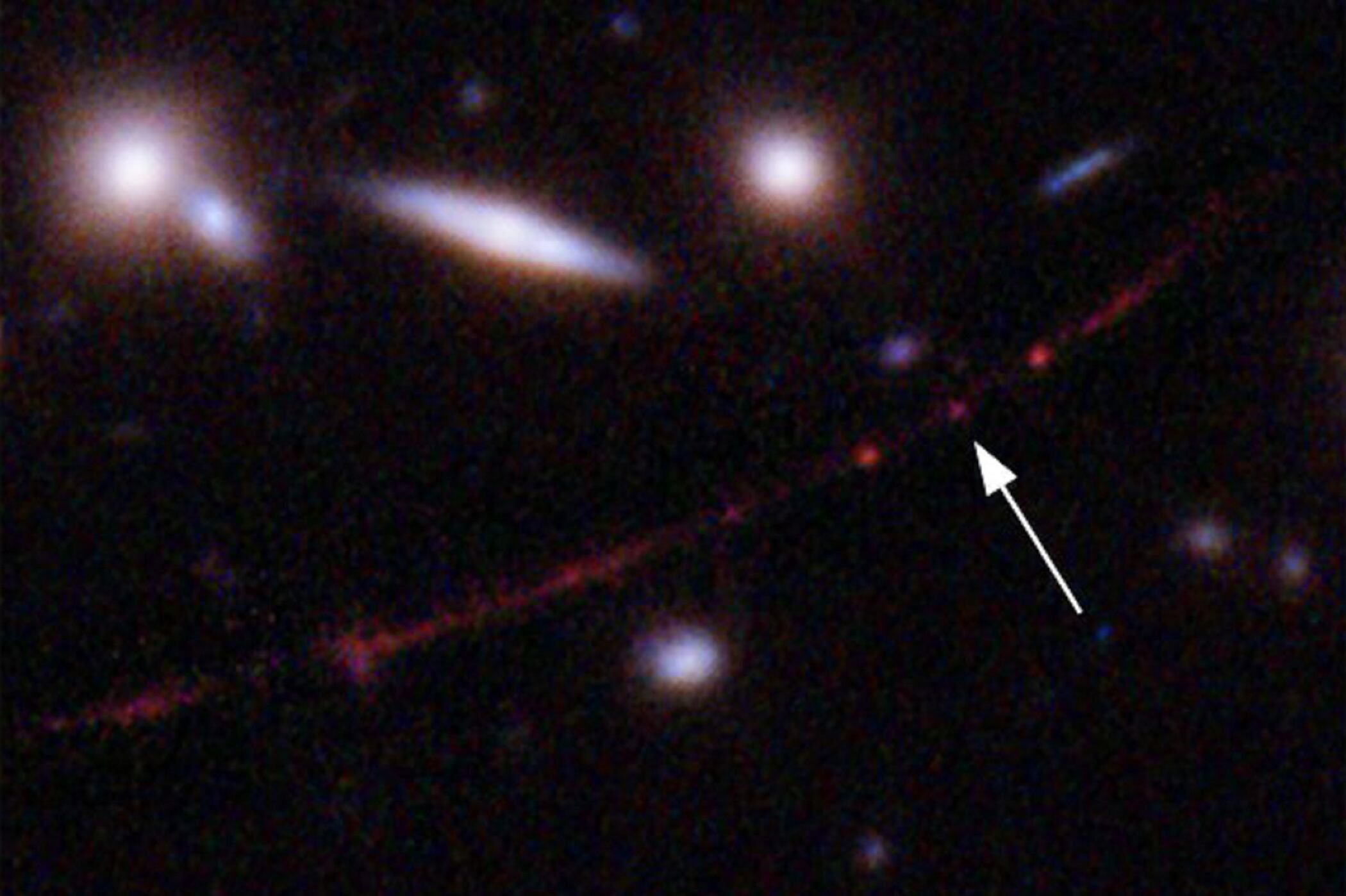
Astronomers have discovered the farthest star yet, a super-hot, super-bright giant that formed nearly 13 billion years ago at the dawn of the cosmos.

But this luminous blue star is long gone, so massive that it almost certainly exploded into bits just a few million years after emerging. Its swift demise makes it all the more incredible that an international team spotted it with observations by the Hubble Space Telescope. It takes eons for light emitted from distant stars to reach us.

“We’re seeing the star as it was about 12.8 billion years ago, which puts it about 900 million years after the Big Bang,” said astronomer Brian Welch, a doctoral student at Johns Hopkins University and lead author of the study appearing in Wednesday’s journal Nature.

“We definitely just got lucky.”

He nicknamed it Earendel, an Old English name which means morning star or rising light — “a fitting name for a star that we have observed in a time often referred to as `Cosmic Dawn.′ ”

The previous record-holder, Icarus, also a blue supergiant star spotted by Hubble, formed 9.4 billion years ago. That’s more than 4 billion years after the Big Bang.

In both instances, astronomers used a technique known as gravitational lensing to magnify the minuscule starlight. Gravity from clusters of galaxies closer to us — in the foreground — serve as a lens to magnify smaller objects in the background. If not for that, Icarus and Earendel would not have been discernible given their vast distances.

While Hubble has spied galaxies as far away as 300 million to 400 million years of the universe-forming Big Bang, their individual stars are impossible to pick out.

“Usually they’re all smooshed together ... But here, nature has given us this one star — highly, highly magnified, magnified by factors of thousands — so that we can study it,” said NASA astrophysicist Jane Rigby, who took part in the study. “It’s such a gift really from the universe.”

Vinicius Placco of the National Science Foundation’s NOIRlab in Tucson, Arizona, described the findings as “amazing work.” He was not involved in the study.

Placco said based on the Hubble data, Earendel may well have been among the first generation of stars born after the Big Bang. Future observations by the newly launched James Webb Space Telescope should provide more details, he said, and “provide us with another piece of this cosmic puzzle that is the evolution of our universe.”

Current data indicate Earendel was more than 50 times the size of our sun and an estimated 1 million times brighter, outsizing Icarus. Earendel’s small, yet-to-mature home galaxy looked nothing like the pretty spiral galaxies photographed elsewhere by Hubble, according to Welch, but rather “kind of an awkward-looking, clumpy object.” Unlike Earendel, he said, this galaxy probably has survived, although in a different form after merging with other galaxies.

“It's like a little snapshot in amber of the past,” Rigby said.

Earendel may have been the prominent star in a two-star, or binary, system, or even a triple- or quadruple-star system, Welch said. There’s a slight chance it could be a black hole, although the observations gathered in 2016 and 2019 suggest otherwise, he noted.

Regardless of its company, the star lasted barely a few million years before exploding as a supernova that went unobserved as most do, Welch said. The most distant supernova seen by astronomers to date goes back 12 billion years.

The Webb telescope — 100 times more powerful than Hubble — should help clarify how massive and hot the star really is, and reveal more about its parent galaxy.

By studying stars, Rigby said: “We are literally understanding where we came from because we’re made up of some of that stardust.”

___

The Associated Press Health and Science Department receives support from the Howard Hughes Medical Institute’s Department of Science Education. The AP is solely responsible for all content.

Share:
More In Science
What We Know About the Omicron Variant of COVID-19
Dr. Farhan Bhatti, a family physician and Michigan State lead for the Committee to Protect Health Care, joined Cheddar to discuss the newly discovered and highly transmissible omicron variant of COVID-19. Bhatti said it is too early to draw any conclusions about the new variant but there is concern that it could eventually mutate and develop a resistance to vaccines. "Time will tell, but for now, it looks like, still, the best thing that we can do to try to limit the spread of this disease is make sure everybody gets a vaccine and make sure everybody avoids large gatherings indoors and wears masks during the wintertime especially," he said.
Omicron Risk, Barbados Drops Queen & Jack Logs Off
Jill and Carlo cover the latest developments with the Omicron variant that are spooking markets once again. Twitter's @Jack is leaving, SCOTUS takes up abortion rights and the world has a brand new republic.
CDC: All U.S. Adults Eligible for Pfizer and Moderna Boosters
A CDC panel unanimously endorsed Moderna and Pfizer Covid-19 vaccine boosters for all U.S. adults. This comes after the FDA gave its own authorization for everyone 18 and older, scrapping previous eligibility factors like age and underlying conditions. Dr. Shereef Elnahal, President and CEO of University Hospital and former New Jersey Health Commissioner, joined Cheddar News to break down the development.
U.S. to Buy 10 Million Courses of Pfizer Covid Pill
The Biden Administration is set to buy 10 million courses of Pfizer's Covid pill if it gains emergency use authorization from the FDA. With this purchase, the U.S. will receive more than 13 million courses of antiviral pills aimed at treating Covid and reducing severe illness and death. Pfizer's pill has been shown to reduce risk of hospitalization and death by 89 percent, proving it could be a key tool in the fight against the pandemic. Dr. Soumi Eachempati, Co-Founder, CEO & CMO of Cleared4, joined Cheddar News to discuss.
New Covid Variant Sends Markets Falling as Investor Concerns Deepen
Friday saw big sell offs, with the Dow Jones posting its worst day since October 2020, falling 905 points, with the Nasdaq and S&P 500 each tumbling more than two percent as well. Much of that due to investor concerns over the new Covid-19 'Omicron' variant first detected in South Africa. Craig Erlam, senior market analyst at Oanda explains what investors should expect this week.
National Geographic's Dr. Sylvia Earle Talks the State of Our Oceans
The ocean is an important topic when it comes to the climate. It plays a vital role in shaping our environment, with rising sea levels causing a 35% increase in natural disasters around the world, affecting 1.7 billion people. Dr. Sylvia Earle has been called perhaps the greatest advocate our oceans have ever had, with Time magazine dubbing her its first 'hero of the planet' and the Library of Congress naming her a living legend. She is also the founder of Mission Blue, an organization that inspires action to explore and protect the ocean. Dr. Earle joined Cheddar Climate for more on the importance of caring for the ocean and its impact on climate change.
Omicron Variant Alarms Scientists Around The World
Scientists are racing to understand the Omicron variant of covid-19 and find out just how dangerous it really is. Omicron, dubbed a variant of concern by the WHO, was first detected in South Africa last week and has already spread to multiple countries, including the UK, Canada, Australia and more. Dr. Jonathan Javitt, CEO of Nrx and adjunct professor at Johns Hopkins School of Medicine, joined Cheddar to discuss what we know and don't know about this new variant.
Biggest Climate Change Investment In U.S. History
The House has officially passed the $1.75 trillion social policy and climate big. This new bill is expected to bring some huge investments into working towards fighting climate change. U.S. President of We Don't Have Time, Sweta Chakraborty, joined Cheddar to discuss more.
Load More