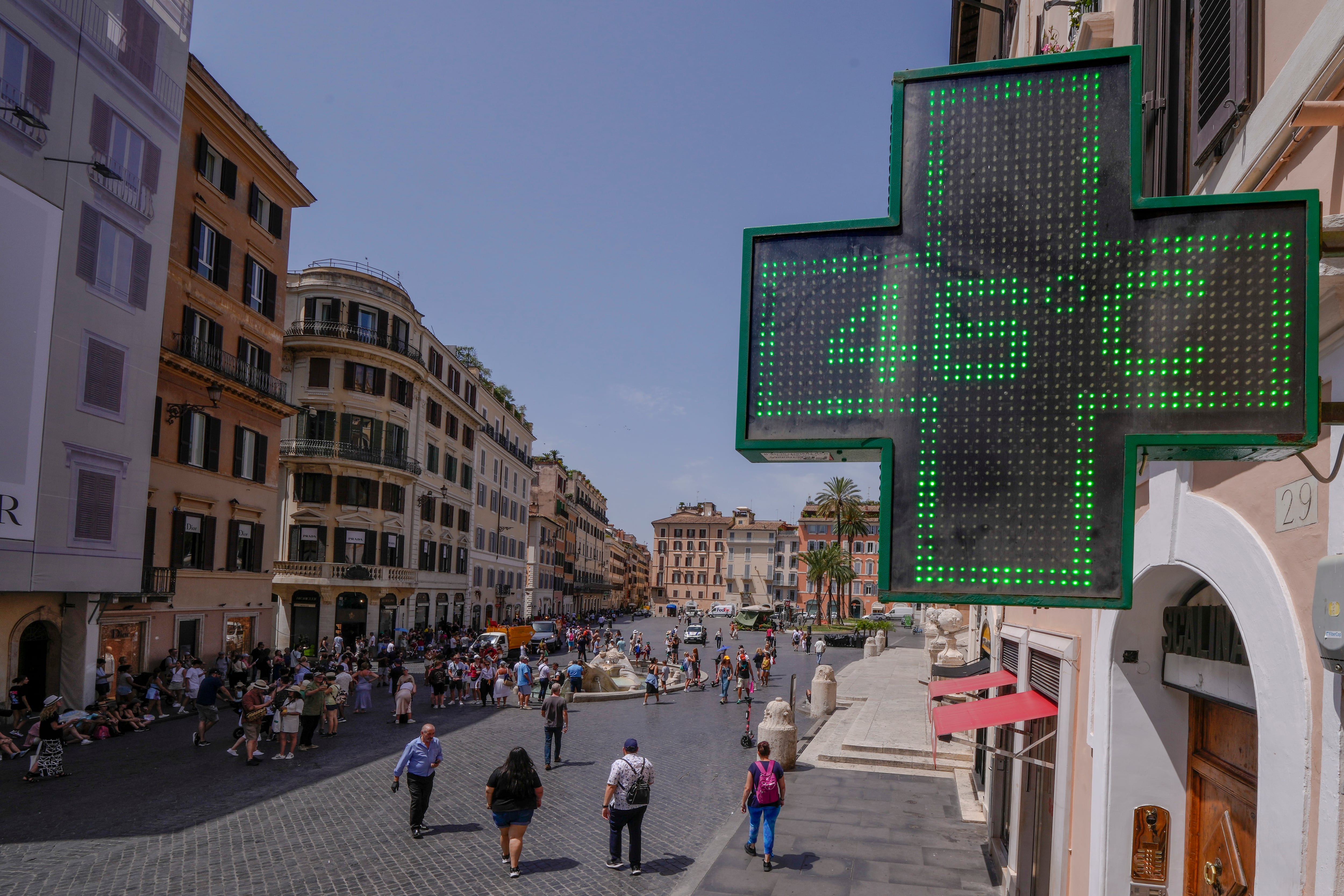
Officials warned residents and tourists packing Mediterranean destinations on Tuesday to stay indoors during the hottest hours as the second heat wave in as many weeks hits the region and Greece, Spain and Switzerland battled wildfires.
In Italy, civil protection workers monitored crowds for people in distress from the heat in central Rome, while Red Cross teams in Portugal took to social media to warn people not to leave pets or children in parked cars. In Greece, volunteers handed out drinking water, and in Spain they reminded people to protect themselves from breathing in smoke from fires.
“Heat waves are really an invisible killer,” Panu Saaristo, the emergency health team leader for the International Federation of Red Cross and Red Crescent Societies, said during a Geneva briefing. “We are experiencing hotter and hotter temperatures for longer stretches of time every single summer here in Europe.”
The new heat wave in several parts of southern Europe is expected to persist for days. The U.N. weather agency said that temperatures in Europe, amplified by climate change, could break the 48.8-degree Celsius (119.8-degree Fahrenheit) record set in Sicily two years ago.
As concerns grew the extreme heat would cause a spike in deaths., civil protection volunteers distributed reusable water bottles at 28 popular spots in Rome. Authorities also encouraged visitors and residents to take advantage of the Italian capital's distinctive public drinking fountains, hundreds of which are located in the city’s historic center alone.
Fausto Alberetto, who was visiting Rome from northern Italy's Piedmont region on Tuesday, asked some volunteers how to use an app to find the closest “nasone.” Reading about the heat wave before his trip did little to prepare him for the reality of Rome’s 40 C (104 F) temperatures, he said.
“We got information and we were prepared. But it is one thing to hear it or read it, it is another thing to feel it,″ Alberetto said as he walked near Piazza Venezia in the heart of Rome. ”Here, it is really dreadful.”
Civil protection volunteers identified four people deemed to be suffering from the heat, but none of them was in serious condition, according to Giuseppe Napolitano, Rome's civil protection director.
In Cyprus, health authorities confirmed that a 90-year-old man died over the weekend and six other older adults were hospitalized after all seven suffered heatstroke at home last week as temperatures surpassed 43 degrees Celsius (110 degrees Fahrenheit).
Heat records are being shattered all over the world, and scientists say there is a good chance that 2023 will go down as the hottest year on record, with measurements going back to the middle of the 19th century.
June saw the warmest global average temperature, according to Europe’s Copernicus Climate Change Service. The U.N.’s World Meteorological Organization predicted that a number of heat records were set to fall this summer. The global organization said unprecedented sea surface temperatures and low Arctic sea-ice levels were largely to blame.
Human-caused climate change from the burning of coal, oil and natural gas is making the world hotter and is being amplified by the naturally occurring El Nino weather phenomenon. But the current El Nino only started a few months ago and is still weak to moderate and isn’t expected to peak until winter.
Temperatures above 40 C (104 F) were forecast to persist not only in the Mediterranean, but across North America, Asia and North Africa.
“These are not your normal weather systems of the past. They have arrived as a consequence of climate change,” John Nairn, senior extreme heat adviser for World Meteorological Organization, said. “It is global warming, and it’s going to continue for some time.”
Nairn noted a sixfold increase in simultaneous heat waves since the 1980s, “and the trend line isn’t changing.”
A relentless summer last year saw Europe sweat through heat wave after heat wave, resulting in 61,000 heat-related deaths, scientists estimate. In 2019, as the world experienced its hottest July on record, the continent also sweltered, with even towns in the Arctic circle reaching new scorching highs.
Spain and Portugal had their temperature records shattered in 2018 when a mass of hot air moved up from Africa, igniting forest fires in the Iberian Peninsula.
The idea that hot weather could be a killer, not just an inconvenience, was impressed on much of Europe by a deadly 2003 heat wave.
France, the most-affected country, had around 15,000 heat-related deaths, many of them of older people left in city apartments and retirement homes without air conditioning. The deaths prompted the country to introduce a warning system and reassess how it dealt with extreme temperatures.
Other countries are taking steps to protect the public's help during the sweltering summer of 2023,
In Greece, authorities last week introduced changes in working hours and ordered afternoon closures of the Acropolis and other ancient sites to allow workers to cope with the high heat. A second heat wave is expected to hit Thursday, and temperatures as high as 44 C (111 F) were expected in parts of central and southern Greece by the end of the week.
Three large wildfires burned outside Athens for a second day. Thousands of people evacuated from coastal areas south of the capital returned to their homes Tuesday when a fire finally receded after they spent the night on beaches, hotels and public facilities.
Most of Spain is under alert for high to extreme heat with forecasts calling for peak temperatures of 43 C (109 F) in areas along the Ebro River in the northeast and on the island of Mallorca. Spain is also dealing with a prolonged drought that has increased concerns about the risk of wildfires.
Some 400 firefighters assisted by nine water-dumping aircraft labored to extinguish a wildfire that burned for a fourth consecutive day on La Palma in Spain’s Canary Islands. Authorities said a perimeter was established around the blaze but it remained active.
In Switzerland, some 150 firefighters, police, troops and other emergency teams backed by helicopters fanned out Tuesday to fight a wildfire that engulfed a mountainside in the southwestern Wallis region, evacuating residents of four villages and hamlets in the area.
In a report Monday, the U.N. weather agency said that a committee of experts has verified the accuracy of Europe's all-time heat record: the 48.8-degree Celsius (119.8 F) temperature reached on August 11, 2021, in Sicily. A full report has not yet been published.
The previous verified record of 48 degrees Celsius (118.4 degrees Fahrenheit) was set in Athens on July 10, 1977.