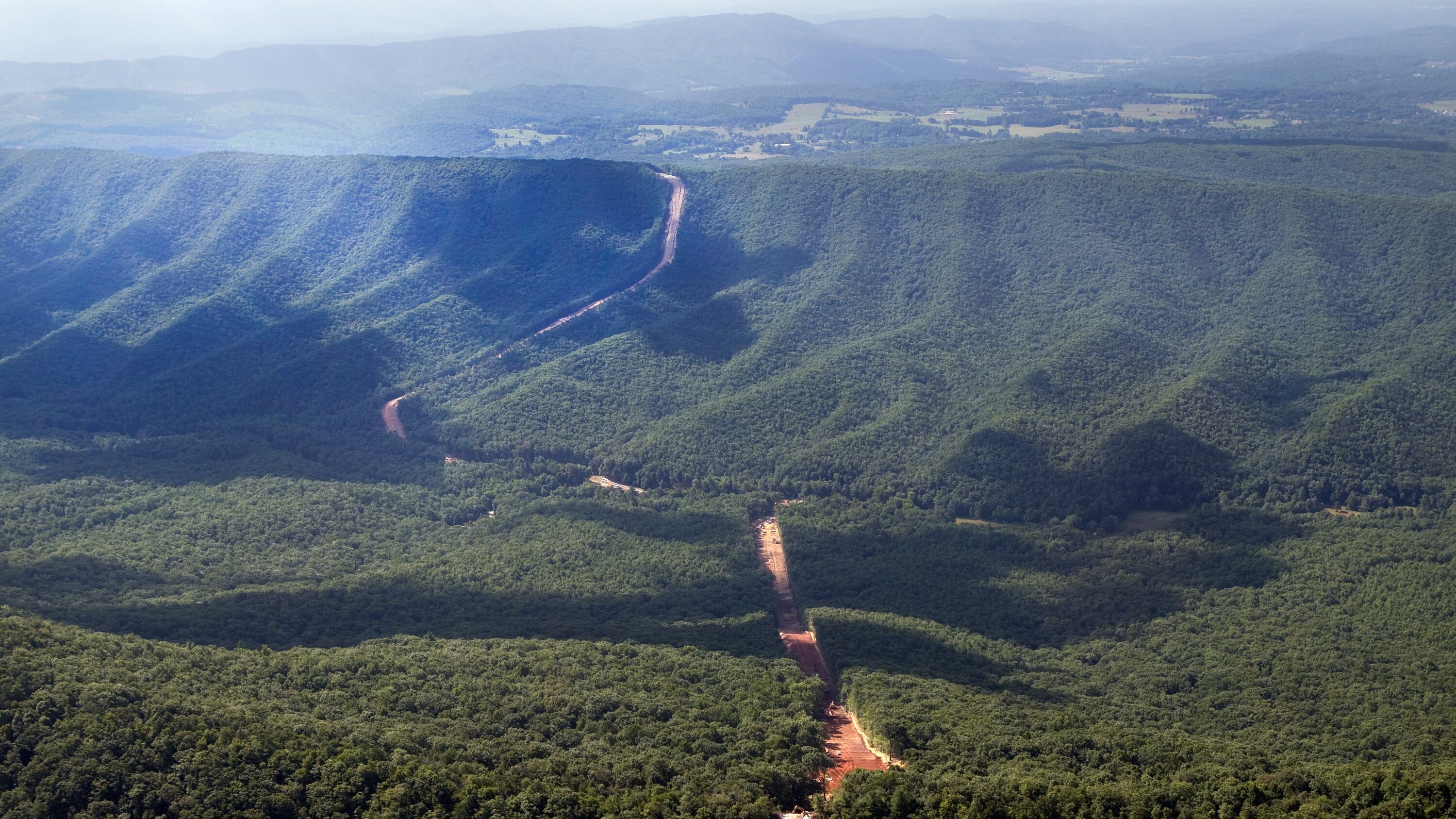
The Supreme Court on Thursday allowed construction to resume on a contested natural-gas pipeline that is being built through Virginia and West Virginia.
Work on the Mountain Valley Pipeline had been blocked by the 4th U.S. Circuit Court of Appeals in Richmond, Virginia, even after Congress ordered the project's approval as part of the bipartisan bill to increase the debt ceiling. President Joe Biden signed the bill into law in June.
The high court's order came as a three-judge panel of the appeals court was hearing arguments in the case.
The Biden administration backed the company in calling for the Supreme Court’s intervention.
“All necessary permits have been issued and approved, we passed bipartisan legislation in Congress, the president signed that legislation into law, and now the Supreme Court has spoken: construction on the Mountain Valley Pipeline can finally resume, which is a major win for American energy and American jobs,” West Virginia Republican Sen. Shelley Moore Capito said in a statement.
Sen. Joe Manchin, a West Virginia Democrat who was a key vote for last year’s sweeping legislation, said on X, the social media platform formerly known as Twitter, that the Supreme Court’s decision “is the correct one.”
Lawyers for the company said they needed quick Supreme Court action to keep plans on track to finish building the 300-mile (500-kilometer) pipeline and put it into service by the winter, when the need for natural gas for heating grows.
Environmental groups have opposed the the $6.6 billion project, designed to meet growing energy demands in the South and Mid-Atlantic by transporting gas from the Marcellus and Utica fields in Pennsylvania and Ohio.
The 4th Circuit panel did not immediately rule on Mountain Valley Pipeline’s motion to dismiss challenges to the project over concerns about the pipeline’s impact on endangered species, erosion and stream sedimentation.
Opponents said they will continue to try to stop construction on the project and are eager to see how the 4th Circuit rules.
“All The Supreme Court did today was weigh in on a preliminary stay. The 4th Circuit still has the meat of the case and they can still grant final relief," said DJ Gerken, executive director of the Southern Environmental Law Center.
“We still believe it’s unconstitutional," he said.
Any ruling by the 4th Circuit would be subject to potential review by the Supreme Court.
In court papers, lawyers for the pipeline argued that Congress was within its rights to strip the 4th Circuit from jurisdiction over the case. They also said that any debate over the law’s constitutionality should be heard not by the 4th Circuit but by an appellate court in Washington, because the law passed by Congress last month spells out that precise scenario.
Mountain Valley Pipeline said the work is largely complete, except for a 3-mile (5-kilometer) section that cuts through the Jefferson National Forest.
“In accordance with the project’s strict safety standards and environmental requirements of the issued permits, we look forward to completing this important infrastructure project,” spokesperson Natalie Cox said in a statement.
West Virginia Attorney General Patrick Morrisey, who had asked the Supreme Court to take up the case, said after the ruling that there was an “urgent need” for the pipeline to be completed without delay.
Jamie Williams, president of The Wilderness Society, said in a statement that allowing the pipeline to proceed “puts the profits of a few corporations ahead of the health and safety of Appalachian communities."
“The Mountain Valley Pipeline is a threat to our water, our air, and our climate,” Williams said.
Derek Teaney, an attorney for Appalachian Mountain Advocates, told the 4th Circuit that Congress’ action last month requiring that all necessary permits be issued for the pipeline's construction “crosses the fence between the judicial power and the legislative power.”
At the end of the hearing, 4th Circuit Judge James A. Wynn commended attorneys on both sides for the work they've done.
”If we grant the motion, this is probably the last time we’re going to see you," he said. “We don’t know where we’ll go from here.”
Associated Press writers John Raby in Charleston, West Virginia, and Denise Lavoie in Richmond, Virginia, contributed to this report.