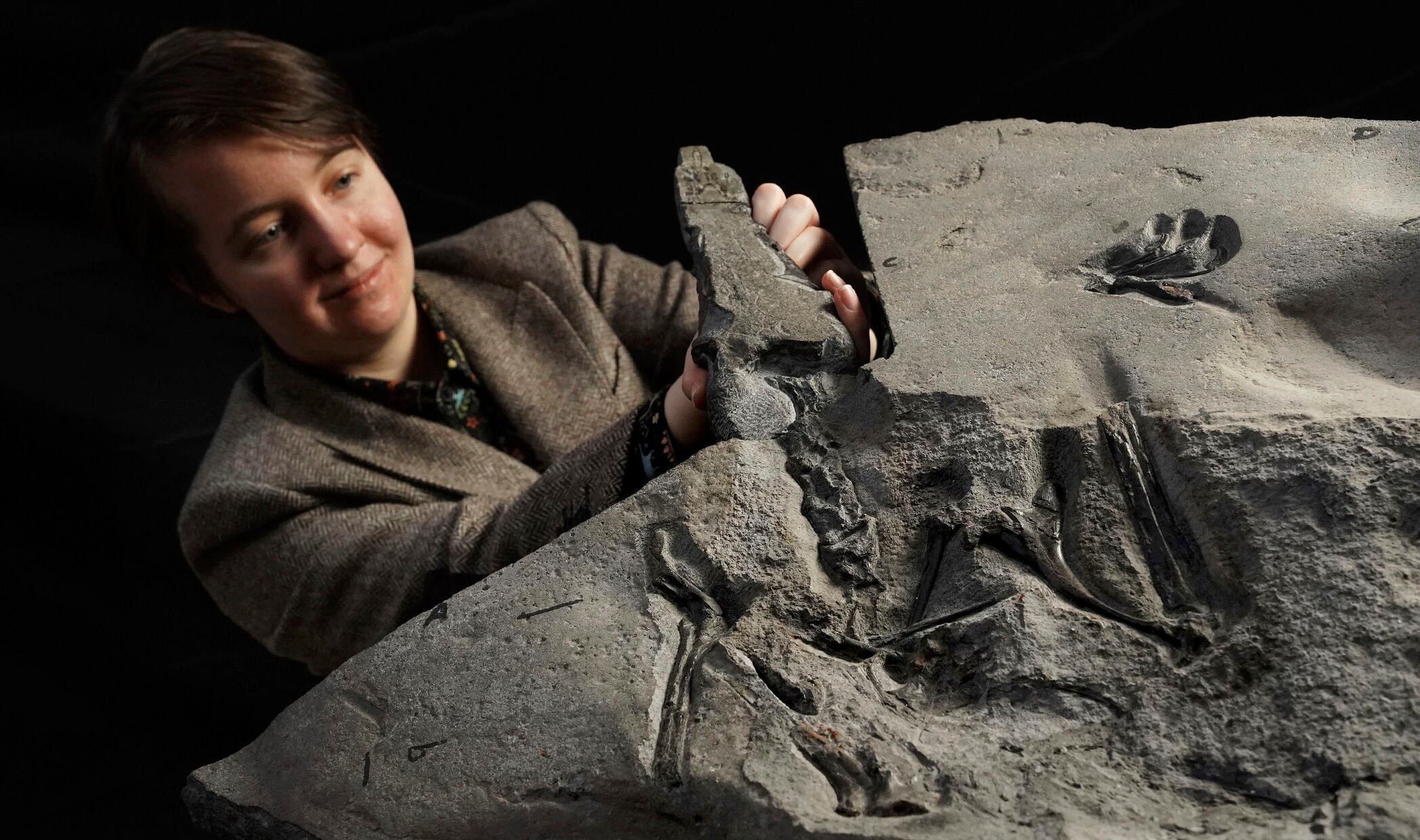
In this undated photo issued by the National Museums Scotland on Tuesday, Feb. 22, 2022, University of Edinburgh PhD student Natalia Jagielska poses for a photo with the world's largest Jurassic pterosaur unearthed on the Isle of Skye. The fossil of a 170-million-year-old pterosaur, more popularly known as pterodactyl, billed as the world’s best-preserved skeleton of the prehistoric winged reptile, has been found on the Isle of Skye in remote Scotland. The National Museum of Scotland said the fossil of the pterosaur is the largest of its kind ever discovered from the Jurassic period. (Stewart Attwood/National Museums Scotland via AP)
By Sylvia Hui
The fossil of a 170 million-year-old pterosaur, described as the world’s best-preserved skeleton of the prehistoric winged reptile, has been found on the Isle of Skye in Scotland, scientists said Tuesday.
The National Museum of Scotland said the fossil of the pterosaur, more popularly known as pterodactyls, is the largest of its kind ever discovered from the Jurassic period. The reptile had an estimated wingspan of more than 2.5 meters (8.2 feet), similar to that of an albatross, the museum said.
The fossil was discovered in 2017 by PhD student Amelia Penny during a field trip on the Isle of Skye in remote northwestern Scotland, when she spotted the pterosaur’s jaw protruding from rocks. It will now be added to the museum’s collection.
“Pterosaurs preserved in such quality are exceedingly rare and are usually reserved to select rock formations in Brazil and China. And yet, an enormous superbly preserved pterosaur emerged from a tidal platform in Scotland,” said Natalia Jagielska, a doctoral student at the University of Edinburgh who is the author of a new scientific paper describing the find.
Steve Brusatte, a professor of palaeontology at Edinburgh University, said the discovery was the best one found in Britain since the early 1800s, when celebrated fossil hunter Mary Anning uncovered many significant Jurassic fossils on the southern English coast.
He said the fossil had “feather light” bones, “as thin as sheets of paper,” and it took several days to cut it from rock using diamond-tipped saws as his team battled against encroaching tides.
It “tells us that pterosaurs got larger much earlier than we thought, long before the Cretaceous period when they were competing with birds, and that’s hugely significant,” Brusatte added.
The pterosaur has been given the Gaelic name Dearc sgiathanach, which translates as “winged reptile."
Pterosaurs were the first vertebrates to fly, some 50 million years before birds. They lived as far back as the Triassic period, about 230 million years ago. They were previously thought to have been much smaller during the Jurassic period.
On this episode of Cheddar Innovates: President of The Pillow Bar breaks down how everyone can benefit from a pillow customized to their unique way of sleeping; CEO of H2Pro explains how to bring environmentally friendly hydrogen to scale; Cheddar gets a look at Curiosity Stream's 'Suppressed Science.'
On this episode of Cheddar Innovates: Gardenuity CEO breaks down how gardening can improve your wellbeing; Augmedix CEO discusses how this technology is helping doctors fight burnout; Cheddar gets a look at Curiosity Stream's 'Suppressed Science.'
On this episode of Cheddar Innovates: Atom Limbs CEO breaks down how the Atom Touch prosthetic is different from other prosthetics on the market; CEO & Chief Scientific Officer of MyMD explains how the MYMD-1 is on track to be the first FDA-approved drug to treat aging and age-related diseases; A look at Curiosity Stream's 'The Future of Warfare.'
On this episode of Cheddar Innovates: SkilsVR CEO explains how virtual reality is being used to train frontline workers to handle difficult customers; Rubicon CEO breaks down how technology and sustainability will go hand in hand in the future; Cheddar gets a look at 'Our Infinite Universe.'
A UN report is warning that relying on seawalls and other engineering fixes will not be enough to keep communities safe from rising sea levels and climate change consequences. Dr. Steve Rose, a senior research economist at the Electric Power Research Institute, joins Cheddar News to discuss.
As gas prices surge amid the Russian invasion of Ukraine, other nations could potentially transition faster to using clean energy than previously expected. Philip K. Verleger, a senior fellow at the Niskanen Center, joined Cheddar News to explain how this could be a possibility in the near future. "Part of the reason I think we have this invasion and the tantrum that's being thrown by Russia, terrible tantrum, is because the Russians were trying to slow down the transition," he said. "Ironically they speeded it up."
As Russia intensifies its war on Ukraine, President Biden announced a ban on oil imported from the aggressor nation. Critics of Russia have said this would be the best way to force Putin to pull back, but curbs on Russian oil exports are expected to send already skyrocketing oil and gas prices even higher, further impacting consumers, businesses, financial markets, and the global economy. Leslie Beyer, CEO of the Energy Workforce and Technology Council, joined Cheddar News' Closing Bell to discuss. "It's certainly going to increase pricing, but it is the right thing to do," she said. "The industry itself has already pulled out of the significant portion of its operations in Russia."
On this episode of Cheddar Innovates: Vision Marine Technologies CEO discusses how e-boats will play a role in the fight against the climate crisis; Lasso CEO breaks down how the design behind these compression socks can prevent injuries and improve performance; Cheddar gets a look at Curiosity Stream's 'The Tombs Of Egypt.'
Vaccine maker Pfizer delayed its COVID shot for kids allegedly due to a lack of data on how it would perform against the omnicron variant, according to the Wall Street Journa. Peter Pitts, professor and founder of the Center for Medicine in the Public Interest and a former FDA associate commissioner, joined Cheddar News Wrap to break down why the authorization can't be rushed. "Going forward, the FDA wants to look at data specifically against omicron, and it looks like that's going to be a three-shot regimen versus two, which was efficient against delta but not omicron because obviously omicron is more infectious," said Pitts.
Walker Ross, Assistant Professor of Sports Business Management at Florida Southern College, joins Business of Sports: The Beijing Winter Olympics 2022, where he says that actions Beijing and other Olympic host sites have been implementing to combat climate change has simply not been enough to offset their carbon footprint.