By Sylvia Hui
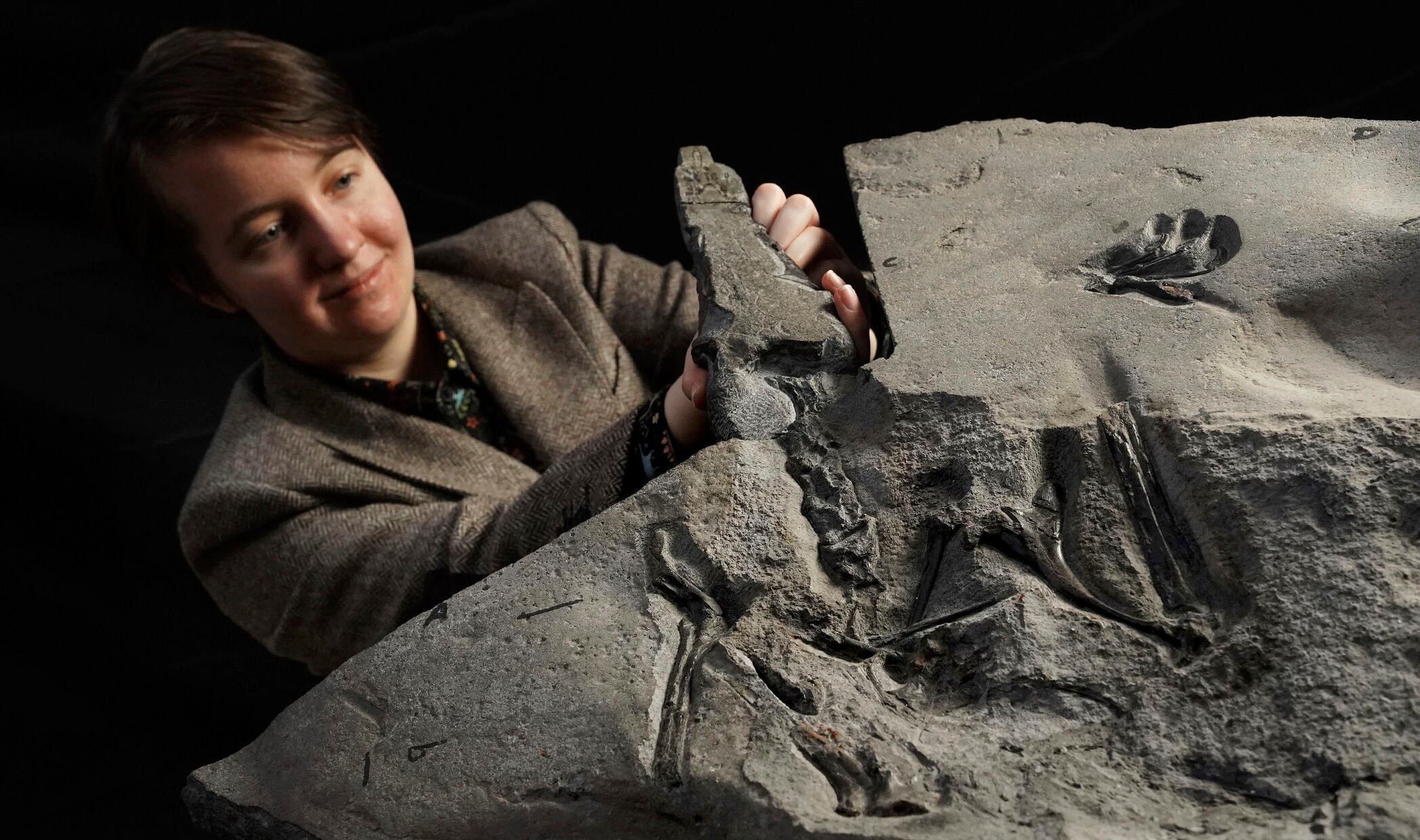
The fossil of a 170 million-year-old pterosaur, described as the world’s best-preserved skeleton of the prehistoric winged reptile, has been found on the Isle of Skye in Scotland, scientists said Tuesday.
The National Museum of Scotland said the fossil of the pterosaur, more popularly known as pterodactyls, is the largest of its kind ever discovered from the Jurassic period. The reptile had an estimated wingspan of more than 2.5 meters (8.2 feet), similar to that of an albatross, the museum said.
The fossil was discovered in 2017 by PhD student Amelia Penny during a field trip on the Isle of Skye in remote northwestern Scotland, when she spotted the pterosaur’s jaw protruding from rocks. It will now be added to the museum’s collection.
“Pterosaurs preserved in such quality are exceedingly rare and are usually reserved to select rock formations in Brazil and China. And yet, an enormous superbly preserved pterosaur emerged from a tidal platform in Scotland,” said Natalia Jagielska, a doctoral student at the University of Edinburgh who is the author of a new scientific paper describing the find.
Steve Brusatte, a professor of palaeontology at Edinburgh University, said the discovery was the best one found in Britain since the early 1800s, when celebrated fossil hunter Mary Anning uncovered many significant Jurassic fossils on the southern English coast.
He said the fossil had “feather light” bones, “as thin as sheets of paper,” and it took several days to cut it from rock using diamond-tipped saws as his team battled against encroaching tides.
It “tells us that pterosaurs got larger much earlier than we thought, long before the Cretaceous period when they were competing with birds, and that’s hugely significant,” Brusatte added.
The pterosaur has been given the Gaelic name Dearc sgiathanach, which translates as “winged reptile."
Pterosaurs were the first vertebrates to fly, some 50 million years before birds. They lived as far back as the Triassic period, about 230 million years ago. They were previously thought to have been much smaller during the Jurassic period.