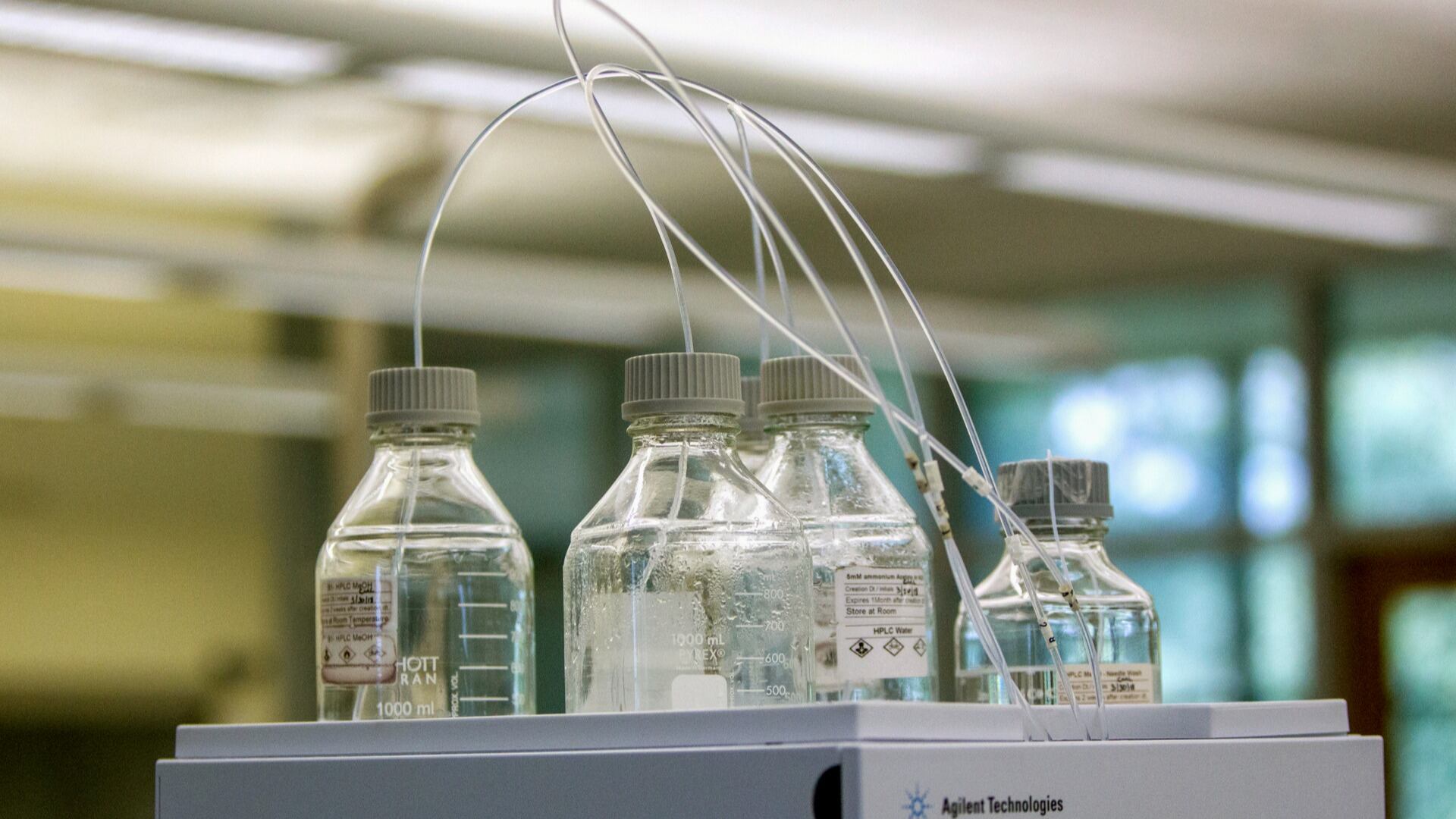
FILE - Equipment used to test for perfluoroalkyl and polyfluoroalkyl substances, known collectively as PFAS, in drinking water is seen at Trident Laboratories in Holland, Mich., June 18, 2018. Drinking water from nearly half of U.S. faucets likely contains “forever chemicals” linked to kidney cancer and other health problems, according to a government study released Wednesday, July 5, 2023. (Cory Morse/The Grand Rapids Press via AP, File)
TRAVERSE CITY, Mich. (AP) — Drinking water from nearly half of U.S. faucets likely contains “forever chemicals” that may cause cancer and other health problems, according to a government study released Wednesday.
The synthetic compounds known collectively as PFAS are contaminating drinking water to varying extents in large cities and small towns — and in private wells and public systems, the U.S. Geological Survey said.
Researchers described the study as the first nationwide effort to test for PFAS in tap water from private sources in addition to regulated ones. It builds on previous scientific findings that the chemicals are widespread, showing up in consumer products as diverse as nonstick pans, food packaging and water-resistant clothing and making their way into water supplies.
Because the USGS is a scientific research agency, the report makes no policy recommendations. But the information “can be used to evaluate risk of exposure and inform decisions about whether or not you want to treat your drinking water, get it tested or get more information from your state" about the situation locally, said lead author Kelly Smalling, a research hydrologist.
The U.S. Environmental Protection Agency in March proposed the first federal drinking water limits on six forms of PFAS, or per- and polyfluorinated substances, which remain in the human body for years and don't degrade in the environment. A final decision is expected later this year or in 2024.
But the government hasn't prohibited companies using the chemicals from dumping them into public wastewater systems, said Scott Faber, a senior vice president of the Environmental Working Group, an advocacy organization.
“We should be treating this problem where it begins, instead of putting up a stoplight after the accident," he said. “We should be requiring polluters to treat their own wastes.”
Studies of lab animals have found potential links between PFAS chemicals and some cancers, including kidney and testicular, plus issues such as high blood pressure and low birth weight.
Federal and state programs typically measure exposure to pollutants such as PFAS at water treatment plants or groundwater wells that supply them, Smalling said. In contrast, the USGS report was based on samples from taps in 716 locations, including 447 that rely on public supplies and 269 using private wells.
The samples were taken between 2016 and 2021 in a range of locations — mostly residences but also a few schools and offices. They included protected lands such as national parks; residential and rural areas with no identified PFAS sources; and urban centers with industry or waste sites known to generate PFAS.
Most taps were sampled just once. Three were sampled multiple times over a three-month period, with results changing little, Smalling said.
Scientists tested for 32 PFAS compounds — most of the ones detectable through available methods. Thousands of others are believed to exist but can't be spotted with current technology, Smalling said.
The types found most often were PFBS, PFHxS and PFOA. Also making frequent appearances was PFOS, one of the most common nationwide.
Positive samples contained as many as nine varieties, although most were closer to two. The median concentration was around seven parts per trillion for all 32 PFAS types, although for PFOA and PFOS it was about four parts per trillion — the limit EPA has proposed for those two compounds.
The heaviest exposures were in cities and near potential sources of the compounds, particularly in the Eastern Seaboard; Great Lakes and Great Plains urban centers; and Central and Southern California. Many of the tests, mostly in rural areas, found no PFAS.
Based on the data, researchers estimated that at least one form of PFAS could be found in about 45% of tap water samples nationwide.
The study underscores that private well users should have their water tested for PFAS and consider installing filters, said Faber of the Environmental Working Group. Filters containing activated carbon or reverse osmosis membranes can remove the compounds.
The USGS study is “further evidence that PFAS is incredibly pervasive and folks who rely on private wells are particularly vulnerable to the harms caused by these chemicals,” Faber said.
On this episode of Cheddar Innovates: Founder of Unlimited Tomorrow breaks down how he is creating completely 3D printed prosthetics to make them more affordable, customizable, and accessible; Chief Technology Officer of Zebra Technologies explains what the future of collaboration between robots and humans may look like; A look at Curiosity Stream's 'Mystery of the Roman Skulls.'
Each year about 5,000 people are diagnosed with ALS. This is such an important conversation. A disease that can weaken a patient's muscles and impact physical function. However, one research company says that could all change soon. Coya Therapeutics has developed a way to isolate a patient problematic T-cells in order to help ultimately slow the decline of not just ALS, but potentially Alzheimer's and other neurodegenerative diseases as well. Founder and Chief Executive Officer at Coya Therapeutics, Dr. Howard Berman, joined Cheddar to discuss more.
In the fight against climate change, much of the conversation revolves around reducing greenhouse gases like carbon dioxide or methane - and attempting to raise oxygen levels. But there's another gas - hydrogen - that could play a big role in the fight for the climate. Marco Alvera, CEO of Italian energy infrastructure company Snam and author of the book, 'The Hydrogen Revolution,' joined Cheddar Climate to explain the role hydrogen plays in helping achieve a net-zero future.
Americans looking to purchase at-home COVID-19 tests will now have to shell out a bit more money after an agreement expired between the White House and companies to sell the tests at cost. The price of Abbot's BinaxNow test kit from October to December was $14 apiece; on Tuesday, Walmart's website listed the test for $19.88, and Kroger listed the tests for $23.99. Carbon Health Regional Clinical Director Dr. Bayo Curry-Winchell joined Cheddar News' Closing Bell to discuss the impact higher prices will have as the nation experiences another surge in cases.
As millions of kids go back to school, districts across the country are determined to keep class in person, despite a surge in COVID cases. In New York City, Mayor Eric Adams has vowed to keep the nation's largest school system open amid Omicron, citing the disastrous effect of remote learning on students. Oswald Feliz, NYC council member who sits on the health and education committee, joined Cheddar to discuss the city's plan to combat the recent surge and keep kids in school.
Schools across the country are determined to keep class in session, despite the rapidly-spreading Omicron variant. While many parents prefer in-person learning, they also worry whether the current public health guidelines will be enough to protect their kids. Erin Richards, national education reporter for USA Today, joined Cheddar to discuss how are schools are preparing for the surge to avoid another round of remote learning.
With the annual CES convention underway amid COVID, HP unveiled rolled out a number of new products virtually this year, including new gaming PCs and 4K display monitors. But as industries look toward a greener future, HP is working with the climate crisis in mind. James McCall, chief sustainability officer at HP, joined Cheddar's Kristen Scholer to discuss the company's climate goals, which includes reducing its carbon footprint to net-zero by 2040. He admitted that reaching the ambitious goal will be difficult because much of the company's emissions totals come from third parties. "A large part of our footprint is outside of HP's direct control. A lot of it comes either from our incoming supply chain, the materials, our manufacturing process, or about 30 to 40 percent of it comes from our consumer-use base," McCall told Cheddar.
Pfizer and BioNTech are working to develop an mRNA-based shingles vaccine following the success of the COVID-19 shot. This latest collaboration will mark the third time the pharmaceutical companies have worked together on a vaccine.
The potential collapse of the Thwaites glacier in Antarctica has been deemed a potential "doomsday event" — researchers and scientists say its melting and collapse could raise global sea levels by at least two feet, enough to destroy coastal communities around the world. One team of scientists is traveling to the Thwaites glacier to drill below in order to gauge current ocean temperatures and attempt to model possible outcomes. David Holland, professor at NYU and Principal Investigator for the International Thwaites Glacier Collaboration, joins Cheddar Climate to discuss the glacier's potential collapse, his team's research plan, and more.
As winter break wraps up and COVID-19 cases hit record levels, the majority of school districts are returning to in-person classes. While some public schools in large cities have shifted to remote learning for the beginning of the year, the schools that are reopening campuses are determined to avoid the academic, social, and logistical challenges that come with a virtual classroom. Cheddar News is joined by Keith Powers, NYC Council Member, to discuss.