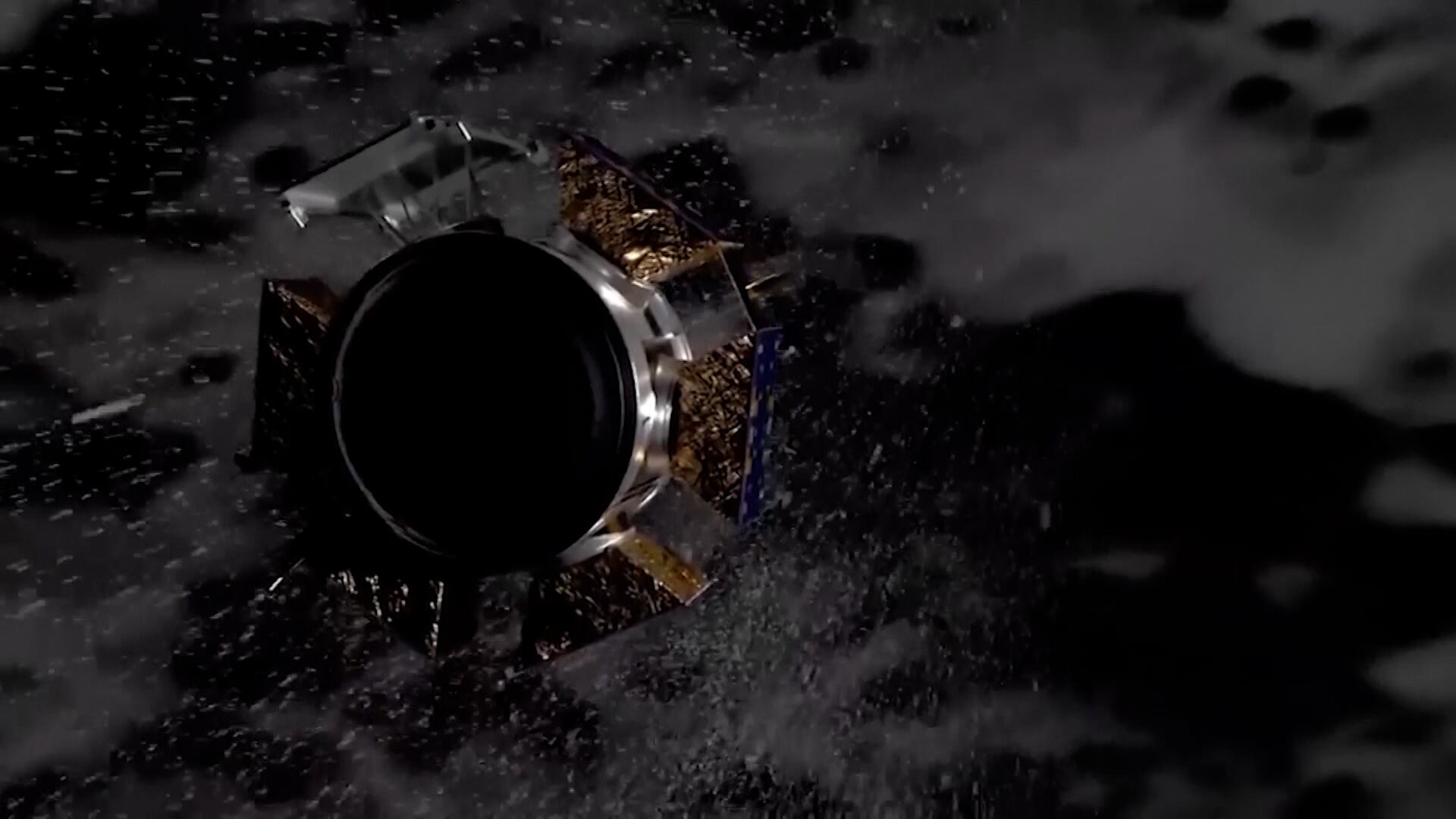
The head of Russia's space agency said Monday that the Luna-25 spacecraft crashed into the moon after its engines failed to shut down correctly, and he blamed the country's decades-long pause in lunar exploration for the mishap.
The pilotless Luna-25 had been scheduled to land Monday while aiming to become the first spacecraft to touch down on the south pole of the moon, an area where scientists believe important reserves of frozen water and precious elements may exist.
Roscosmos Director General Yury Borisov said the spacecraft's engines were turned on over the weekend to put Luna-25 into a “pre-landing orbit" but did not shut down properly, plunging the lander onto the moon.
“Instead of the planned 84 seconds, it worked for 127 seconds. This was the main reason for the emergency,” Borisov told Russian state news channel Russia 24.
Roscosmos had contact with the spacecraft until 2:57 p.m. local time Saturday, when communication was lost and “the device passed into an open lunar orbit and crashed into the surface of the moon,” he said.
The lunar mission was Russia’s first since 1976, when it was part of the Soviet Union. Only three countries have managed successful moon landings: the Soviet Union, the United States and China.
“The negative experience of interrupting the lunar program for almost 50 years is the main reason for the failures,” Borisov said, adding “it would be the worst decision ever” for Russia to end the program now.
The Luna-25 was in a race with an Indian spacecraft launched on July 14 to be the first to reach the south pole. Both were expected to reach the moon between Aug. 21 and Aug. 23.
A previous Indian attempt to land at the moon's south pole in 2019 ended when the spacecraft crashed into the moon’s surface.
Luna-25 launched from the Vostochny Cosmodrome in Russia’s Far East on Aug. 10. The spaceport is a pet project of Russian President Vladimir Putin and key to his efforts to make Russia a space superpower.
Before the launch, Roscosmos said it wanted to show Russia “is a state capable of delivering a payload to the moon,” and “ensure Russia’s guaranteed access to the moon’s surface.”
Following the crash, the Russian space agency said the moon mission was about ensuring long-term “defense capability” as well as “technological sovereignty.”
“The race to develop the moon's natural resources has begun,” Borisov said Monday. “In the future, the moon will become an ideal platform for the exploration of deep space.”
Sanctions imposed on Russia since it launched a war in Ukraine nearly 18 months ago have affected its space program, making it more difficult to access Western technology.
The Luna-25 was initially meant to carry a small moon rover, but the idea was abandoned to reduce the weight of the craft for improved reliability, analysts said.
The lunar south pole is of particular interest to scientists, who believe the permanently shadowed polar craters may contain frozen water in the rocks that future explorers could transform into air and rocket fuel.
A new study shows that Americans feel record levels of stress amid inflation and global uncertainty about the war in Ukraine. Cheddar News speaks with Lynn Bufka of the American Psychological Association about how to best put your worries aside.
Colgate-Palmolive is shedding light on the little-known fact that oral health is integral to overall health. The consumer products company will commit $100 million over five years to transform the way the world thinks about and addresses oral health. Maria Ryan, Chief Clinical Officer at Colgate-Palmolive, discusses why oral health is so vital to our physical and mental well-being.
Scientists say they have found the sunken wreck of polar explorer Ernest Shackleton’s ship Endurance, more than a century after it was lost to the Antarctic ice.
Researchers say a large spider native to East Asia that proliferated in Georgia last year could spread to much of the East Coast. The Joro spider’s golden web took over yards all over north Georgia in 2021, unnerving some residents.
News of Russian forces taking control of a Ukrainian after artillery bombardment of a nuclear power plant raised concerns this week. Nuclear policy expert and Quincy Institute Distinguished Fellow Joe Cirincione joined Cheddar News to discuss the implications for a potential disaster. “I’m with the director general of the IAEA, the International Atomic Energy Agency. He says that he is extremely concerned, and that this Russian attack is a severe risk and that Russia clearly violated the fundamental principle of preserving the integrity of nuclear power plants," Cirincione said.
Adam Battle, research assistant at University of Arizona's Lunar and Planetary Laboratory, joins Cheddar News to discuss space junk heading to the moon and if more should be done to prevent space junk in the future.
UN and Ukrainian officials say no radiation was released from a Russian attack at Europe’s biggest nuclear power plant in Ukraine and firefighters have extinguished a blaze at the facility..
Under the U.S. Renewable Fuel Standard (RFS), corn-based ethanol has been mixed into gasoline sold at pumps in the U.S. since 2005, when a policy was enacted aimed at reducing emissions. Corn-based ethanol had been thought to be a relatively greener energy source compared to other biofuels, but now, a new study published in the Proceedings of the National Academy of Sciences reports it may be actually worse for the climate than straight gasoline. Tyler Lark, an assistant scientist at the University of Wisconsin-Madison's Center for Sustainability, joined Cheddar News' Closing Bell and discussed the pushback against the study. "Essentially when you need to produce more corn to meet the demand for use as ethanol as fuel, farmers respond and they switch more crops like soybeans and wheat into corn," Lark said. "They also bring more land into production, so things that used to be pasture grassland, and both those activities are associated with increased greenhouse gas emissions."
Caroline Hickman, lecturer at University of Bath and psychosocial researcher on climate change, joins Cheddar News to discuss climate change's impact on mental health.