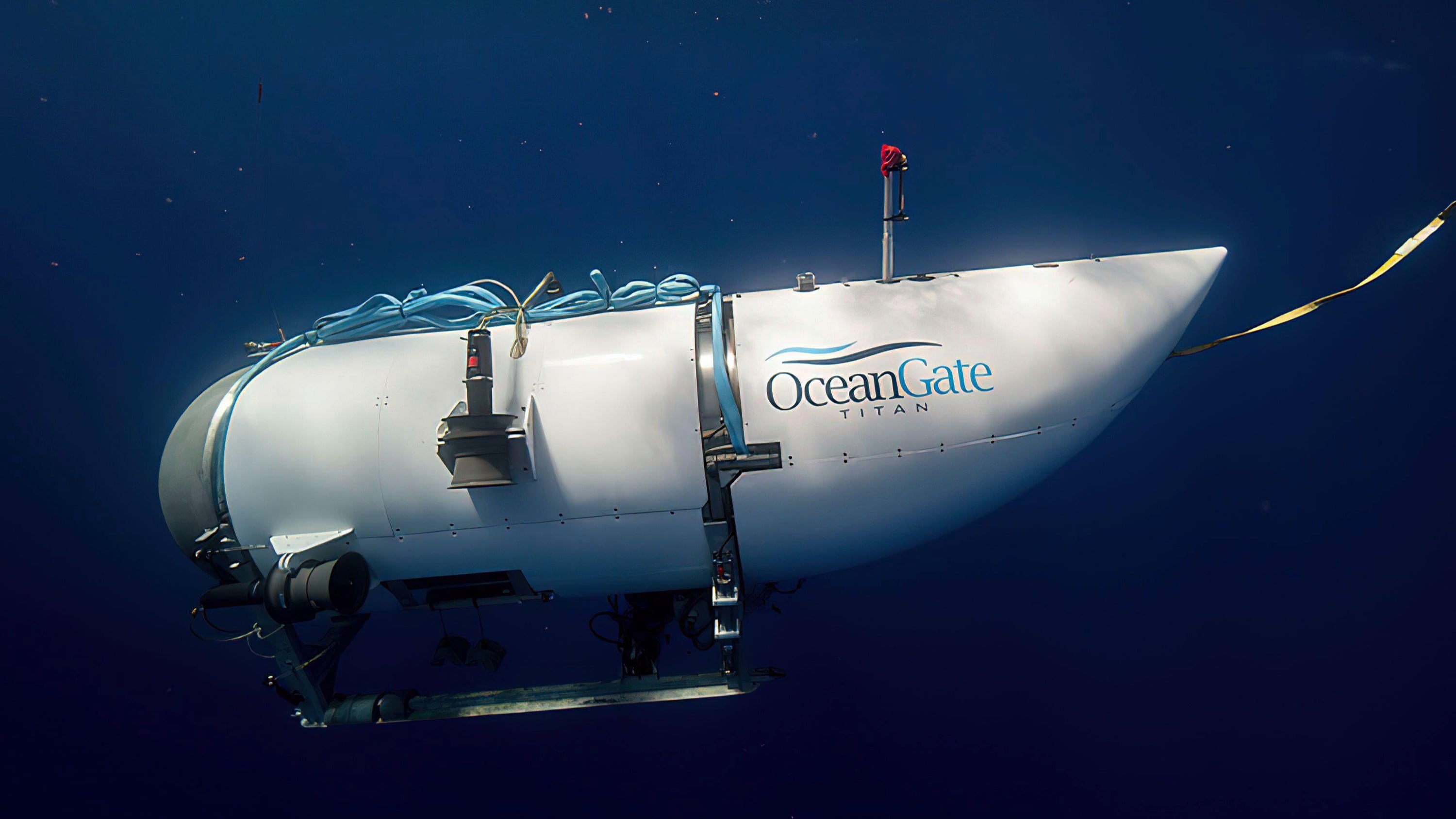
The Coast Guard has recovered remaining debris, including presumed human remains, from a submersible that imploded on its way to explore the wreck of the Titanic, killing all five onboard, deep beneath the Atlantic Ocean's surface, officials said Tuesday.
The Coast Guard said that the recovery and transfer of remaining parts was completed last Wednesday, and a photo showed the intact aft titanium endcap of the 22-foot (6.7-meter) vessel. Additional presumed human remains were carefully recovered from within Titan’s debris and transported for analysis by U.S. medical professionals, the Coast Guard said.
The salvage mission conducted under an agreement with the U.S. Navy was a follow-up to initial recovery operations on the ocean floor roughly 1,600 feet (488 meters) away from the Titanic, the Coast Guard said.
The new materials were offloaded at an unnamed port.
The Coast Guard previously said it recovered presumed human remains along with parts of the Titan after the debris field was located at a depth of 12,500 feet (3,800 meters).
Investigators believe the Titan imploded as it made its descent into deep North Atlantic waters on June 18.
The multiday search mounted after Titan went silent captured attention around the world. The submersible was attempting to view the British passenger liner that sank in 1912.
The Coast Guard’s Marine Board of Investigation said investigators from the U.S. National Transportation Safety Board and the Transportation Safety Board of Canada joined the salvage expedition, and the Coast Guard is coordinating with international investigative agencies to schedule a joint review of the evidence to determine the next steps for forensic testing.
The Marine Board of Investigation, meanwhile, will continue its analysis and witness interviews ahead of a public hearing on the tragedy, officials said Tuesday.
OceanGate, the operator of the vessel, has since gone out of business. Among those killed in the implosion was Stockton Rush, the submersible’s pilot and CEO of the company.
The National Eating Disorders Association has decided to remove hundreds of helpline staffers and volunteers after they voted to unionize, and now many of these positions will be replaced by a chatbot named Tessa. Cheddar’s Ashley Mastronardi spoke to one eating disorder expert who thinks this may have harmful consequences.
Earth has pushed past seven out of eight scientifically established safety limits and into “the danger zone,” not just for an overheating planet that's losing its natural areas, but for the well-being of people living on it, according to a new study.
One person was killed when a boiler exploded at a southeastern Texas power plant Wednesday morning, according to a spokesperson for Dallas-based Luminant.
Two Democratic senators are pushing for legislation to change the Federal Aviation Administration's standards around seat sizing and spacing on aircrafts. Sens. Tammy Duckworth and Tammy Baldwin have introduced a new bill, which would also require the FAA to set new standards for aircraft evacuations that are more realistic in case of emergencies.
Jury selection in the groundbreaking trial of a former sheriff's deputy charged with failing to confront the killer of 14 students and three staff members at a Florida high school five years ago got off to a speedy start Wednesday, with the preliminary round concluding in just one day.
Centrist Democrats and Republicans pushed it to approval over blowback from conservatives and some progressives. The Senate is expected to act quickly by the end of the week.
Hurricane season officially starts tomorrow, and News 12 meteorologist Lauren Due tells us everything you need to know to prepare
We know life can be tough sometimes, so we'd like to take a moment to share One Good Thing happening in the world today. A Wisconsin woman has gone viral after taking in a stray cat that had been coming to her door every single day for a few weeks.
Families of passengers who died in the crash of a Boeing 737 Max in Ethiopia can seek damages for the pain and terror suffered by victims in the minutes before the plane flew nose-down into the ground, a federal judge has ruled.
Former first lady Rosalynn Carter has been diagnosed with dementia, and the Carter Center said her family wanted to share her health news to increase important conversations around the country. According to the CDC, there are about 5.8 million people in the United states living with dementia. Here to help us understand this complex disease is Dr. Jen Caudle, family physician and associate professor at Rowan University.